Portuguese
  Spanish


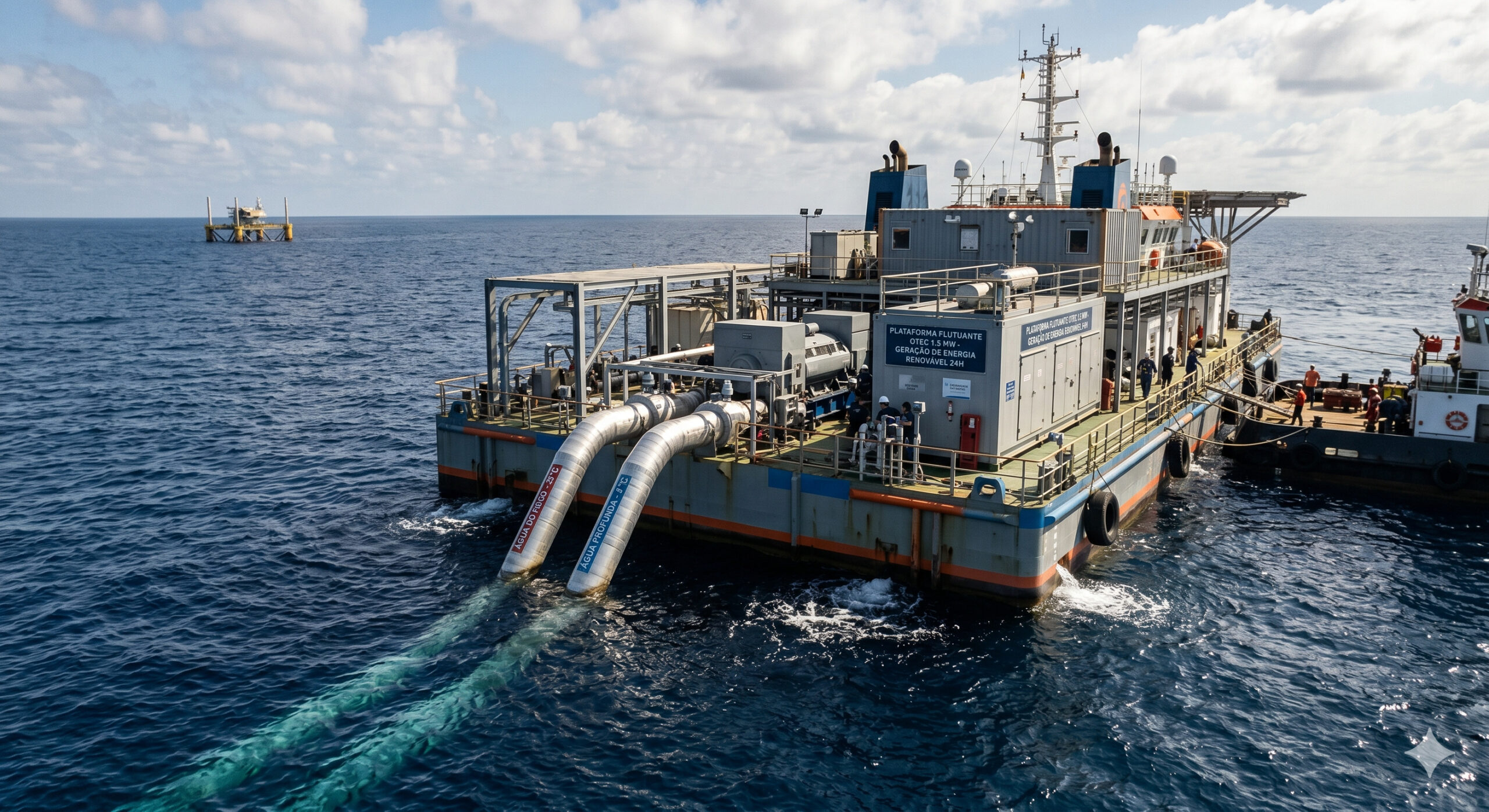

OTEC Plant uses a 20 °C difference in the ocean to generate continuous energy and can supply up to 17% of São Tomé and Príncipe.
In 2025, the British Global OTEC kept on the radar one of the most ambitious projects in recent energy engineering: the floating platform Dominique, planned for São Tomé and Príncipe and based on ocean thermal energy conversion (OTEC). The proposal uses the temperature difference between the warm surface water and the cold deep water to generate continuous electricity, and the company presents the system as a baseload alternative for tropical islands dependent on diesel.
The idea was proposed back in the 19th century by French physicist Jacques-Arsène d’Arsonval, but remained for decades limited by technical and economic barriers. Now, with a 1.5 MW project and plans for future expansion, Global OTEC claims that Dominique was designed to demonstrate, on a commercial scale, how the ocean can provide energy 24 hours a day, throughout the year.
OTEC technology uses ocean temperature difference to generate continuous electricity
The operation of the OTEC system is based on a thermodynamic cycle similar to that of a conventional thermal power plant, but with a fundamental difference: instead of burning fuel, it uses the natural heat of the ocean.
-
USP researcher creates thesis to attract international funds for the country’s electric energy sector

-
Trafigura receives authorization from ANEEL to trade electricity in Brazil and expands its operations in the largest energy market in Latin America.
-
Mobile solar panels promised to share space with corn crops, but the 20% to 25% shade reduced production by an average of 7.7% and opened a new dispute between energy and food.
-
More than 80 million kilometers of wires need to be replaced by 2040: the energy transition doesn’t just depend on panels and electric cars, but on a colossal race for copper, aluminum, transformers, and recycling of old cables.




Surface water in tropical regions can reach temperatures between 25 °C and 30 °C, while water at about 800 to 1,000 meters deep remains close to 4 °C to 5 °C. This difference of approximately 20 °C to 25 °C is sufficient to operate a power generation cycle.
The process occurs in three main stages:
- Warm surface water heats a low boiling point fluid, such as ammonia, causing it to evaporate
- The generated vapor moves a turbine connected to an electric generator
- The cold deep water condenses the vapor, restarting the cycle
This system allows for continuous generation, regardless of weather conditions such as sun or wind, making OTEC one of the few renewable sources capable of operating stably 24 hours a day.
Low efficiency has always been the main challenge of the technology
Despite the elegant concept, OTEC faces a fundamental physical problem: low thermodynamic efficiency. Due to the small temperature difference between the hot and cold sources, the typical efficiency of the system is between 2% and 4%, much lower than that of conventional thermal power plants.
This means that large volumes of water need to be moved to generate relatively modest amounts of electricity.
For decades, this factor made the technology economically unviable, as the construction and operation costs outweighed the energy benefits.
Cost of heat exchangers was the biggest historical obstacle
One of the main bottlenecks of OTEC has always been the cost of heat exchangers, essential components for transferring thermal energy between fluids.
Historically, these systems used titanium, a material resistant to marine corrosion, but extremely expensive.
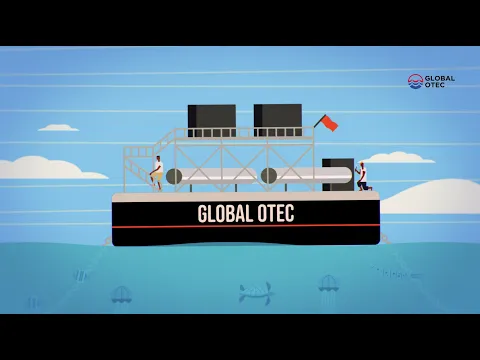
Studies indicated that these exchangers could represent up to 90% or more of the total cost of an OTEC plant, making commercial projects impractical. The recent advancement lies precisely in reducing this cost, with the development of more efficient and cheaper exchangers, utilizing thin-sheet designs and new manufacturing techniques.
Project in São Tomé and Príncipe could mark a turning point for the technology
The plant planned by Global OTEC will be installed on a floating platform called Dominique, with a capacity of approximately 1.5 megawatts (MW).
Although it seems modest compared to large plants, this volume is significant for São Tomé and Príncipe, where it could represent up to 17% of the national electricity demand.
This factor makes the project especially relevant as a demonstration of viability in island countries, which often rely on imported fossil fuels for energy generation.
System also produces cold water useful for other applications
In addition to electricity generation, OTEC offers a valuable byproduct: deep cold water.
This water can be used for:
- cooling air conditioning systems
- aquaculture of species that require lower temperatures
- industrial refrigeration
This enhances the economic value of the system, transforming the plant into a multifunctional infrastructure, not just a source of electricity.
Previous experiments showed potential, but also limitations
The OTEC technology is not new. One of the first experiments took place in Cuba in 1930, and subsequent projects were tested in different countries.
In the 1980s, an experimental plant in the Pacific managed to generate about 120 kW, but consumed approximately 90 kW just to operate, highlighting the difficulty of achieving significant positive net efficiency.

These results reinforced the perception that OTEC was technically possible, but economically unfeasible. In recent years, advances in engineering and materials have begun to change this equation.
The development of more efficient heat exchangers, more economical pumping systems, and optimized designs of floating platforms has significantly reduced operational costs.
These improvements have allowed OTEC to be reconsidered as a viable solution, especially in regions with direct access to deep waters.
Technology can benefit especially tropical and island countries
OTEC is particularly suitable for tropical regions, where the temperature difference between surface and depth is more pronounced and constant throughout the year.
Island countries, which face high energy costs and dependence on imports, can benefit significantly from the technology.
Moreover, the possibility of continuous generation reduces the need for energy storage, one of the main challenges of intermittent renewable sources.
Challenges still include scale, cost, and environmental impact
Despite the advancements, OTEC still faces significant challenges. The construction of offshore infrastructure, the need for deep pipelines, and the potential impact on marine life are factors that need to be carefully evaluated.
Additionally, the scalability of the technology still needs to be proven in larger projects, capable of competing with other energy sources.
The concept of OTEC represents a significant shift in how energy can be generated. Instead of relying on fuels or weather conditions, the system utilizes a permanent characteristic of the planet: the temperature difference in the oceans.
This transforms the ocean into a kind of natural thermal machine, operating continuously without the need for fuel replenishment.
Do you believe that the ocean can become one of the main sources of energy of the future
The resurgence of OTEC after more than a century raises a central question for the global energy future.
If the technology can overcome its challenges and become economically viable on a large scale, it could offer a continuous and predictable renewable energy source.
In light of this, can the ocean cease to be just an environmental resource and become one of the main foundations of global energy generation?