






 Portuguese
  Spanish


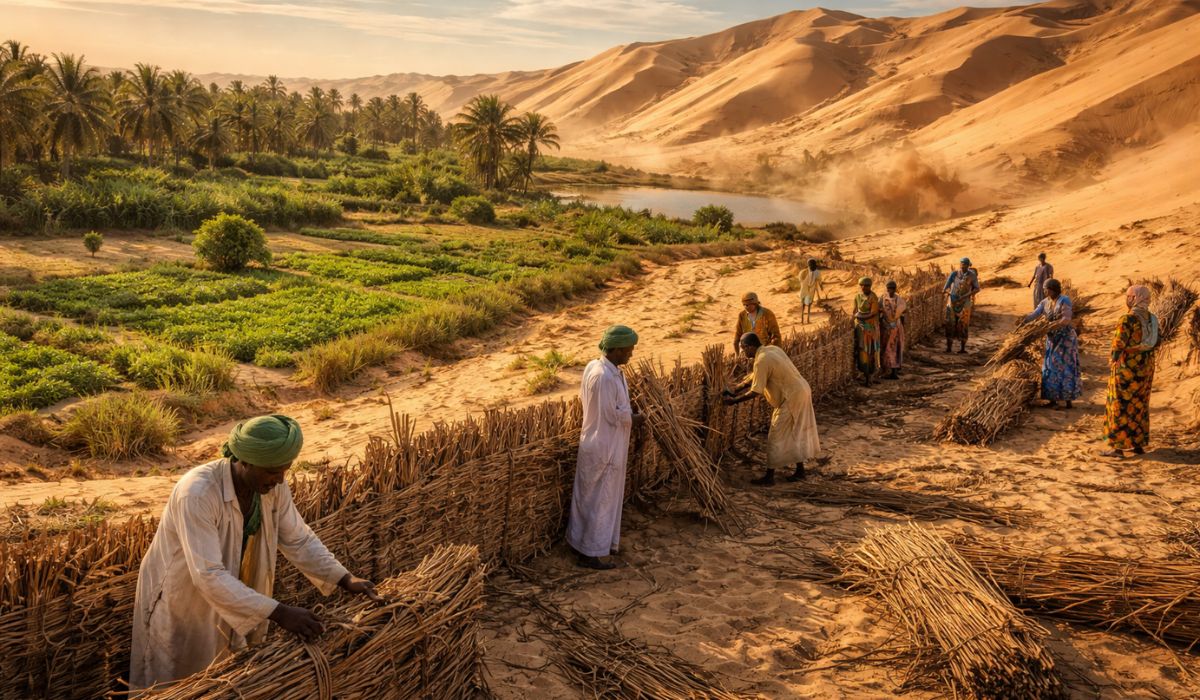


Between palms, gardens, and moving sand, the advance of dunes over the oases of Chad reveals how climate, water, and work intersect in one of the most fragile areas of the Sahara border.
In western Chad, the advance of mobile dunes over oases is already affecting fertile areas, putting pressure on agriculture, and threatening the survival of families who depend on groundwater to live on the Sahara’s edge.
In Kaou, in the Kanem province, the landscape combines sand, palms, and gardens in a stretch of vegetation that resists amidst the desert.
It is in this narrow space, supported by underground water reserves, that hundreds of families maintain crops, harvest dates, and try to preserve a way of life that has long depended on the existence of the oasis.
-
Scientists warn that melting ice is triggering an alarming chemical transformation in preserved areas, and the first signs are already concerning researchers worldwide.

-
China placed 198 robotic legs under a 7,600-ton school and made the building walk 62 meters in 18 days, rotating the historic structure as if a concrete structure had gained feet to escape demolition.

-
Distributor confirms the premiere of ‘Dark Horse’, Bolsonaro’s film, in 650 cinemas with 99% of copies dubbed.
-
9-year-old boy who could only hold a plank for 6 minutes in physical education class trained alone for 6 months, without needing encouragement from his parents, until he broke the world children’s record with 61 minutes and 5 seconds.


Oases in the Sahara sustain water, cultivation, and human permanence
The functioning of an oasis depends on the presence of water in a region where rain is scarce and heat limits agricultural production.
When this water reaches the surface or feeds lower areas of the land, vegetation can sustain itself and creates conditions for cultivation and human presence.
In the case of Kaou, according to The Guardian, the oasis remains a survival base for more than 500 families.
About 100 farmers directly depend on the area to grow food and harvest fruits from the remaining palms.
This balance, however, has become more fragile with the advance of sand and the gradual loss of vegetation cover.
Without trees, shade, and moisture, the soil becomes more exposed to the wind, and the dunes advance with fewer natural barriers.

In Kaou, the green strip shrinks as the sand approaches
The local chief Mahamat Souleymane Issa, 51, reported to The Guardian that the wadi, the valley that organizes agricultural life in the region, was much larger when he was a child.
According to him, the area had more trees, more pasture, and a greater presence of livestock in the surrounding villages.
Today, the cultivable strip is smaller, and vegetation appears compressed between the dunes.
To the British newspaper, he summarized this dependence in a straightforward phrase: “Without this wadi, we cannot live.”
The statement encapsulates the weight that this space still holds for the community.
In arid regions like this, the loss of an oasis does not only represent a decline in agricultural production.
It also affects the permanence of families, the supply of water, and the very possibility of continuing to live in the territory.
Residents build straw barriers to try to halt the dunes
To try to contain the advance of sand, residents of Kaou set up barriers with palm leaves and stalks driven into the ground.
According to The Guardian, the community received support from the NGO SOS Sahel to install a solar-powered irrigation system, receive seeds, increase the use of groundwater, and build containment structures in the most vulnerable areas.
The proposal was to reduce the movement of sand and provide more stability to the crops.

Even so, the barriers require frequent maintenance and need to be rebuilt after stronger winds.
In one of the accounts gathered by the newspaper, Hereta Abakar Issa, a farmer and mother of seven children, reported starting to plant vegetables that the family did not consume before, such as okra and fresh tomatoes.
She also participated in community efforts to rebuild fences knocked down by the wind.
In these areas, containment depends on constant work and simple materials used to try to protect the productive part of the oasis.
Desertification and heat worsen pressure on fertile areas
What is happening in Kaou is part of a broader context of desertification and climate pressure in Chad.
A large part of the country’s territory consists of arid or desert areas, and the combination of heat, water scarcity, loss of vegetation, and soil degradation makes cultivation more unstable.
In this scenario, oases function as support points in an environment marked by resource limitations.
When sand advances over these areas, the impact is not limited to the landscape.
The change interferes with land use, reduces agricultural areas, and alters the routine of communities that directly depend on these spaces.
In Kaou, residents already associate the shrinking of the oasis with the growing difficulty of remaining in the region.

Lack of work and advancing sand push youth to mining
The pressure on the oases is also reflected in the local job market.
According to reports published by The Guardian, many young people leave the region every year and head to the gold mines of Tibesti, in northern Chad, in search of income.
Residents associate this movement with the scarcity of opportunities linked to the wadi and the worsening living conditions in the desert.
Souleymane Issa told the newspaper that his own son made this journey.
According to him, some return weakened after facing harsh working conditions and staying in mining areas.
The departure of these workers alters the dynamics of the villages and shows how the loss of productive capacity of the oasis also affects income and the permanence of the population.
Barkadroussou shows how continuous projects can enhance local resilience
The same report from The Guardian presents a contrast in the Barkadroussou region, another oasis in the area.
There, a project initiated by SOS Sahel in 2014 still stands as an example of action with more lasting effects.
According to the newspaper, a solar pump continues to support hundreds of farmers and thousands of residents indirectly.
In the area, onion, lettuce, beet, and millet crops coexist with palm trees, banana trees, and a lake in the center of the green area.
The case is cited as an example of how the continuity of technical support and infrastructure can enhance resilience in arid regions.
The comparison between Barkadroussou and Kaou highlights that water alone does not guarantee the survival of an oasis.
The stability of these areas also depends on sand containment, vegetation preservation, agricultural production maintenance, and job availability for the local population.
The permanence of families depends on soil, water, and work
In Kaou, the advance of the dunes is already interfering with the relationship between productive land and human permanence.
The community is trying to preserve what remains of the oasis with manual labor, irrigation, and barriers made of straw and palm leaves.
But the continuity of these actions depends on technical support, resources, and regular maintenance.
In areas like this, the survival of the oasis is linked to several factors at the same time.
Groundwater, vegetation, productive soil, and income need to continue functioning together for the population to remain in the territory.
When one of these foundations weakens, the pressure on families increases.
When several deteriorate at the same time, permanence is no longer guaranteed.
In the west of Chad, this dispute is already visible in the landscape.
On one side, the gardens, palm trees, and water that still sustain life continue.
On the other side, the dunes continue to advance over an increasingly smaller space.





