Portuguese
  Spanish


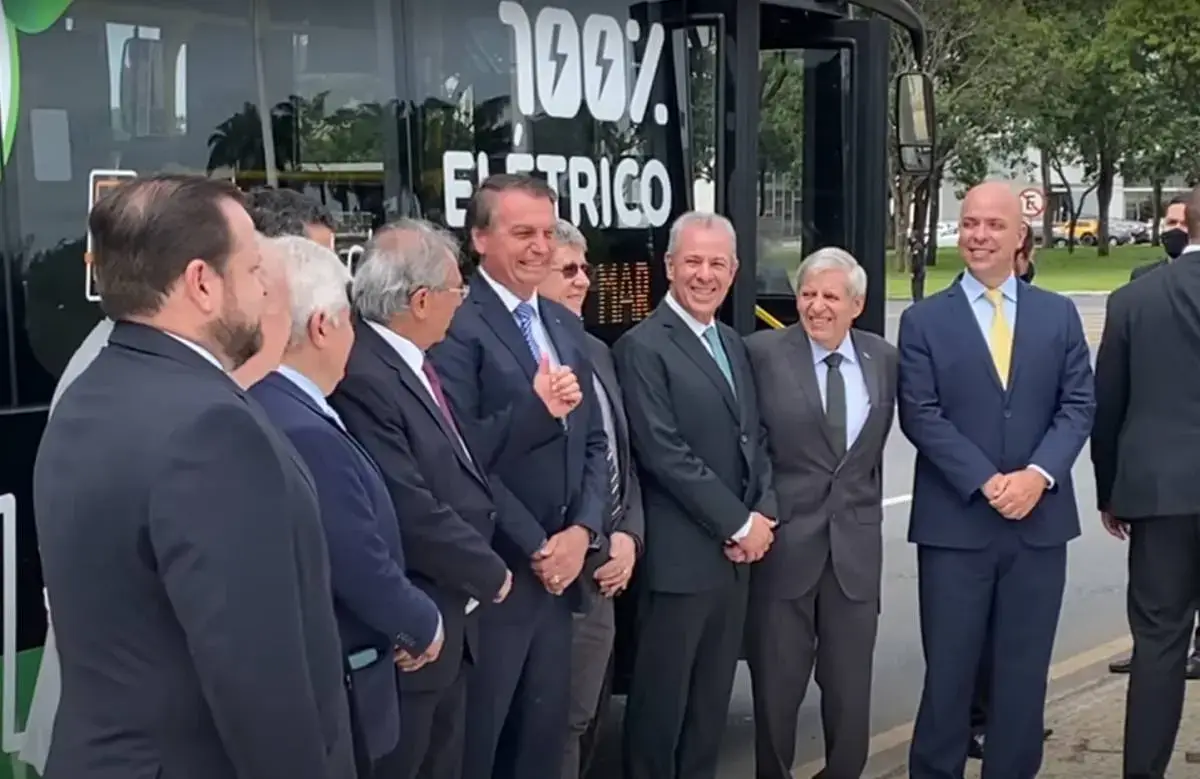

President Jair Messias Bolsonaro Received Yesterday the Board and Employees of Marcopolo and Learned About the Project of the 100% Electric Bus Produced in Brazil.
Yesterday, at an official event, the President of the Republic, Jair Bolsonaro, met with representatives and members of Marcopolo, a Brazilian company specialized in bus production, for the presentation of the 100% electric vehicle produced in Brazil. The President drove the bus from Alvorada to the Planalto and praised the Green initiative. Alongside the country’s leader were the Chairman of the Board of Marcopolo, Mauro Bellini, Senator Flávio Bolsonaro, and Ministers Paulo Guedes (Economy), Marcos Pontes (Science and Technology), Augusto Heleno (GSI), Joaquim Leite (Environment), and Bento Albuquerque (Mines and Energy).
- Chinese Manufacturer Higer Bus Will Produce Electric Buses in SP
- Cop 26: What Changes Regarding Oil and Renewable Energies?
- Bolsonaro Speaks at the G20 About a New Rise in Fuel Prices
In his speech, the President praised Bellini’s entrepreneurial spirit, recalled the end of COP 26, and reinforced the importance of green technology to mitigate the economic impact of rising fossil fuel prices.
Besides the President, Bellini also talked a bit about the projects that Marcopolo has in mind, emphasizing that these new projects will bring jobs and income to the country. “The idea is to showcase the capacity that National Industry has to invest in technology to bring the best in the world to be produced in Brazil, generating jobs and encouraging this industrial park,” said the businessman.
-
Automatic, economical, and known for reliability: with a 1.5 engine of up to 110 hp, CVT transmission, seven airbags, and fuel consumption of up to 15.9 km/l, this used hatchback appears as a rational alternative to Polo, HB20, and Onix; meet the Toyota Yaris XLS 2020.

-
Brazil saved US$ 32.4 billion in 2025 by switching from fossil to renewable energy and only ranked behind China and the United States on the IRENA global podium.

-
A company from SC that moves R$ 125 billion in agribusiness is integrated into an international group, maintains its headquarters and jobs in Chapecó, and is preparing to expand software for cooperatives, grain companies, and industries while targeting new markets without leaving the western region of Santa Catarina.
-
Portugal “hides” gold reserves of 382 tons valued at 47 billion euros in an armored building, and the story involves gold from colonial Brazil, Nazi Germany, and a fortune that once amounted to 866 tons.



Meanwhile, Minister of Economy, Paulo Guedes, emphasized the importance of Brazilian entrepreneurship, showing that green technology and other trends of this kind have space in Brazil.
The promise that remains with the possibility of implementing fully electric mass public transportation in Brazil also involves reducing its cost, which is always a major discussion point among politicians.
100% National Electric Bus: Tested and Approved
The 100% electric bus that Marcopolo brought to Brasília yesterday is not just a “show” prototype, as it is being experimentally used by Suzantur.
The company, responsible for public transportation operation in ABC Paulista and in the city of São Carlos, in the interior of SP, has been testing the same vehicle that was brought to Brasília today, on a route similar to line tr03 (Santo André Oeste Terminal/Vila Luzita Terminal – via Passos Municipal), but without carrying passengers.
At this moment, the vehicle’s range is 250 km, and it can be charged in up to 4 hours.
Are Plug-in Electric Buses More Interesting Than Trolleybuses?
This is a question that some people tend to ask regarding urban electric public transportation.
Trolleybuses, a direct evolution of the so-called electric streetcars, are vehicles powered by electricity that can only travel along certain paths, as they depend on electricity generated by a high-voltage network, from which they draw the necessary electricity to move.
Although they are currently cheaper to build, trolleybuses incur enormous infrastructure costs to install the cable networks, allowing the movement of these primitive electric buses.
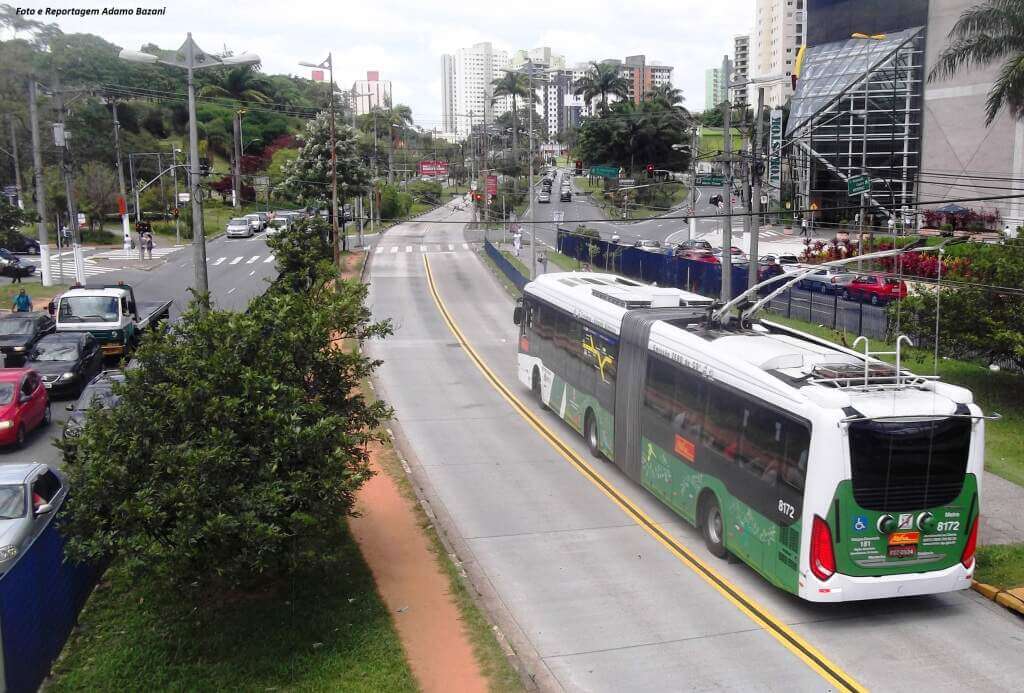
These buses have less mobility and often face difficulties when it comes to staying “on track,” as they generally disconnect from the network when changing lanes, especially when turning more abruptly, forcing the driver to exit the vehicle and reconnect it to the track, which creates a significant inconvenience.
At this moment, the technology used in the 100% national electric bus is still plug-in technology, where the vehicle has a battery with limited range and needs to be recharged. In the future, it is expected that Brazil’s electric fleet will be powered by Green hydrogen, which tends to be more economical and, above all, easily produced in Brazil.
What Else Do We Know About Marcopolo?
Marcelo is a multinational company based in Brazil that has been showing incredible growth in recent years.
Being responsible for almost half of the national bus production, Marcopolo is the third-largest bodybuilder in the world.
It has factories in several locations around the world, and the company’s initiative to present a 100% electric prototype indicates a strong interest in developing even more models.