






 Portuguese
  Spanish


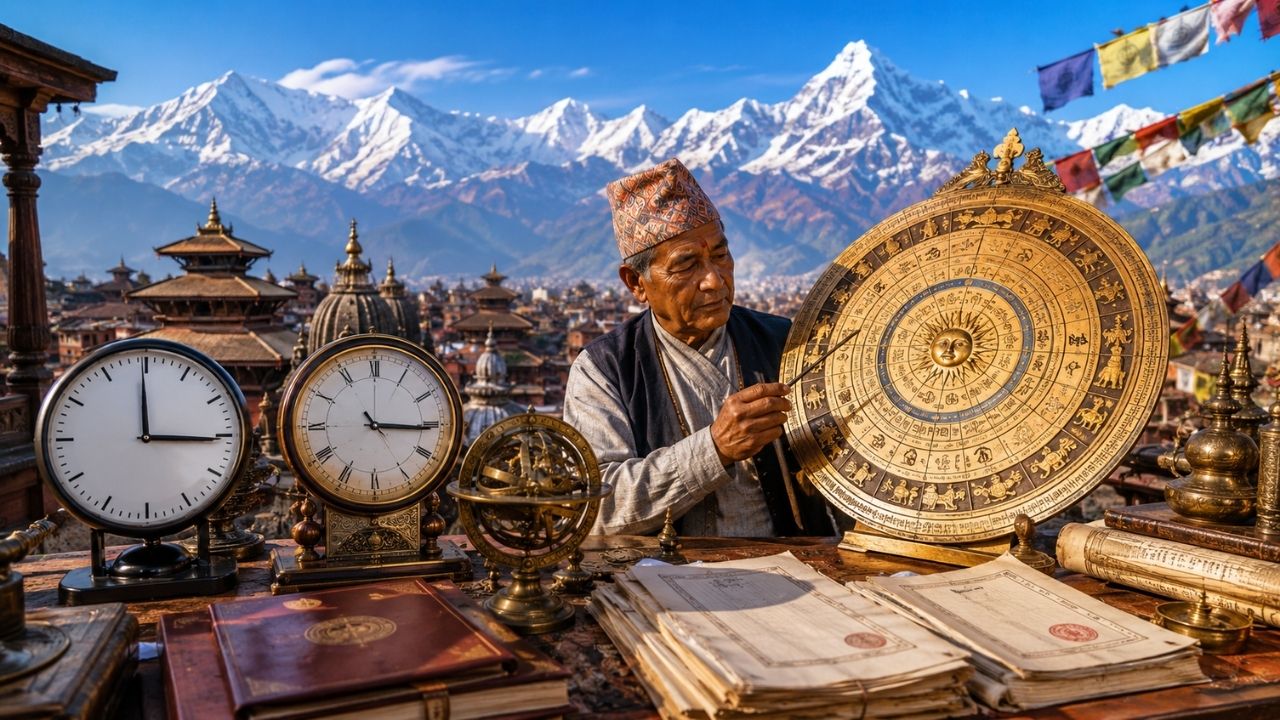

In the Himalayas, Nepal entered the year 2083 according to the Bikram Sambat calendar in April 2026 and maintains a time zone of UTC+5:45, fifteen minutes ahead of India. This combination coexists with Gregorian dates in international contexts and reveals a unique way of organizing time, identity, and celebrations in the Nepalese country.
Nepal, a country located between India and China in the Himalayan region, began the year 2083 on April 14, 2026. This change does not mean that the territory is decades in the future: it results from the Bikram Sambat calendar, a date counting system widely used in Nepalese daily life.
According to Superinteressante, this peculiarity adds to another national hallmark: Nepal’s time zone operates at UTC+5:45, fifteen minutes ahead of India’s official time. Thus, a country known for Mount Everest and the Himalayan landscapes also draws attention for the unique way it organizes years, months, and hours.
Year 2083 does not mean that Nepal is in the future

For those who only follow the Gregorian calendar, used in Brazil and in most international relations, the information that Nepal lives in the year 2083 may seem like a time travel. In practice, the difference arises because different calendars use their own references to organize the passage of years.
-
Billionaire says the most valuable skill will help overcome job elimination caused by AI, following Bill Gates’ fears

-
A Dutchman created a ‘box’ that makes trees grow in the desert almost without water and without irrigation: the invention has already brought seedlings to dozens of countries and achieves up to 90% survival where common planting did not exceed 10%.

-
Abandoned warehouse hid a giant collection of rare computers, with over 2,000 artifacts from the 1930s to the 1980s.
-
Scientists warn that melting ice is triggering an alarming chemical transformation in preserved areas, and the first signs are already concerning researchers worldwide.




In the Asian country of the Himalayas, the Bikram Sambat calendar coexists with the Gregorian calendar. While the world recorded April 2026, the Nepalese celebrated the transition to 2083 on the first day of the month of Baisakh, which in that cycle corresponded to April 14.
The difference lies in the counting, not in the time lived by the population. Banks, offices, celebrations, and local activities may adopt dates from the Nepali calendar, while international travel, diplomatic relations, and documents intended for abroad also require references understandable to other countries.
This coexistence means that the same date can appear in different ways, depending on the context. For a visitor, the numbering is surprising; for residents of Nepal, the year 2083 integrates commitments, holidays, and everyday events.
Bikram Sambat Calendar organizes dates and celebrations in the country
The Bikram Sambat calendar is deeply connected to Nepali cultural and administrative life. It establishes the sequence of local months and serves as a reference for public dates, festivities, and traditional activities, making the year 2083 present in the country’s routine since April 2026.
The correspondence with the Gregorian calendar does not occur by simple number exchange. The Nepali months span different periods than Western months, which requires conversion to identify exactly when a local date will occur in the international standard.
Besides the Bikram Sambat calendar, other time-counting traditions circulate in Nepal. The Nepal Sambat maintains historical and cultural relevance, especially among the Newar community linked to the Kathmandu Valley, while Tibetan Buddhist practices also influence celebrations in certain regions.
The result is a country where the calendar functions not just as a bureaucratic tool, but as an expression of cultural diversity. In a society formed by different religious and ethnic traditions, counting the days also helps preserve community ties.
45-minute time zone sets the country apart from the more common standard
The Nepali time zone also deviates from the model more commonly known in various parts of the world. Instead of adopting whole hour or half-hour differences relative to Coordinated Universal Time, Nepal uses UTC+5:45, a configuration known as Nepal Time.
This means that when it is 12:00 UTC, Nepali clocks show 17:45. Compared to India, which uses UTC+5:30, the country is exactly fifteen minutes ahead. The difference is small on the clock, but enough to make Nepal a cartographic and cultural exception.
The current format of the time zone was adopted in 1986, when the country’s clocks moved fifteen minutes ahead of the standard that followed India. Since then, Nepal has maintained the same time throughout the year, without adopting daylight saving time.
For those participating in international meetings, purchasing tickets, or following live events, the 45 minutes make a practical difference. A conversion made as if the country were in UTC+5:30 or UTC+6 can cause delays and mismatches, especially in activities scheduled with precision.
Himalayas also appear in the reference used to measure time
The choice of Nepalese time is not disconnected from its geography. The meridian associated with the country’s time zone passes through the region of Mount Gaurishankar, a peak of the Himalayas located east of Kathmandu and traditionally related to the national time reference.
This peculiarity helps to understand why Nepal did not simply replicate the clock of India or China, its two large neighbors. Although surrounded by much larger territorial powers, the country has built its own references to represent its geographical position and internal organization.
The Himalayas mountain range also occupies a central place in Nepalese identity. It is in the country’s territory that part of Mount Everest, the highest point on Earth, is located, along with other peaks that attract mountaineers and visitors from different regions of the world.
In Nepal, mountains, calendar, and clock intersect in a single narrative of national identity. The country draws attention not only for its extreme terrain but also for maintaining particular ways of recording time in a region marked by diverse cultural and political influences.
Country gathers other symbols that deviate from the international standard
The unique way of counting hours and years is not the only unusual characteristic of Nepal. Its national flag is composed of two overlapping triangles, in a reference traditionally associated with the mountains, and it is the only flag of an independent country that does not have a rectangular shape.
The visual symbol reinforces an image that also appears in the Bikram Sambat calendar and the time zone: that of a territory that preserves its own elements instead of fully following more frequent international standards.
This distinction does not prevent coexistence with global rules. Nepal uses international dates and references when necessary, especially in relations with other countries, travel, and documents intended for external circulation. At the same time, it maintains local systems that remain relevant to its population.
The year 2083, therefore, should not be interpreted merely as a numerical curiosity. It shows how different societies can organize daily life based on their own historical, cultural, and territorial references, even in an increasingly connected world.
Understanding the differences avoids confusion for visitors and foreigners
For tourists arriving in Nepal, identifying a date written in the Bikram Sambat calendar might cause initial confusion. Tickets, local notices, holidays, and events may display the year 2083, even though the trip occurred in 2026 according to the Gregorian calendar.
The same goes for the clock. The time zone at UTC+5:45 requires attention for flight connections, video calls, bookings, and communication with people in other countries. The fifteen-minute difference from India makes it inappropriate to assume that the two neighbors share the same time.
These particularities also enhance the cultural interest in the country. Instead of being merely practical obstacles, they reveal how history and geography have influenced decisions that remain present in the daily life of the population.
Nepal shows that measuring time is not just about counting minutes or turning calendar pages. In some places, the official time and the year number also carry memory, autonomy, and unique ways of viewing collective life.
Among the mountains of the Himalayas, parallel calendars and clocks outside the most common standard make the country even more unique. Do you find it interesting to maintain unique systems of dates and times as part of national identity, or do you believe that universal standards would make everyday life easier? Leave your opinion in the comments.





