Portuguese
  Spanish


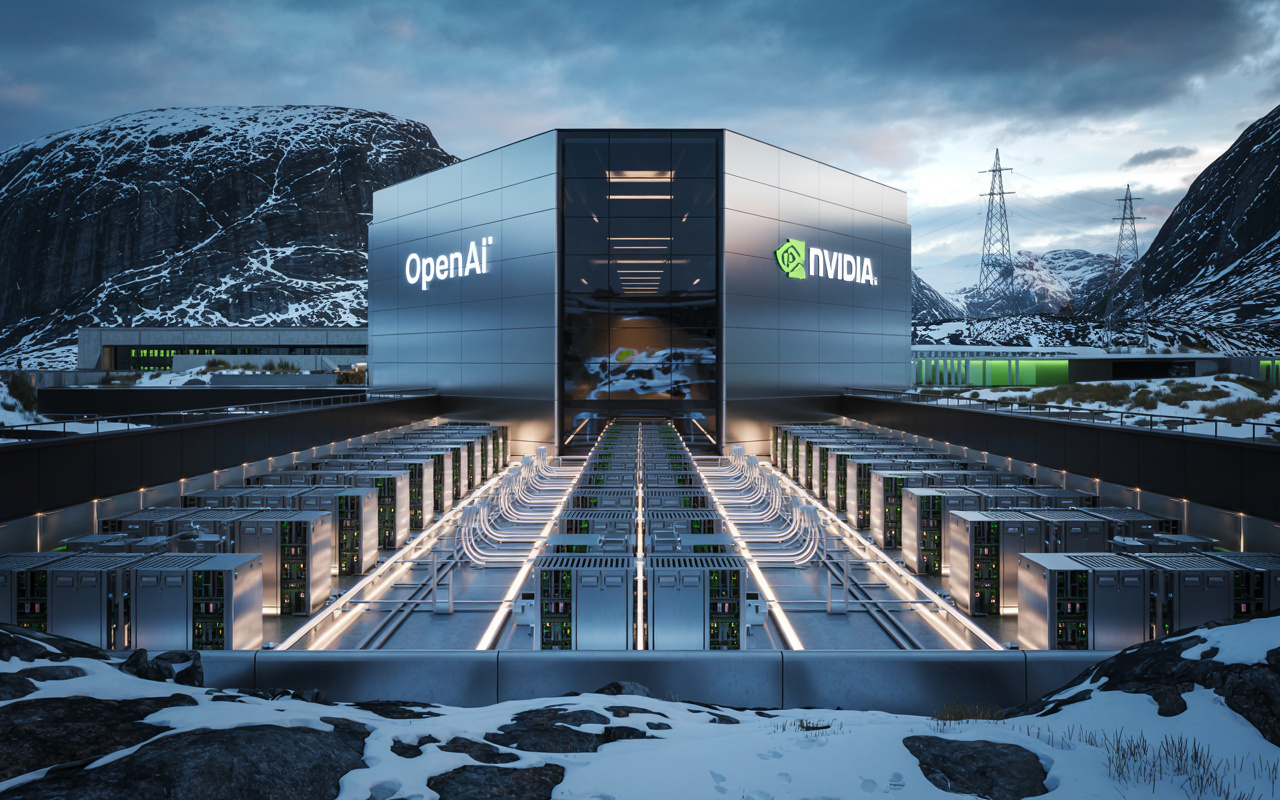


New Infrastructure Called Stargate Norway Will Be Powered By 100% Renewable Energy and Reinforces European Geopolitical Ambitions in the Artificial Intelligence Sector.
OpenAI, the developer of ChatGPT, has just announced the construction of one of the largest dedicated artificial intelligence data centers ever designed in Europe. Named Stargate Norway, the project will be located in Narvik, in northern Norway, and will have an initial capacity to operate 100,000 NVIDIA GPUs, potentially reaching 250,000 units in the long term.
The announcement is part of the “OpenAI for Countries” program, a global initiative aimed at building critical AI infrastructure in strategic locations around the world. The stated goal is to provide the advantages of artificial intelligence in an accessible way, while also ensuring technological independence in regions where there is a growing demand for homegrown solutions—without relying solely on infrastructures based in the United States.
The Role of Norway as a Strategic AI Hub
The choice of Norway to host Stargate was not random. The Narvik region has a cold climate, an abundance of low-cost hydroelectric energy, and a solid industrial park, ideal conditions for the installation of high-density data centers. The entire system will be powered by 100% renewable energy supplied by Nordkraft, and will use liquid cooling in a closed loop directly on the chips, reducing water consumption by up to 90%—something increasingly relevant in times of climate crisis.
-
Scientists Discover Mysterious Black Fungus Thriving in Chernobyl for Nearly 40 Years, Challenging Extreme Radiation and Potentially Revolutionizing Space Missions

-
Antarctica’s Blood Falls: Scientists Uncover a 1.5-Million-Year-Old Isolated Ecosystem, Shedding Light on Potential Ice Changes
-
Mati Carbon Wins $50 Million Prize for Boosting Harvests and Capturing Carbon by Distributing Free Basalt Dust to Small Farmers in India and Africa

-
Human Waste in Kenya is Solar-Treated and Turned into Fuel Briquettes, Tackling Open Sewage, Charcoal Use, and Deforestation





In addition to energy efficiency, Norway also stands out for its political engagement in favor of digital sovereignty. The country has been discussing ways to protect its critical infrastructures and expand its internal technological capacity. The partnership with OpenAI includes discussions with representatives of the Norwegian government to integrate AI solutions in the public and educational sectors.
An AI Center for All of Europe
Stargate Norway will not only serve the Norwegian market. The idea is for the infrastructure to benefit the entire European AI ecosystem. According to OpenAI, startups, developers, and researchers from Norway will have priority access, but the remaining capacity will be offered to companies and institutions in the United Kingdom, Nordic countries, and northern Europe.
This means that, in addition to serving as a computational hub, the project also represents an important geopolitical move: to create its own structure in Europe to support large-scale generative AI models, without relying exclusively on data centers located in the U.S. or Asia. The shortage of chips on the continent and the lag behind China and the U.S. in this field are often cited as strategic challenges for European autonomy.
OpenAI and NVIDIA: Billion-Dollar Partnership Under Expansion
Expected to be operational by 2026, Stargate Norway will initially be equipped with 100,000 NVIDIA GPUs, equivalent to one of the largest infrastructure investments ever made in Europe in the AI sector. NVIDIA, which dominates the AI chip market, has seen record demand for its cards since the boom of generative models like ChatGPT.
OpenAI will have priority access to the initial contractual purchases of GPUs, with the option to increase volumes as needed. The plan includes future expansion up to 250,000 units, depending on the evolution of the project and regional demand.
The center will be designed and operated by Nscale, a company specialized in high-performance computing infrastructure, with support from Aker, a traditional Norwegian group with a strong presence in the energy and technology sectors. Both companies also assure that the heat generated by the operations of Stargate can be utilized by local low-carbon emission projects.
Global Expansion: From Norway to the Middle East
The announcement of Stargate Norway is not an isolated case. In 2024, OpenAI had already revealed a similar project in the Middle East, Stargate UAE, and signed memorandums of understanding with the UK government and Estonia, including the use of ChatGPT in secondary schools.
These initiatives indicate that the company is betting on a decentralization of its infrastructure, building computational hubs in regions that consider AI a strategic priority. In Europe, OpenAI has also expressed interest in participating in the consortia of the European Union’s Gigafactories initiative, focused on local technology development.
Europe Accelerates Search for Computational Sovereignty
In the face of the dominance of giants like OpenAI and Microsoft, the European continent is racing to make up for lost time. The European Union is investing billions of euros in projects like IRIS²—its own constellation of satellites—and in the development of local supercomputers, but still faces challenges in scale and competitiveness.
In this context, OpenAI’s project in Norway appears as a hybrid solution: partnership with the private sector to accelerate computational infrastructure, while also offering local countermeasures and creating space for the European AI ecosystem to flourish.
For Norway, Stargate represents economic opportunity, international projection, and technological advancement, while positioning the country as a key player in the new global landscape of artificial intelligence.