Portuguese
  Spanish


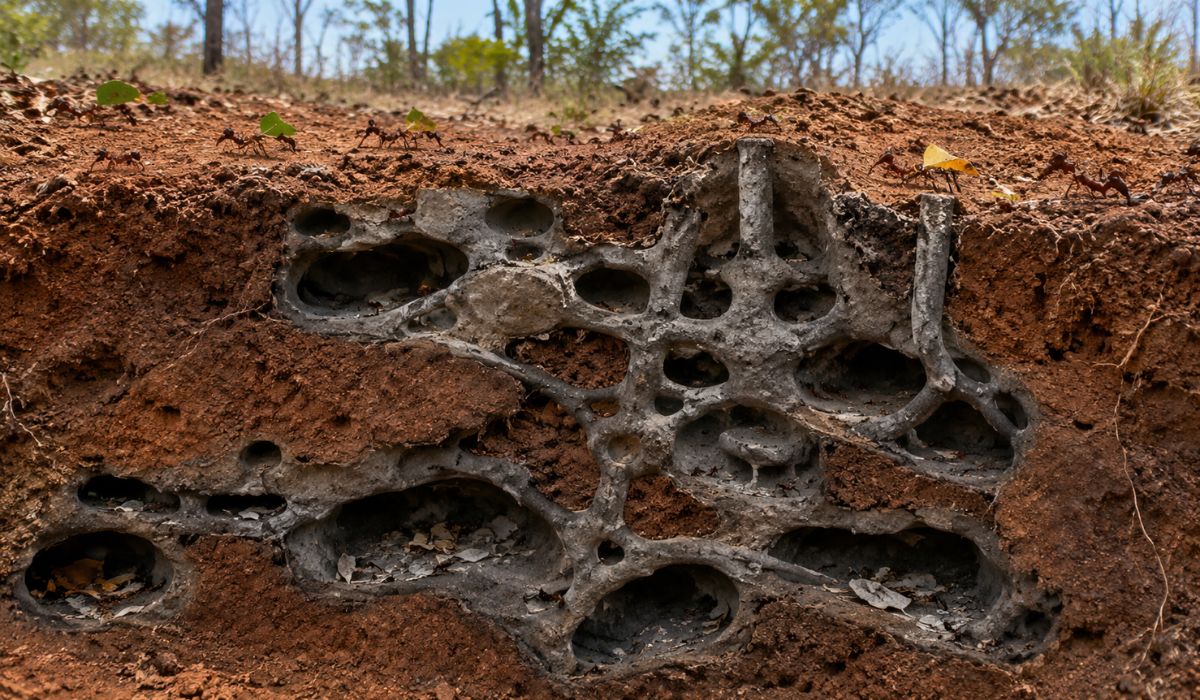

Cement cast in abandoned nest exposed an underground network of leaf-cutter ants, with chambers, tunnels, and natural air circulation mechanisms studied by researchers in Brazil.
An abandoned leaf-cutter ant nest in Brazil revealed a complex underground structure when researchers filled part of its tunnels with cement and excavated the surrounding soil.
The cast exposed a network of chambers, galleries, and connections that indicates how leaf-cutter ants build organized systems for shelter, circulation, fungus cultivation, and gas exchange.
The case gained notoriety due to the image of the concrete-molded nest, described in scientific dissemination materials as a kind of “underground city”.
-
OnePlus N6 Smartphone to Launch in India with 8,000mAh Battery and 45W SuperVOOC Charging, Lasting Up to Three Days

-
Scientists Plan to Release Air Bubbles Underwater to Protect Antarctica’s “Doomsday Glacier” from Melting

-
Chinese R6000 Drone Combines Airplane and Helicopter Features, Carries Up to 12 People for Multiple Missions
-
In the World’s Most Densely Populated Desert, Families Dig Funnel-Shaped Underground Cisterns to Capture Rare Rainfall and Store Drinking Water for Up to Eight Months




The comparison is used to gauge the scale of the construction, but academic studies confirm more precise data: nests of Atta laevigata, a common leaf-cutter ant species in Brazil, can gather thousands of chambers and reach several meters in depth.
Research conducted in Botucatu, in the interior of São Paulo, analyzed the internal architecture of three nests of this species.
Two were opened by trenches, while one was molded with cement to allow visualization of the structure.
The study recorded between 1,149 and 7,864 chambers in the examined nests, with depths of up to 7 meters and foraging tunnels extending up to 70 meters from the loose soil area on the surface.
Cement revealed the structure of the ant nest underground
The use of cement in abandoned nests allows for the creation of a mold of the empty space left by the ants.
After the material hardens, researchers remove the surrounding soil and observe, in three dimensions, the shape of the tunnels and chambers.
The technique helps preserve the internal arrangement of the nest, which can be lost in a direct excavation.
In the case of leaf-cutter ants, studies indicate that the internal organization does not occur randomly.
There are tunnels used as circulation routes, chambers associated with fungus cultivation, empty areas, and spaces related to waste removal.
Leaf-cutter ants do not feed directly on the leaves they cut.
They carry plant fragments into the nest and use this material as a substrate to cultivate fungi, which serve as food for the colony.
For this reason, the distribution of chambers is related to the maintenance of temperature, humidity, and gas circulation.
In the study on Atta laevigata, researchers observed chambers with different sizes and shapes.
The recorded volume ranged from 0.03 liters to 51 liters.
In some of the analyzed nests, many chambers were associated with fungus cultivation; others appeared empty or with soil inside.
Leaf-cutter ants build large-scale underground networks
The formation of a nest of this size results from the collective activity of the worker ants.
Each one performs tasks such as excavating, transporting soil particles, opening passages, and maintaining paths in use.
From these repeated actions, the colony modifies the subsoil and creates an architecture capable of housing a large number of individuals.
The species Atta laevigata belongs to the group of leaf-cutter ants, known in Brazil as “saúvas”.
These insects have an ecological impact because they remove leaves, move soil, and influence the dynamics of vegetation around the nests.
In natural environments, this activity can alter physical characteristics of the soil and create areas different from neighboring regions.
The amount of soil displaced by leaf-cutter ants over the lifetime of a colony can be high.
However, the figure of 40 tons of soil cited in popular science texts is not directly confirmed in the academic study consulted about the Atta laevigata nest in Botucatu.
The reliable information, in this case, is the scale recorded by the researchers: thousands of chambers, up to 7 meters deep, and tunnels extending for tens of meters.
Tunnels and chambers aid in nest air circulation
Ventilation is one of the aspects analyzed in studies on leaf-cutter ant nests.
Colonies of this type consume oxygen and produce carbon dioxide, just like the fungi cultivated inside the chambers.
At depth, the soil tends to have less oxygen and a higher concentration of carbon dioxide, which makes gas exchange relevant for nest maintenance.
A study on ventilation in giant nests of Atta laevigata and Atta capiguara investigated air movement with tracer gas and also analyzed cement casts and excavations.
Researchers recorded CO₂-rich air exiting through higher openings and O₂-rich air entering through lower openings, a result compatible with passive wind-induced ventilation.
The analysis, however, presented a caveat: the air circulating through the tunnels was not directly detected inside the fungus chambers.
According to the study’s authors, colony respiration depends on diffusive flows between the air in the chambers, the nest atmosphere, and the surrounding soil.
Thus, ventilation occurs, but it should not be described as a direct current flowing through all compartments.
This distinction avoids an exaggerated interpretation of the structure.
The nest is not equivalent to a human air conditioning system, although it presents natural gas exchange mechanisms.
The shape of the galleries, the position of the openings, wind, and gas diffusion act together in the subterranean environment.
Leaf-cutter ant architecture combines chambers, galleries, and openings
In Atta laevigata nests, the combination of scale and function appears in the distribution of chambers at different depths, connected by narrow galleries.
Foraging tunnels connect the nest’s interior to the external environment and allow for the transport of cut leaves.
The subterranean architecture also reduces the exposure of the queen, larvae, and cultivated fungus to external variations.
By keeping essential parts of the colony below the surface, the nest creates more stable conditions compared to the external environment.
The openings and earth mounds on the surface, in turn, participate in air circulation and the removal of excavated material.
Studies on ventilation indicate that the external shape of the nest can induce air movements inside, especially when there are openings at different heights.
The passage of wind over these entrances creates pressure differences, which favors the movement of gases between the surface and the subterranean galleries.
The image of the cement cast helps to make visible a structure that normally remains hidden in the soil.
For researchers studying social insects, the case allows observing how simple individual behaviors can result in large-scale collective constructions, without the need for centralized command.
Atta laevigata nest shows social insect organization
The comparison to a human city frequently appears because the structure features circulation, areas with distinct functions, and maintenance mechanisms.
It is, however, a metaphor.
Ants do not build with aesthetic intent or elaborate plans; the organization arises from collective behaviors associated with needs such as food, shelter, ventilation, and waste disposal.
Even so, the nest is treated in studies and promotional materials as an example of complex biological construction.
It shows how social insects can modify the environment on a large scale and create deep, resistant, and functional structures.
It also contributes to research on the management of leaf-cutter ants, considered relevant for agriculture and reforestation areas due to their consumption of plant material.
By revealing the interior of an ant nest, the cement transformed an invisible structure into a physical record of the colony’s subterranean organization.
What was once hidden beneath the soil now reveals the scale of collective work performed by insects measuring just a few millimeters.