





 Portuguese
  English
  Spanish
  4 min of reading
  0 comments


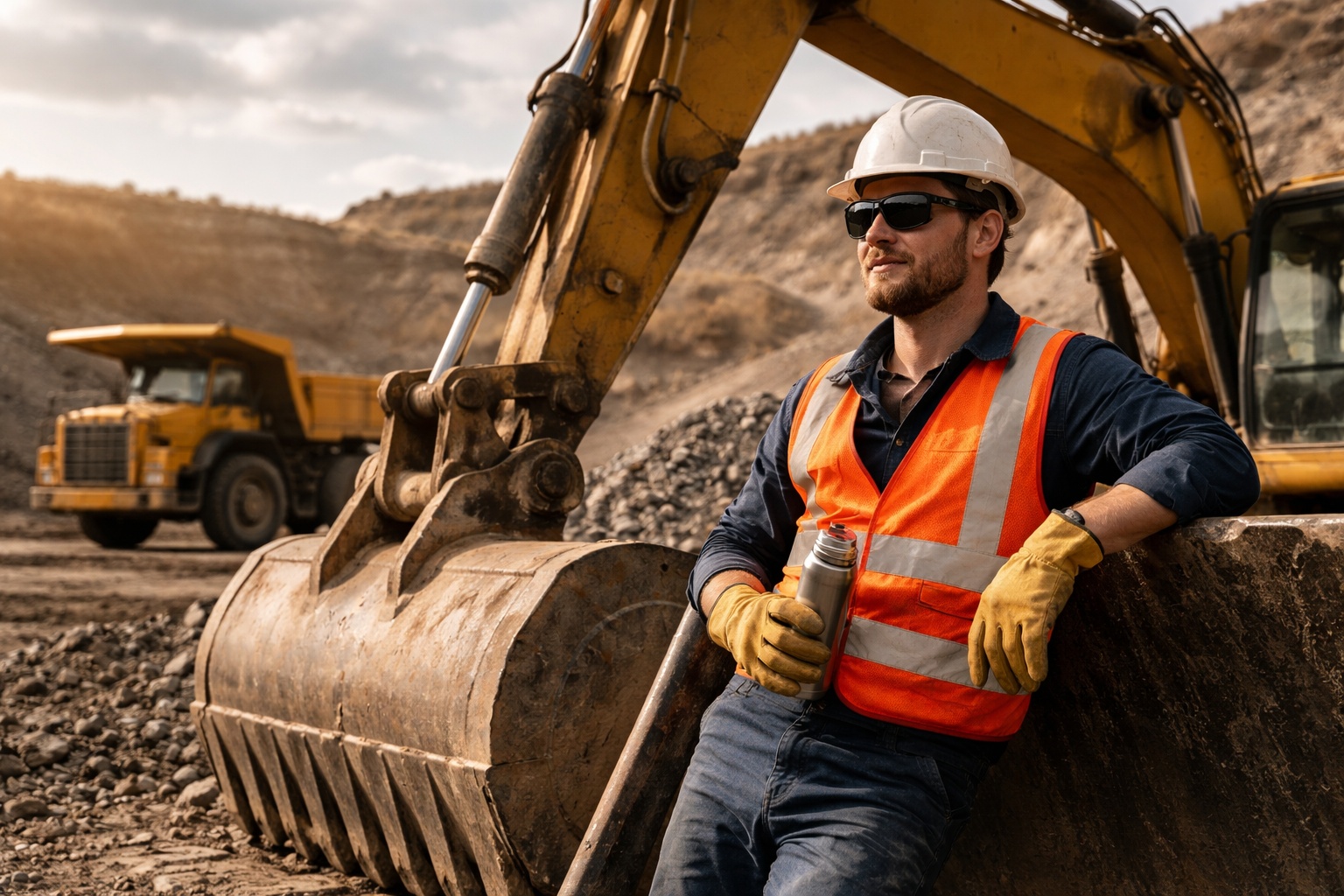
NR-17 and CLT Guarantee Mandatory Breaks for Heavy Machinery Operators; Non-compliance Results in Overtime, Compensation, and Fines in Industry and Mining.
Few workers know that operating excavators, off-road trucks, drilling machines, loaders, industrial presses, or large equipment is not just a technical or productive issue. It is an activity that, by law, requires mandatory breaks throughout the work period, precisely because it involves high physical risk, intense mental fatigue, and the potential for serious accidents. When these breaks are not granted, the employer begins to accumulate labor liabilities that include overtime, compensation for moral damage, and administrative fines.
This understanding does not arise from isolated interpretation but from the direct application of the CLT, NR-17 (Ergonomics), and repeated decisions from the Labor Court, especially in sectors such as mining, steelmaking, heavy industry, logistics, and infrastructure works.
What Legislation Says About Breaks for Heavy Machinery Operators
The legal basis starts with article 4 of the CLT, which considers all periods when the worker is subject to the pace and demands of the activity as time at the employer’s disposal. In addition, NR-17 establishes the obligation to organize work in a way that respects the physical and mental limits of the worker.
-
The STJ decides that a woman who left her career for more than 30 years to take care of the house, children, and family is entitled to lifetime alimony after divorce; the decision by the 3rd Panel recognizes extreme financial vulnerability and values invisible work in marriage.

-
Two global aviation giants are convicted in Paris and will have to pay R$ 1.3 million each for the crash of the Rio-Paris flight that killed 228 people in 2009.

-
Deputies against the government join forces to maintain a 6×1 schedule, workweeks of up to 52 hours, a 10-year transition, halving the FGTS, and special rules for certain sectors.

-
New law prohibits motorcycle passengers, imposes a fine equivalent to R$ 2,100, and was created to try to curb robberies and attacks committed by criminals using motorcycles in Peru, Brazil’s neighboring country.




For heavy machinery operators, the regulation requires periodic breaks for physical and cognitive recovery, especially in continuous, repetitive activities or those that demand a high level of attention. It is not a “kindness” from the company, but rather a legal obligation linked to safety and occupational health.
Why NR-17 Applies Directly to Mining and Heavy Industry
In mining and industry, the operator not only performs repetitive tasks but assumes direct responsibility for equipment that can weigh tens or hundreds of tons. A minimal error can result in fatal accidents, environmental damage, or million-dollar losses.
That is why NR-17 does not limit its application to offices or light production lines. The Labor Court has consolidated the understanding that activities with physical overload, constant vibration, forced posture, and prolonged attention require mandatory breaks, under penalty of illness and extreme risk.
What Happens When the Company Does Not Grant Mandatory Breaks
When the company suppresses or ignores the breaks provided for in NR-17, the time that should be devoted to rest is considered time at the employer’s disposal, generating the right to payment as overtime.
Moreover, the courts have been recognizing that the systematic suppression of breaks can constitute moral damage, especially when there is proof of physical wear, illness, excessive stress, or risk to the worker’s integrity.
In labor lawsuits, it is common for the employee to obtain:
– payment for overtime related to ungranted breaks
– reflexes in vacation pay, 13th salary, FGTS, and notice
– compensation for moral damage
– recognition of an inadequate work environment
Labor Jurisprudence on Breaks for Machinery Operators
Regional Labor Courts and the TST have consistently decided that heavy machinery operators are entitled to breaks, even when there is no express provision in a collective agreement. The dominant understanding is that health and safety standards prevail over agreements that attempt to supplant them.
In various decisions, the Justice has recognized that the absence of breaks violates the dignity of the worker and increases the risk of accidents, especially in mining and base industry environments.
The Argument of PPE Does Not Dismiss the Right to Breaks
Another recurring point in lawsuits is companies’ attempts to justify the absence of breaks by providing PPE. However, this argument has been rejected by the Labor Court.
Courts understand that PPE reduces risks but does not eliminate physical and mental wear caused by the continuous operation of heavy machinery. Thus, even with adequate protective equipment, breaks remain mandatory.
Economic Impact for Companies That Violate NR-17
The cost of non-compliance can be significant. In addition to individual penalties, companies may face:
– violation notices from the Ministry of Labor
– administrative fines
– public civil actions for collective moral damage
– increased labor liabilities in audits and inspections
In mining and heavy industry, where entire teams operate equipment for long shifts, the suppression of breaks can generate million-dollar liabilities over the years.
What the Worker Can Do When Breaks Are Denied
The worker does not need to accept the situation passively. It is possible to:
– document the actual work routine
– gather witnesses
– keep schedules and work orders
– seek union or legal guidance
Even after the termination of the contract, it is possible to seek judicially the payment of suppressed breaks, provided the limitation period is respected.
Why This Topic Has Gained Traction Now
The increase in accidents, occupational illnesses, and labor lawsuits in industry and mining has led the Judiciary to reinforce the application of NR-17. The logic is simple: production cannot override health and safety.
In a scenario of increasingly larger machines, long shifts, and pressure for productivity, breaks no longer become minor details and become a central element of the legality of the work environment.
In Brazil, operating heavy machinery without breaks is not only risky it is illegal. And the legal consequences for those who violate this rule are becoming clearer.
And you, reader: in your company, are breaks truly respected or do they exist only on paper?






-

2 people reacted to this.