






 Portuguese
  Spanish


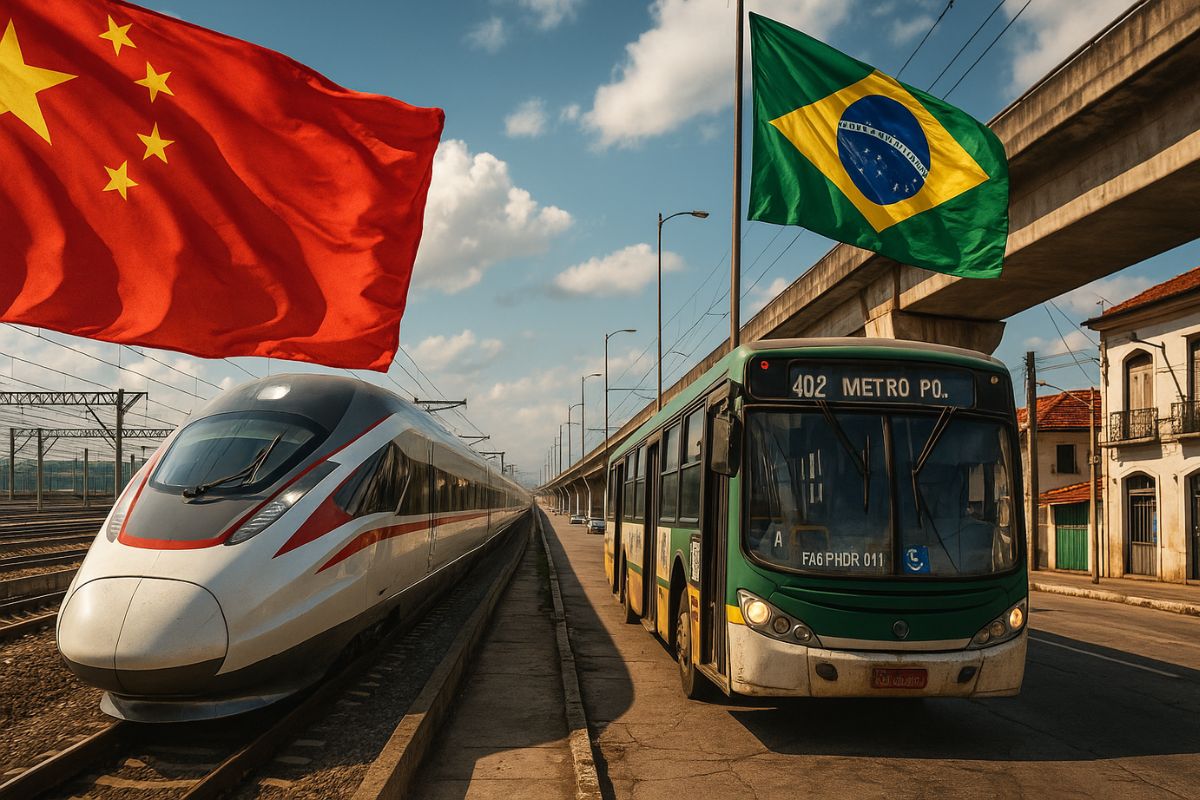


China Built the World’s Largest High-Speed Rail Network in Just 15 Years, Surpassing 40,000 km of Lines and Projecting to Reach 50,000 km by 2025, While Brazil Remains Without a Single Bullet Train, Revealing Contrasts in Planning, Investments, and Transportation Integration Between the Two Nations
China transformed its transportation infrastructure in record time by building more than 40,000 km of high-speed trains in just 15 years, consolidating the largest high-speed rail network in the world. This advancement redefined national mobility, brought cities closer together, reduced distances, and created a new standard of internal and external connectivity.
Meanwhile, Brazil, with its continental dimensions and historical logistical bottlenecks, has yet to inaugurate a single bullet train. The comparison exposes a chasm in terms of strategic planning, execution capacity, and political priorities that help explain the distinct paths of each country.
The Political Decision That Changed Chinese Transportation
The turning point occurred in the early 2000s when Beijing decided to invest heavily in high-speed rail.
-
How to Prevent Brown Recluse Spider Bites: Common Hiding Spots and Free Tips to Reduce Risks

-
Natto: The Unusual Japanese Superfood Gaining Popularity on Social Media and Driving Record Exports
-
Brazilian Mayor Goes Undercover as Homeless for 24 Hours to Assess Public Services

-
15-Year-Old Entrepreneur Malu Lira Publishes 20 Children’s Books on Financial Education, Earns $500,000, and Expands Her Project to the Amazon Rainforest




The strategy aimed to modernize transportation, reduce pressure on airlines and highways, and create a system capable of supporting long-term economic growth.
Unlike Japan, which developed its Shinkansen independently, China sought international partnerships with companies from Germany, Japan, France, and Canada.
It bought technology, absorbed knowledge, and quickly initiated reverse engineering processes to create its own models, adapted to local demands.
The Accelerated Expansion of the World’s Largest High-Speed Rail Network
The major leap occurred starting in 2008, when the global financial crisis led Beijing to adopt railway construction as part of an economic stimulus package.
Between 2008 and 2023, the network grew rapidly, surpassing 46,000 km by 2024 and aiming for 50,000 km by 2025.
This scale was only possible due to state mobilization and centralized decision-making.
Although criticized for overlooking environmental and social impacts in some segments, the execution speed became a hallmark of the Chinese model.
Technological Innovation and Exporting Know-How
With the consolidation of the network, China transitioned from importer to exporter of rail technology.
Today, in addition to operating the largest high-speed rail network in the world, the country supplies trains and infrastructure to countries like Indonesia and Laos.
Among the cutting-edge projects are the CR450, a next-generation train designed to operate at 400 km/h, and the Shanghai Maglev system, which utilizes magnetic levitation and reaches speeds of 430 km/h.
There are also research efforts aimed at achieving even higher speeds, like prototypes of 600 km/h and even concepts of 2,000 km/h.
Internal Impacts and Criticism of the Model
Chinese bullet trains have radically changed the dynamics of domestic travel.
Routes of up to 1,300 km have become cheaper and faster by train than by plane, reducing the relevance of air travel in various connections.
But critics warn that the rapid growth has also brought high debt costs and profitability issues on low-demand lines.
The expansion model in less populated regions raises concerns about long-term economic sustainability.
The Contrast with Brazil
While China advances with tens of thousands of kilometers in operation, Brazil has yet to implement bullet train projects, such as the connection between São Paulo and Rio de Janeiro, discussed for over a decade.
The absence reflects political obstacles, regulatory disputes, high costs, and a lack of priority on the state agenda.
This contrast reveals not only the difference in execution capacity but also the long-term strategic vision.
For Beijing, investing in high-speed rail is a state policy, while in Brazil, the issue remains a recurring promise, with no concrete advances.
The construction of the world’s largest high-speed rail network established China as a global leader in modern rail transport, while Brazil remains without a single operational project.
The future of mobility shows how political decisions and investment priorities can determine such different trajectories.
Do you believe Brazil should adopt a model similar to China’s, even with high costs and challenges, or do you think the Brazilian reality demands another solution for transportation and national integration? Share your opinion in the comments—we want to hear from those who live this reality firsthand.








Se pesquisar a fundo vamos descobrir que pagamos muito mais que a China nesse período pra ficarmos com carroças…