Portuguese
  Spanish


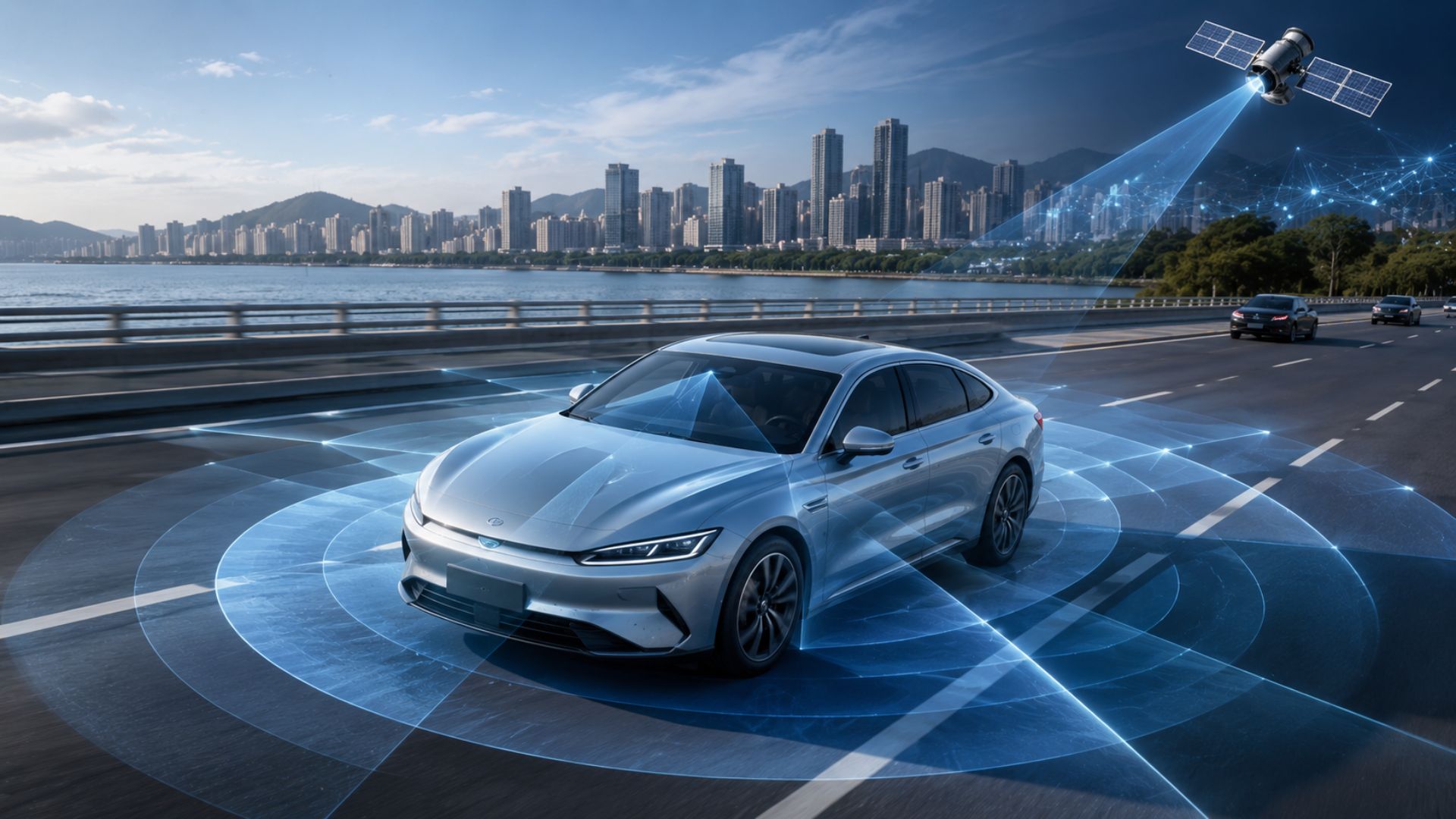

Despite the impactful name and images of a car driving alone on the track, it is important to clarify: it is an advanced assistant, not a vehicle that dispenses with the driver. The technology, which in China already equips cheap models, combines cameras, radars, and even LiDAR with DeepSeek’s artificial intelligence.
BYD will bring to Brazil in 2027 the God’s Eye, named Olho de Deus, an advanced driver assistance system with artificial intelligence, 5G network, and satellite connection. The Chinese automaker wants to popularize the technology across its entire line of cars, bringing features once restricted to luxury vehicles to more affordable models, in a strategy that promises to shake up the Brazilian automotive market.
The announcement was made during an event at the company’s headquarters in Shenzhen, China, where BYD presented its strategic plans. Before any excitement, however, it is worth an important clarification to avoid false expectations: despite the grandiose name, the God’s Eye is an advanced driver assistance system, known by the acronym ADAS, and not a fully autonomous driving system. At all levels, the driver remains responsible and needs to supervise the vehicle.
What is, in fact, the God’s Eye

The God’s Eye is a set of driver assistance features, such as adaptive cruise control, automatic emergency braking, and autonomous parking, equivalent to the so-called Level 2 of the international automation scale, where the car assists but does not replace the human driver.
-
End of an era in Brazil: beloved sedan by Brazilians is discontinued despite having a 2.0 engine with 151 hp, CVT transmission, 466-liter trunk, and up to 650 km of range.

-
New Law Proposal in Brazil Could Heavily Penalize Drivers: Dangerous Overtaking May Become a Serious Offense with Fines Increased Tenfold and a 12-Month License Suspension; Update on 2026 Progress

-
Electric Revolution: Watts W125 Motorcycle Offers 160 km Range, 90 km/h Speed, and Affordable Price Starting at $3,000
-
General Motors Replaces Over a Thousand Workers with 50 Cobots at Electric Vehicle Plant, UAW Union Criticizes Move Amid Industry’s Automation Push


BYD itself positions the system as driver assistance, not full autonomy. Although the brand has released videos of a Yangwang supercar driving alone on a closed track, this is a controlled demonstration, not what the average driver will be able to do on the streets. In practice, the God’s Eye makes driving safer and more comfortable, but the steering wheel remains the responsibility of the driver.
The three levels and the correct names
It is worth correcting a common confusion about the technology nomenclature. The system runs on BYD’s proprietary architecture called Xuanji, and is divided into three levels controlled by DiPilot line processors, and not by a chip called “Xuanji A3”, as circulated in some publications.
The entry-level is God’s Eye C, with the DiPilot 100 processor, with 100 TOPS capacity, based on cameras, radars, and ultrasonic sensors, without LiDAR, intended for BYD’s higher volume models. Next comes God’s Eye B, with the DiPilot 300, with 300 TOPS, which adds a LiDAR sensor and is aimed at premium brands. At the top is God’s Eye A, with the DiPilot 600, with 600 TOPS and three LiDARs, reserved for the luxury brand Yangwang. The higher the level, the greater the processing capacity and the number of sensors.
How the car really “sees”


Another point that deserves precision is how the system perceives the surrounding environment. Although the Xuanji architecture uses satellite connection and 5G network, the perception of what is around the car comes mainly from cameras, millimeter-wave radars, and ultrasonic sensors, in addition to LiDAR in more advanced versions, and not from satellites, as one might imagine.
In other words, the satellite and 5G are part of the vehicle’s connectivity, for data exchange, updates, and navigation, but they are not the “eyes” of the car. The entry-level version, for example, has 12 cameras, five millimeter-wave radars covering 360 degrees, with a front range of up to 300 meters, and 12 high-precision ultrasonic sensors. It is this combination of sensors that allows the system to see the road, other vehicles, pedestrians, and obstacles.
The artificial intelligence of DeepSeek
One of the great differentials of the system is the brain behind it. The Xuanji architecture is integrated with the R1 artificial intelligence model from the Chinese company DeepSeek, the same company that gained worldwide fame by launching a powerful and low-cost AI, which helps the system recognize driving intentions and predict the behavior of dynamic obstacles.
To feed this intelligence, BYD claims to gather a huge volume of data, with about 72 million kilometers of training information per day and thousands of engineers dedicated to intelligent driving. The company also says it has invested around 100 billion yuan, equivalent to approximately R$ 75 billion, in research and development, and uses an algorithm that dispenses with high-precision maps, which facilitates expansion to new countries, such as Brazil.
The Goal of Zero Accidents
BYD presents the God’s Eye with ambitious objectives, which should be read as company goals, not guarantees. Among the declared purposes by the automaker are to eliminate traffic accidents, ensure that assistance systems operate with the precision of an experienced driver, and use artificial intelligence as a kind of onboard personal assistant.
It is important to approach these promises with due critical sense. No assistance system completely eliminates the risk of accidents, and the classification of God’s Eye as Level 2 technology itself reinforces that driver attention remains indispensable. The goal of zero accidents is a long-term vision and a marketing discourse of the brand, not a reality that the consumer will find ready when buying the car.
BYD’s Offensive in Brazil
The arrival of God’s Eye fits into the brand’s accelerated advancement in the country. In May 2026, BYD surpassed Volkswagen and became the retail sales leader in the Brazilian market, registering almost 15,000 cars during the period, a significant milestone for an automaker that arrived in the country only a few years ago.
Bringing an advanced driving assistance system, with cutting-edge AI and at a competitive cost, is another step in this strategy of popularizing technology that BYD has been adopting globally. For the Brazilian consumer, the trend is access to features previously exclusive to expensive cars, while for traditional automakers, the challenge is to respond accordingly. Brazil, which receives heavy investments from the brand, including the factory in Bahia, becomes a strategic market in this technological dispute.
BYD’s God’s Eye promises to bring advanced driving assistance to the Brazilian public starting in 2027, with artificial intelligence, cutting-edge sensors, and modern connectivity. But, as we have seen, it is essential to understand what the technology really is: a powerful assistant that enhances safety and comfort, not an autopilot that dispenses with the driver. Separating real innovation from marketing exaggeration is what allows the consumer to enjoy the best of technology without taking risks from overconfidence.
And you, would you trust a driving assistance system like BYD’s God’s Eye? Do you think this type of technology makes traffic safer or could it lead to overconfidence at the wheel? Leave your comment, share your opinion about the future of assisted driving, and share the article with those who follow cars, technology, and innovation.