






 Portuguese
  Spanish


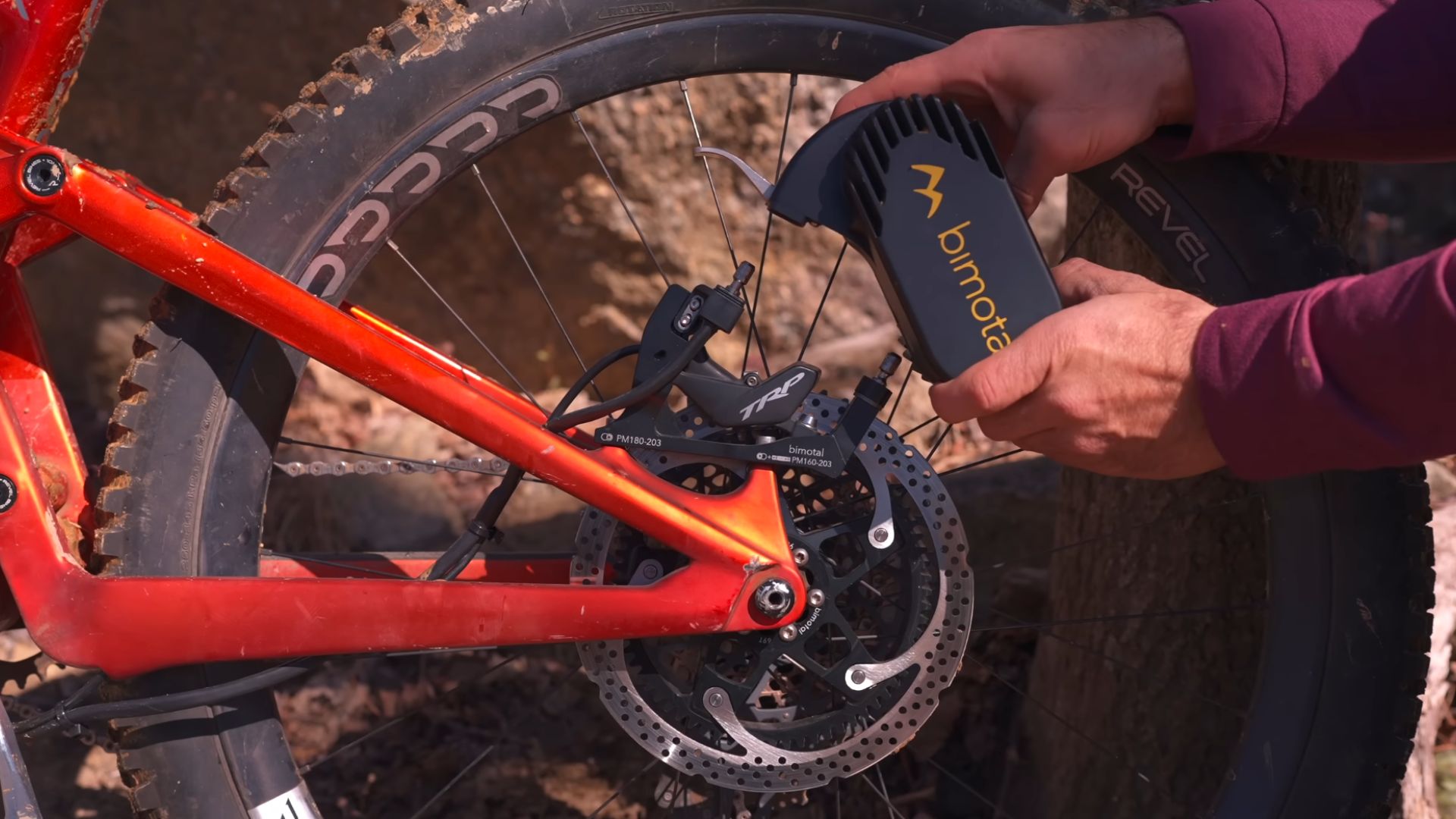


Removable Kit Created In The United States Promises To Convert Regular Bikes Into Electric Ones By Connecting The Motor Directly To The Disc Brake, With Up To 1,250 W Of Power And A 300 Wh Battery, Without Wheel Replacement And With A Proposal For Alternate Use Between Assisted And Analog Mode.
A removable kit from the American company Bimotal promises to transform a regular bicycle into an electric one without replacing the wheel and without installing a fixed motor on the frame, by connecting the drive directly to the disc brake area through a system called Elevate.
Called Elevate, the kit combines a drive unit fitted near the caliper, a 300 Wh external battery mounted on the frame, and a control on the handlebars, with a speed limit of 20 miles per hour under the “class 2” standard adopted in the United States.
How The Elevate Transmits Force To The Wheel Via The Disc
Instead of using a motorized hub or a central motor in the movement, Bimotal claims that the Elevate transfers power by rotating the wheel via gears, utilizing the brake rotor area and keeping the rest of the bike as it originally was.
-
Spain Launches World’s Largest Floating Dry Dock: 56-Meter Giant Produces Massive Concrete Structures in A Coruña Using Technology Proven in Brazil

-
AI-powered toys that talk, recognize faces, and collect data face scrutiny from Brazilian government over children’s privacy concerns

-
4,000-Year-Old Child’s Skull Unveils Ancient Burial in 7,500-Year-Old Norwegian Rock Shelter, Impressing Archaeologists

-
Norway Defeats Brazil in World Cup but Invests Billions to Preserve the Amazon, Strengthens Amazon Fund, and Joins Brazil in Leading Global Effort Against Tropical Deforestation


For this, the kit relies on a piece that replaces the traditional disc: the rotor-gear, a toothed rotor that makes contact with an output gear from the drive unit when the motor is fitted into the mount.

According to the manufacturer, the rotor-gear uses a six-bolt ISO interface and can be used on centerlock hubs with an adapter, expanding the mounting possibilities on bicycles that already use disc brakes.
Still, braking remains in play: deceleration continues to be handled by the bike’s hydraulic system, while the toothed set serves as a connection point for the motor to generate traction on the wheel.
Power, Torque, And Upgrade To 1,250 W
In the standard configuration, Bimotal announces 750 W of power and maximum torque of up to 70 Nm, with 50 Nm of continuous torque, a level that places the kit above compact solutions focused only on light assistance.
In addition to the standard version, the company sells a “MAX” option and also an upgrade service that enables a total power of 1,250 W, presented as an addition of 500 W compared to the original set.
In practice, this format reinforces the proposal to offer strong assistance when needed and allow the cyclist to return to analog mode in a few seconds by removing the motor and battery for transport or use on another compatible bike.
Declared Autonomy And Variations According To Use
The 300 Wh battery is installed on the frame in a mount that takes advantage of common attachment points, such as those used for bottle cage mounts, and Bimotal associates the range with typical off-road cycling conditions.

In the company’s materials, different ranges appear, mentioning 10 to 15 miles as the typical range and, on another institutional page, referencing 10 to 20 miles per charge, always with caveats about terrain and driving mode.
A test from the specialized site The Loam Wolf also highlighted this variability and cited range numbers released by the brand in terms of distance and elevation gain, in addition to pointing out that behavior depends on how much the throttle is used.
Compatibility Requires Checking The Brake And The Frame
By operating alongside the disc, the Elevate imposes space and mounting standard requirements, and Bimotal itself describes that the frame needs to provide clearance for the drive unit and the brake set must meet specific criteria.
According to The Loam Wolf, the kit requires four-piston hydraulic calipers and tends to need a rotor larger than the minimum supported by the frame, a combination that can limit installation on road bikes and some urban ones.
The company also admits the possibility of use on the front wheel but recommends the rear wheel whenever possible due to the “torque steer”, an effect where the steering can pull during acceleration when traction is in the front.
Weight Of The System, Control, And Proposal For Alternate Use

In weight, Bimotal reports about 8.8 pounds on the installed system, something close to 4 kg, detailing the division with 1.50 kg for the drive unit and 1.55 kg for the battery, in addition to the mounting kit and cables.
Activation can be done via a throttle on the handlebars and via an app, and the company’s discourse insists on “electrifying the bike that the cyclist already loves,” preserving the option to remove the set on technical descents or where local rules restrict e-bikes.
International Recognition And Price Of The Kit
The Elevate gained prominence by entering Time magazine’s Best Inventions list for 2024, which described the device as a compact motor capable of transforming a bicycle into an e-bike and cited interest from search and rescue teams.
On Bimotal’s website, the kit appears with a price of US$ 2,195 for the standard version and US$ 2,595 for the MAX version, while the company also lists a separate “Search and Rescue Motor System” with a higher price, aimed at this type of application.
By betting on a detachable motor and transmission via the brake rotor, the proposal differentiates itself from conversions through motorized wheels and more invasive central systems, but also places compatibility as a decisive step before purchase and use.
If removable kits with full e-bike power gain traction, how many cyclists will prefer to transform their own bicycle into two different vehicles, alternating between electric and analog mode, rather than buying a dedicated e-bike?








Onde comprar para distribuir?
For that price just buy an ebike.
Donde se puede comprar