






 Portuguese
  Spanish


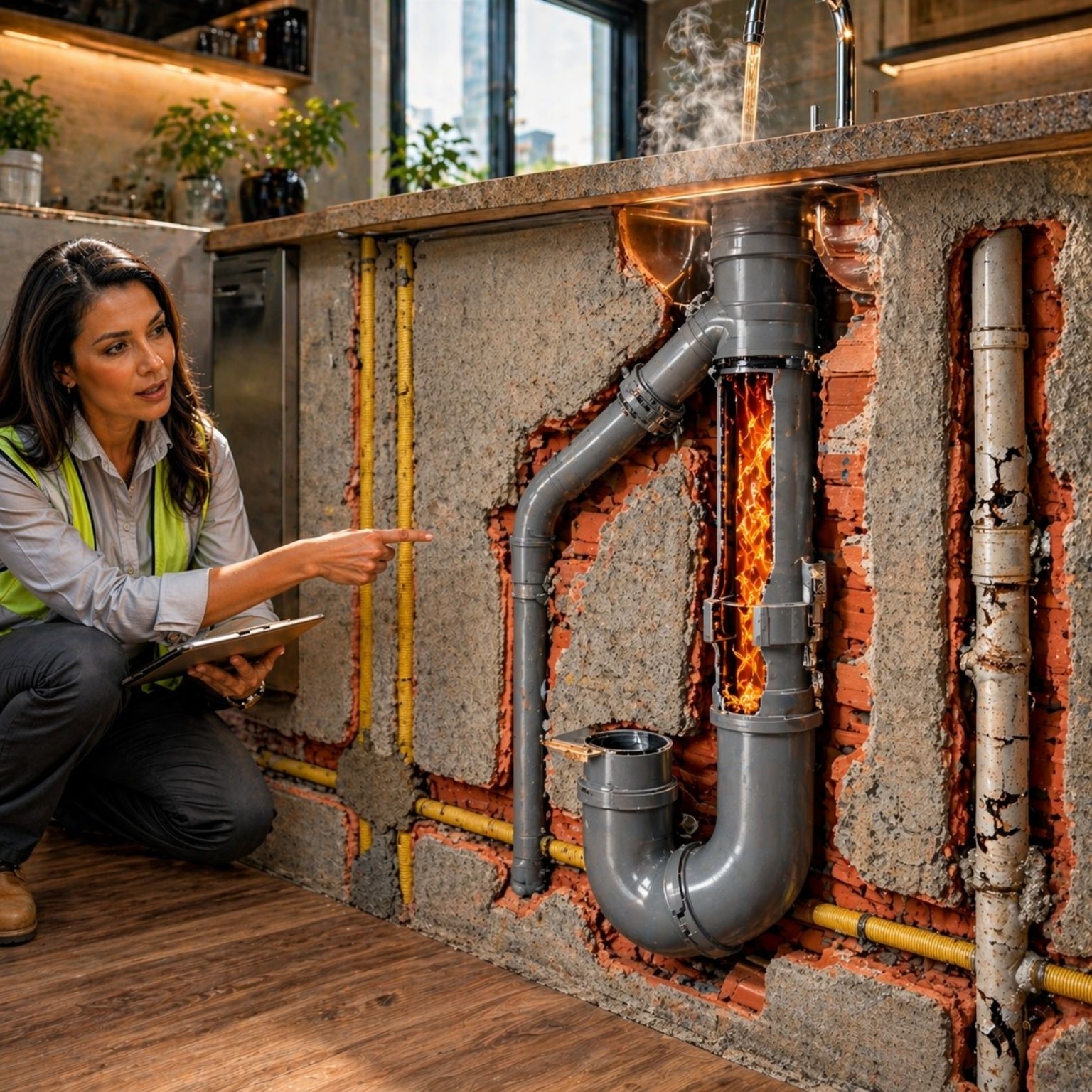


In kitchen drainage, using reinforced series gray PVC piping helps handle boiling water in the sink and hot effluent from the washing machine, reducing the risk of cracks and increasing installation durability with little cost difference over a few meters.
A civil engineer specializing in BIM installation projects explained why kitchen drainage often requires two types of piping in the same environment. In the project shown, white pipes, normal series PVC drainage, and gray pipes, reinforced series PVC, appear. The difference, according to her, is not aesthetic: it is a choice of use to avoid future problems in the client’s installation.
The central point lies in the kitchen routine. Contrary to what many people think, the challenge is not just “hot tap water.” Kitchen drainage receives high-temperature effluents from the washing machine, which can discharge water at 70°C, and also very hot water from food preparation, such as electric kettle water poured into the sink and boiling water used in cooking, which ends up going down the drain.
Kitchen drainage: why reinforced series gray piping is recommended

The engineer states that normal series white PVC piping does not resist high temperatures as well as the reinforced series. Therefore, the project guidance is to use reinforced series PVC throughout the entire kitchen drainage line up to the grease trap.
-
Brazilian Fishing Couple Spends 4 Years Building Solar-Powered Floating Home on the Paraguay River, Now a Navy-Approved Vessel with Leisure Area and Tour Demand

-
While the World Opens New Airports and High-Speed Trains, Brazil Rushes to Complete Projects Stalled for 40 Years
-
Brazil Invests in Massive Waterway to Transport Soybeans by Barge, Reducing Costly Truck Reliance
-
Bridge Rebuilt in Just One Year Reconnects Two Brazilian States


The logic is preventive. She explains that by choosing the reinforced series in the kitchen, the project aims to reduce the risk of cracks and failures associated with repeated exposure to hot effluents, something that may not appear immediately but can emerge over time with use.
What changes in practice: washing machine effluent at 70°C and boiling water in the sink become the real test
The most direct example cited is the washing machine, which heats water for cleaning and can discharge an effluent of around 70°C into the system. Added to this are common daily habits: electric kettle water and boiling cooking water, such as pasta water, which many people pour directly into the sink.
In practice, this means that kitchen drainage doesn’t just receive “lukewarm” water. It can frequently receive temperature peaks, and this repetition is the type of stress that, according to the engineer, makes reinforced series PVC a safer choice for this specific section.
Impact resistance: why the reinforced series helps beyond temperature
In addition to temperature, reinforced series piping is described as more impact-resistant. The engineer mentions that it is also recommended when piping passes through areas with vehicle traffic and without a slab above, precisely because it is a more robust material.
In the case of the kitchen, the practical consequence is to increase the installation’s tolerance to aggressions from use and construction, reducing the chance of small cracks that turn into leaks and subsequent repairs.
“Will it be a problem if I use white PVC?” The risk that might only appear in 2 or 3 years
The engineer does not say that white PVC will necessarily fail immediately. She states that nothing might happen in six months, or even in a year. The warning is about the medium term: depending on the frequency of installation use, the problem might appear in 2 or 3 years, precisely when many people already think “everything is resolved.”
That’s why the recommendation is to focus on specific points. The idea is not to apply the reinforced series throughout the entire house, but in the section where the actual use of kitchen drainage is more aggressive.
“Few meters, big difference”: the cost argument and the design decision


Another point highlighted is the cost. The engineer states that there is a small difference in the per-meter value between normal series white PVC and reinforced series PVC of the same gauge, and that, since kitchens have few meters, the additional investment tends to be limited.
According to her, this small acquisition difference can generate a big difference in the quality and durability of the installation, because it avoids rework and future problems in a critical point of the house.
BIM and quantities: how the choice becomes a material list and arrives ready at the construction site
The engineer also explains how this fits into the design process. Since projects are done in BIM, everything inserted into the model automatically appears in the quantities. She cites the example of inserting 4 meters of reinforced series piping, which automatically appears in the material list, allowing the client to quote, purchase, and bring to the construction site exactly what is planned.
In practice, the choice of material ceases to be “on-site improvisation” and becomes a planned decision in the project, with a direct impact on execution.
Do you use reinforced series for kitchen sewage in your projects, or do you think white PVC is sufficient and reinforced is overkill?
Content based on information presented on the channel Julia Cadore – BIM Installations.


