






 Portuguese
  Spanish


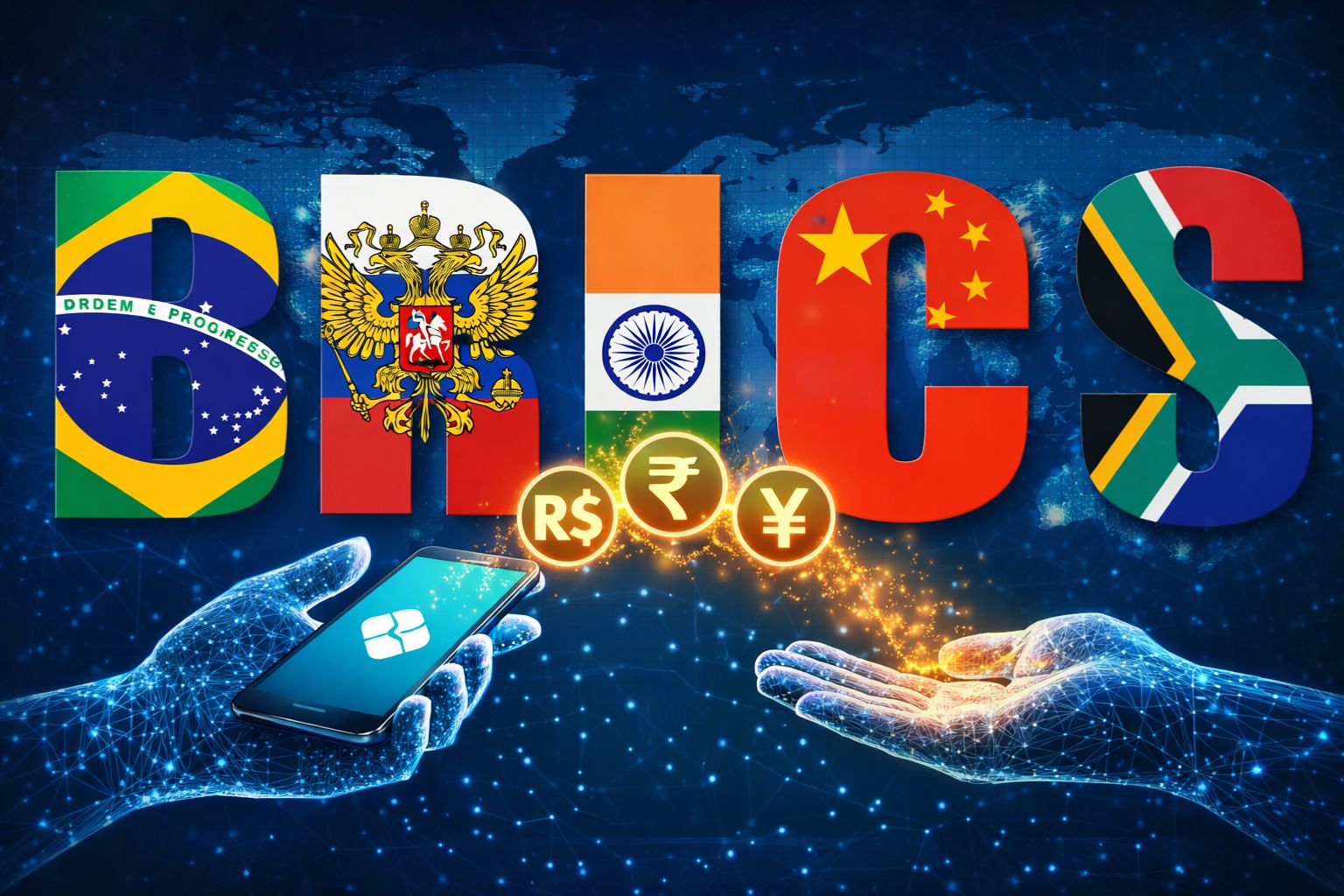


The BRICS advance in creating a cross-border payment system inspired by the Brazilian PIX, using central bank digital currencies (CBDCs) for direct transactions between countries without the need for the dollar. India, which will host the 18th Summit of the bloc in 2026, has prioritized this topic. China and India already conduct 80% of their mutual trade in local currencies.
The BRICS are developing a payment system that could change the way money circulates among the world’s largest emerging economies. The Indian central bank, Reserve Bank of India, proposed during the last summit the creation of a joint payment mechanism among the bloc’s members that operates with national digital currencies, allowing direct country-to-country transactions without needing Western financial systems as intermediaries. The declared inspiration for the system is the Brazilian PIX, and the agenda will be strongly discussed during the 18th BRICS Summit, which will be hosted by India in 2026. What is at stake is not just a payment platform; it is a concrete step to reduce global dependence on the US dollar.
Trade among BRICS members is already moving in this direction. Up to 65% of trade transactions between the bloc’s countries are conducted in local currencies, and China and India, the second and fourth largest economies in the world, already conduct 80% of their mutual trade without using the dollar. However, most BRICS currencies, except for the Chinese yuan, still suffer from limited liquidity, and existing settlement systems remain integrated into Western financial infrastructure. The BRICS payment system aims to resolve exactly this contradiction: countries already trade in local currencies but still rely on platforms controlled by the West to process these transactions.
How the BRICS payment system will work in practice
According to information from Revista Fórum, the model proposed by the BRICS is not a common currency like the euro, but something different and possibly more viable. The system would connect the sovereign digital currencies of each member country, allowing central banks to settle transactions directly with each other, without needing to convert everything into dollars and without using platforms like SWIFT, which is controlled by Western institutions and can be used as a tool for sanctions. In practice, if Brazil wants to pay India for an import, the transaction will be made in digital real and digital rupee, with automatic conversion between the two currencies.
-
Inspired by Brazilian termites, researchers develop microrobots capable of sensing their environment, exchanging signals, and acting collaboratively without relying on a central command

-
SpaceX Prepares Starship for Orbit Completion and Steps Toward Large Cargo Orbital Transport
-
Researchers Develop Densified Wood Structural Nails, Increasing Wall Rigidity and Paving the Way to Reduce Metal Connectors

-
Scientists Create New Cement Type Inspired by Elephant Skin, Absorbing Water in 50 Milliseconds and Cooling Buildings by Up to 20 °C Without AC


The BRICS Payment Task Force has already made progress in defining the “interoperability” of the future system. The leaders’ declaration signed during the Rio Summit in 2025 classified the development of the system as a “strategic priority”, entrusting finance ministers and central bank governors to continue the discussions. The document acknowledged the progress made in identifying “possible pathways to support the continuation of discussions on the potential for greater interoperability of the BRICS payment systems,” a diplomatic language that translates into real technical advancements.
Why the Brazilian PIX is the inspiration for the BRICS payment system

The choice of PIX as a model is not accidental. The Brazilian instant payment system is considered one of the most successful in the world, with over 150 million users and the ability to process transactions in seconds, without traditional banking intermediaries and with virtually zero cost for the user. PIX has demonstrated that it is possible to create an efficient, cheap, and accessible payment infrastructure in a country of continental dimensions.
For the BRICS, the logic of PIX translates to an international scale. If a system can connect millions of people within a country in real-time, the same architecture can be adapted to connect central banks from different countries, allowing cross-border transactions to be as fast and cheap as a PIX transfer between two Brazilians. The difference is that, instead of reais, the system would operate with digital currencies from central banks (CBDCs) of each BRICS member, automatically converting between currencies and eliminating the need for the dollar as an intermediary currency.
The role of China and the digital yuan in the BRICS payment system
China is the most advanced BRICS member in central bank digital currencies. The digital yuan (e-CNY) has already surpassed the trillion-dollar mark in transactions, according to data from the Atlantic Council, and the country is also investing in platforms like mBridge, originally developed with support from the Bank for International Settlements, which allows direct settlements between central banks without intermediary currencies.
For the BRICS payment system, China’s experience is both an advantage and a tension. China’s technological leadership in CBDCs could accelerate the development of the platform, but other BRICS members fear that the digital yuan could end up dominating the system and turning dedollarization into “yuanization,” replacing dependence on one dominant currency with another. The model of interoperability between sovereign currencies, instead of a common BRICS currency, is precisely the solution to this concern: each country maintains its currency, its monetary policy, and its economic sovereignty.
What dedollarization means for BRICS countries
The reduction of dependence on the dollar has been a stated goal of the BRICS for years, and the payment system is the most concrete instrument to achieve it. The countries in the bloc together account for about 30% of all global trade, and every transaction that is no longer intermediated by the dollar reduces the influence of the United States over global financial flows. For nations that have faced or fear facing American sanctions, such as Russia and Iran, this financial independence is a matter of economic survival.
For Brazil, dedollarization has practical implications. Transactions in local currency reduce exchange costs for Brazilian exporters and importers who today need to convert reais into dollars and then into yuan, rubles, or rupees to trade with BRICS partners. A direct payment system would eliminate this double conversion, saving billions in exchange fees and reducing the exposure of the Brazilian economy to dollar volatility.
The challenges that the BRICS still face to launch the system
Despite the advances, the BRICS payment system is not inevitable. The majority of the bloc’s currencies suffer from limited liquidity in the international market, which means that converting large volumes of Indian rupees into South African rand, for example, is still difficult without using the dollar as a price reference. Solving this liquidity problem is the main technical challenge that the Payment Task Force needs to overcome.
There are also political challenges. Harmonizing financial regulations among 11 countries with very different legal systems, monetary policies, and levels of technological development requires negotiations that can take years. Technical interoperability between CBDCs depends on common standards that are still being defined, and each country has different incentives to accelerate or slow down the process. Still, the fact that the BRICS already trade 65% among themselves in local currencies shows that the demand for a proprietary payment system is real, and the 18th Summit in India should bring concrete advances.
The BRICS are preparing a payment system inspired by PIX for dollar-free transactions. Do you think the world should depend less on the dollar? Does this change benefit or harm Brazil? Leave your opinion in the comments.


It’s surprising that you are mentioning Brazilian Pix without mentioning that PIX is actually a literal word-to-word inspiration from INDIA’s UPI system and it has more than 1Billion users (yes 7 times more than Brazil’s PIX) and is already being used in Singapore, UAE, France, Bhutan, Mauritius, Sri Lanka, and Nepal.
How surprising it is that the western media still tries to underplay Indian things just because it won’t go down well with your readers that something from India is going to be the inspiration as the payment method for BRICS currency. PIX as well is inspired from INDIA’S UPI system – not the other way around.
Dear Brazil, I understand your desire to control the world’s economy because you even dug up more than 70,000 meters, mining into the Earth for gold, just to have the largest gold reserve in the world and previously proposed that gold standard back, even if the USA itself already gave rhat up in the 1930s.
Now you and BRICS wish to propose digital currency which you know is of benefit to no one except the app controller of that digital currency.
The pendejo son of Brazil steals even from his own bank and I myself, am a firsthand victim of this. If a Brazilian son of a President cannot even be trusted with running a small legitimate bank, you dare propose a speculative, air based currency to run the global economy. Didn’t China already propose something like that last year? Why are you insisting on your version of it this time.
BRICS might have been better off with that new BRICS currency it came out with in 2024 but please, not another digital currency of any kind o, ok.
Please pay for the USD$2,850,000.oo CD Inheritance due me which your Satanist pendejo son, Luiz Franci Da Silva stole from me, by stealing it from the Finance Officer of the Phoenix Bank of Arizona who handled it.
sai do fake Flávio Bolsonaro, da pra ver que é vc pela tamanha burrice escrita
The western country are a cup up a huge amount in the shape of the money but it the BRICKS country is a good efforts in the payments systems .at the end a country other than European countries are still active with this RRICKS activity behind the financial institution in the world.