






 Portuguese
  Spanish


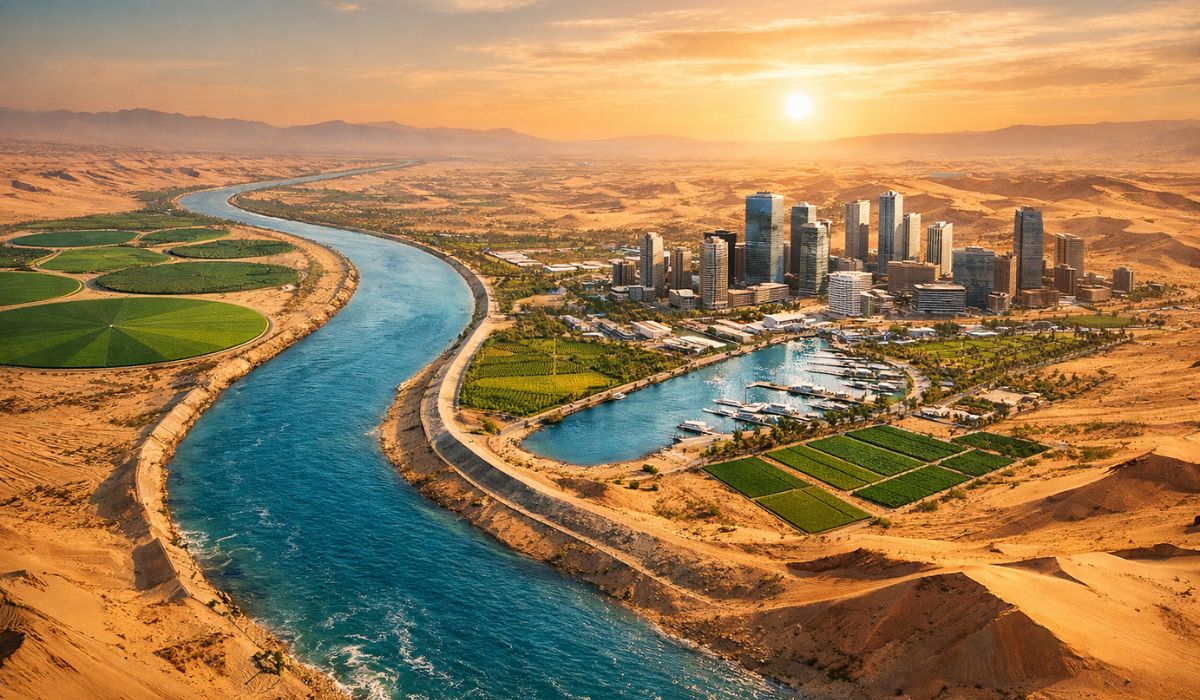


Project in the Egyptian desert puts the use of Nile water, urban expansion in arid areas, and the attempt to integrate infrastructure, agriculture, and the real estate market in the same front of territorial transformation back in focus.
The proposal from Egypt to build the city of Jirian in the desert, west of Cairo, has brought back to the center of debate one of the country’s most sensitive issues: how to expand urban and agricultural areas in an arid territory without increasing pressure on a water system already under strong demand.
The project plans to divert about 10 million cubic meters of Nile water per day to supply the new development and, at the same time, help irrigate the agricultural initiative called New Delta.
According to the government and developers, the new city will occupy 6.8 million square meters and will be located about 42 kilometers from downtown Cairo.
-
She bought a used motorhome at 23, refused an expensive renovation, dismantled furniture from the old apartment, and created a home on wheels with compact carpentry and repurposed pieces.

-
At 7 years old, boy swaps toy cars for raising bantams, dreams of becoming a veterinarian, and conquers the internet with his routine in the countryside of Santa Catarina; meet Luiz Miguel, the “Piá do Garnizé”

-
New York removed the tracks from over 2,500 subway cars and dumped everything at the bottom of the Atlantic, and what seemed like trash turned into an artificial reef teeming with fish and divers.

-
From matches sold by bicycle at age 5 to a global furniture empire: the lumberjack’s son founded IKEA at 17 in his uncle’s kitchen and transformed a small company into the largest furniture retailer on the planet.



More than a real estate project, Jirian has been presented by the government as part of a broader strategy for occupying the Egyptian desert.
The plan includes housing, commercial areas, a marina for yachts, and a free economic zone, in partnership between three private developers and Mostakbal Misr for Sustainable Development, a state agency linked to the Armed Forces.
When announcing the initiative, Prime Minister Mostafa Madbouly stated that the goal is to increase the value of state assets and boost land prices through “non-traditional” and “innovative” ideas.
Nile Water and Pressure on Water Resources
The volume of water projected for the project is one of the central points of the proposal.
The estimated daily flow for Jirian is equivalent, according to the official presentation, to approximately 7% of Egypt’s annual quota from the Nile.
In a country that almost entirely depends on the river, this data helps to gauge the weight of the project in the debate about water use.
The Food and Agriculture Organization of the United Nations, FAO, reports that the Nile accounts for more than 90% of Egypt’s water resources and that the country faces a situation of water stress, with about 500 cubic meters of renewable water per person per year.

New Delta and Agricultural Expansion in the Desert
Jirian was not announced in isolation.
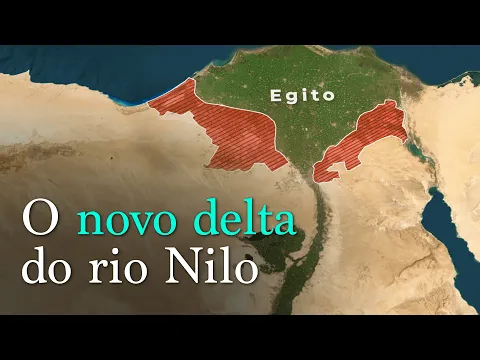
The city is connected to the New Delta, an agricultural expansion initiative in desert areas west of the Nile Delta.
Satellite images analyzed by NASA show that this transformation can already be identified in the territory.
In December 2024, the space agency described the New Delta as an attempt to convert 2.2 million feddans, equivalent to about 9,240 square kilometers, into productive land.
These images help to understand why the issue goes beyond the construction sector.
In Egypt, agricultural expansion in arid regions depends on large-scale water capture, pumping, treatment, and redistribution networks.
This is a complex equation in a country where rain is scarce and naturally fertile soil is concentrated in limited areas of the valley and delta.
FAO also points out that urbanization represents a pressure on Egyptian agriculture, encroaching on some of the country’s most productive land.
In this context, projects like Jirian and New Delta fit into a dual logic.
On one hand, the state seeks to reduce urban pressure on the traditional agricultural strip.
On the other hand, it attempts to bring infrastructure to previously underutilized areas, based on advanced irrigation, water reuse, and large-scale works.
NASA itself recorded that the New Delta relies on a combination of water sources, including recycled water from a large treatment plant, pumping, and connection to a canal fed by the Rosetta branch of the Nile.

Water infrastructure and land planning
It is at this point that Jirian begins to be observed also from the perspective of natural resource management.
In Egypt, the debate about water is directly linked to food security, population growth, and land planning.
FAO data indicates that about 86% of the total water withdrawal in the country is allocated to agriculture.
In another publication, the agency states that Egypt has 55.5 billion cubic meters per year in its allocation from the Nile and that 85% of this volume is consumed by irrigation.
The expectation that water will flow through the new city before moving to agricultural areas also draws attention for its functional and urban role.
In the project design, the canal appears as part of the water infrastructure and, at the same time, as an element of land valuation.
In practical terms, this means integrating supply, landscaping, and urban occupation into a single structure.
Water planning specialists often point out that in arid regions, such projects require continuous monitoring to prevent losses and ensure efficiency in the use of water.
Moreover, the project clarifies how Egypt has been associating urbanization, agriculture, and infrastructure in a single expansion front.
The circulation of water through the desert serves not only a technical function.
It also helps sustain a model of occupation based on opening new areas for housing, production, and investment.
In this type of arrangement, each stretch of canal and each pumping station gains strategic importance.
Urban expansion in Egypt and desert occupation
The case of Jirian also highlights a characteristic of the development model adopted by Egypt in recent years: the central presence of the state in megaprojects and the involvement of agencies linked to the military structure in sectors deemed strategic.
The agency Mostakbal Misr, which represents the public authority in the agreement, is already associated with the advancement of the New Delta.
By combining urbanization, agriculture, and real estate appreciation in a single package, the government aims to transform the desert into an economic asset.
At the same time, the initiative revives an old guideline of Egyptian territorial policy: to expand occupation beyond the narrow fertile strip of the Nile Valley.

The difference now lies in the scale of the works and the combination of technologies employed.
Treatment stations, artificial canals, satellite images, and more complex irrigation systems have begun to integrate this type of expansion.
Still, the starting point remains the same: a predominantly arid country, with a large population and a strong dependence on a single river.
For this reason, Jirian has been monitored not only as a real estate venture but also as part of a broader territorial experience.
The new city is part of a discussion that involves the limits of water engineering, the reorganization of urban space, and the use of desert areas to increase agricultural production.
In the Egyptian case, this process is underway and combines infrastructure works, state planning, and redistribution of water resources.
When a country that relies almost entirely on the Nile decides to direct some of that water into the desert and use it as the axis of a new urban and agricultural front, the project begins to be seen as an indicator of the strategic choices made to deal with scarcity, growth, and land occupation.





An illusion any creature could experience! It your dream, you could dream the Nile water flows from Egypt to Ethiopia, instead of the natural line, from Ethiopia to Egypt! Ethiopia is the source of the Nile water!
Good job. ቅዱስ ስሪሕ. This is what good leaders should do for their people. if the down stream states like 🇪🇬 are using the coming water like this, then think how the river source states like 🇪🇹 are so idle in using their water for irrigation and drink while large areas their lands are bare due to water stress, people and animals suffering from shortage of water
Parem com este absurdo! O Nilo não é nada sem o Abay, um rio na Etiópia que contribuiu com 85% da sua água. Não existe nenhum tratado colonial! Temos agora o Acordo-Quadro Abrangente (CFA).
Retirar 10% do Nilo não é aceitável, talvez fosse se tivessem outro Nilo.
Repare, existem realidades atuais neste mundo, especialmente no **** de África e nos países do Alto Nilo. Há a GERD e outras GERD a caminho.
O Egito pode usar a sua influência.