Portuguese
  Spanish


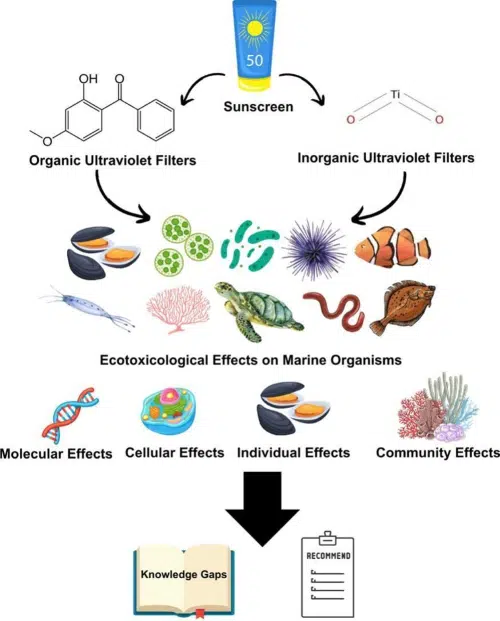

Discover How UV Filters in Sunscreens Threaten Marine Life by Affecting Corals, Fish, and Mollusks
The sunscreens, essential for protecting the skin from ultraviolet rays, are raising concerns among scientists and environmentalists. Their UV filters, found abundantly in the oceans, threaten marine biodiversity.
A study conducted by researchers from the Plymouth Marine Laboratory and the University of Plymouth, published in the Marine Pollution Bulletin, revealed that these chemicals are accumulating in the environment and may have toxic effects on many marine species.
Corals, fish, and mollusks are among the affected species. These toxic and persistent compounds interfere with reproduction, cause oxidative stress, and accumulate in the food chain.
-
In the Desert, Nearly Black Solar Panels Could Trigger Rainfall: Researchers Aim to Prove if Heat from Solar Farms, Combined with Humid Winds and Artificial Dunes, Can Generate Clouds in Arid Regions

-
Electric Vehicle Repairs Cost 23% More, But the Battery Isn’t to Blame
-
China’s Solar Panel Installation in Desert Unintentionally Alters Soil, Moisture, and Vegetation Dynamics

-
China’s Plan to Prevent Giant Asteroids from Hitting Earth Involves Deep Nuclear Blasts and 20 Years of Preparation




Urgent and Widespread Impact of UV Filters
With thousands of tons of UV filters being released annually into coastal waters, the situation has become urgent. This problem is not limited to tourist areas. Studies show that contamination reaches isolated regions, highlighting its global dispersion.
The inefficiency in wastewater treatment, combined with the persistent nature of these compounds, increases concern. The bioaccumulation of these emissions in the food chain also raises questions about risks that have not yet been fully understood.
UV Filters: Essential Yet Dangerous
The UV filters, essential in sunscreens, function by absorbing or reflecting ultraviolet rays. They are divided into two categories: organic (chemical) and inorganic (mineral).
Among the organic ones, oxybenzone stands out, both for its widespread use and associated risks. Classified as persistent and bioaccumulative, it accumulates in organisms and the environment.
Studies indicate that this substance harms the endocrine system of fish and corals, causing deformities in coral larvae.
The inorganic filters, such as titanium dioxide (TiO₂) and zinc oxide (ZnO), are considered safer. However, under certain conditions, they can generate free radicals.
This causes oxidative stress and cellular damage in marine organisms. The lack of research on the long-term impact of these compounds makes a complete risk assessment difficult.
Corals in Danger
Corals, highly sensitive to UV filters, undergo accelerated bleaching when exposed to high concentrations of these compounds.
This seems to result from the disruption of the symbiotic relationship between corals and zooxanthellae, microscopic algae essential for energy supply.
Oxybenzone penetrates coral tissues, alters metabolism, and results in discoloration and loss of vitality.
In addition to bleaching, UV filters compromise the renewal of reefs by affecting the development of coral larvae.
The difficulty of these larvae in settling on marine substrates puts the continuity of these fragile ecosystems at risk.
Impacts on Fish and Invertebrates
Marine fish and invertebrates also suffer from the presence of UV filters. Some fish species show reduced fertility and embryonic malformations. There are also hormonal imbalances, characterized as endocrine disruption.
In mollusks and crustaceans, oxidative stress induced by UV filters results in cellular damage and weakened immune defenses.
Toxicity intensifies with the interaction of these compounds with other marine pollutants, such as hydrocarbons and heavy metals. This makes the assessment of environmental impact even more complex.
Alarming Dispersion and Persistence
The UV filters from sunscreens reach the oceans in various ways. Contamination occurs directly, when people enter the sea wearing sunscreen, and indirectly, when washing off at beach showers or laundering clothes and towels with product residues.
Once in the marine environment, these compounds accumulate and resist natural degradation processes.
Even conventional wastewater treatments, such as ozonation, are ineffective at removing these pollutants.
Ozonation, widely used in treatment plants, fails to degrade the UV filters, allowing their infiltration into aquatic environments.
Contamination Beyond the Oceans
The issue extends beyond the oceans. Some treated wastewater is reused in agriculture. The transparency and fertilization of soil with sewage sludge lead to the dispersion of UV filters in cultivated areas.
These compounds accumulate in soil and crops, potentially entering the food chains consumers may ingest. Thus, the risk extends to end consumers, including humans.
The co-author of the study, Awadhesh Jha, emphasizes that the bioaccumulation of these polluting substances in the food chain is still poorly understood scientifically. However, environmental and health risks may be underestimated.
With the increasing demand for solar products and the growth of coastal tourism, the contamination of aquatic and terrestrial environments is likely to worsen.
With information from Science-et-Vie.