
Study conducted in the Qinghai Gonghe photovoltaic park compared the area under the panels with neighboring regions and found better ecological performance within the plant, but the researchers themselves call for long-term monitoring
A desert area in China covered by solar panels has drawn attention for an effect that goes beyond electricity generation. In the Qinghai Gonghe photovoltaic park, in Talatan, researchers found signs of improvement in the local microclimate, soil conditions, and diversity of plants and microorganisms.
The study was published in 2024 in the Scientific Reports journal, part of the Nature group, and analyzed the ecological impact of the plant based on 57 indicators. The area directly occupied by the panels had a higher environmental score than the neighboring regions used for comparison.
The result does not mean that covering deserts with solar plants is an automatic solution for recovering degraded areas. The study itself treats the case as a specific evaluation, conducted in a region of high altitude, dry climate, and a history of desertification.
-
China’s Plan to Prevent Giant Asteroids from Hitting Earth Involves Deep Nuclear Blasts and 20 Years of Preparation

-
Google Invests Billions in Italian Island’s Innovative Energy Storage Using Liquid CO2 Technology

-
LG Unveils 670-Liter Multidoor Refrigerator in Brazil with Transparent “InstaView” Panel, Independent Temperature Zones, and Smartphone Control, Starting at $15,100
-
Scientists Convert Common Plastic into Synthetic Graphite for Electric Car Batteries, Paving the Way for High-Value Recycling




Even so, the data shows a concrete phenomenon. The shadow of the panels reduced soil evaporation, altered the temperature near the surface, and created more favorable conditions for vegetation in a place where wind, intense solar radiation, and lack of water have always hindered plant growth.
The solar park did not just change energy production
The case cited by Xataka Brasil on July 7, 2026, is based on the Qinghai Gonghe photovoltaic park, located in Qinghai province, in northwest China. The report highlighted that the plant was analyzed in three different areas: the region under the panels, a transition zone around it, and an external control area.
The difference appeared in the numbers. The plant area, referred to in the study as WPS, obtained an index of 0.439, classified as “general.” The transition zone scored 0.286 and the external area 0.28, both classified as “poor.”
The scale does not measure landscape beauty or energy production. It gathers environmental and ecological data to compare how the space behaves after the installation of the panels. The central point is that the area covered by the panels showed better conditions than the immediate surroundings.
This result draws attention because large solar plants in deserts are usually seen only as a way to make use of less productive land. In Qinghai, researchers observed that the physical structure of the panels also began to directly interfere with the environment.
The shadow of the panels became a kind of shelter for the soil
The explanation starts with something simple: shade. Photovoltaic modules block part of the direct solar radiation, which reduces soil moisture loss through evaporation. In dry areas, this difference can alter the behavior of plants, microorganisms, and the top layer of the soil.
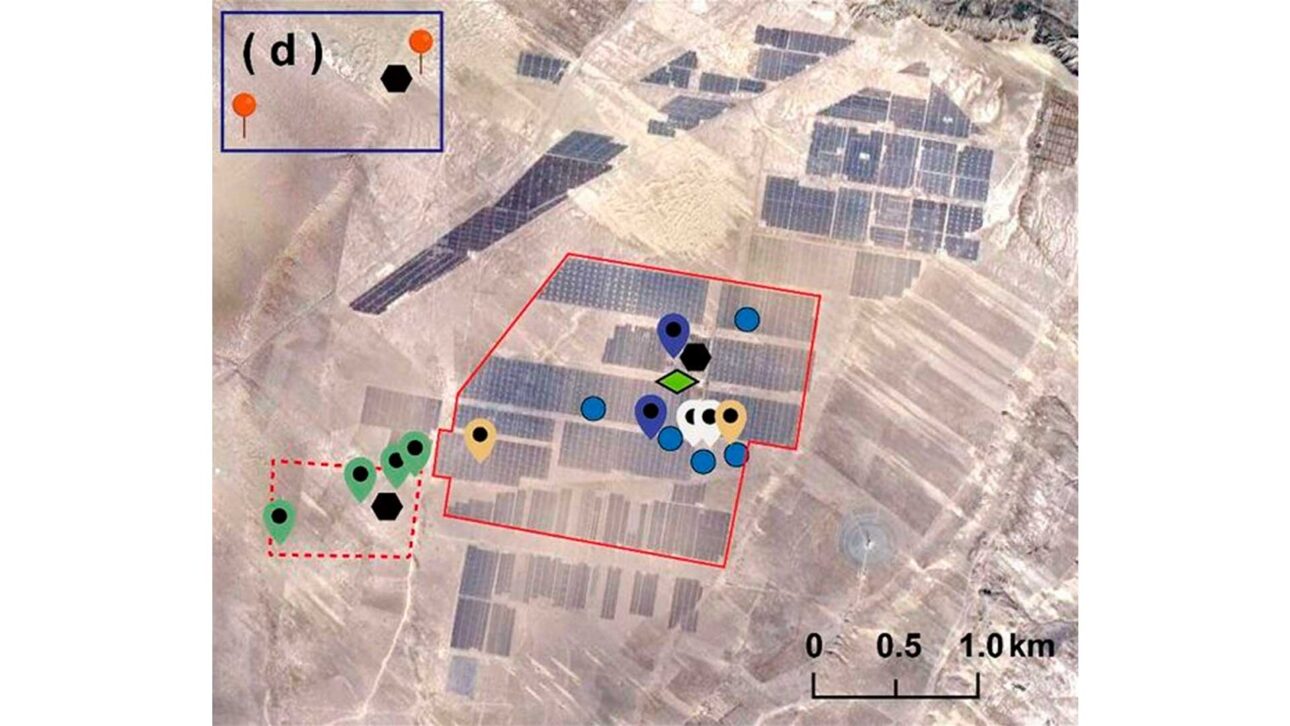
According to pv magazine, the research was conducted by scientists from Xi’an University of Technology at a 1 GW facility in the arid alpine desert of Talatan, comparing the plant area with transition zones and external areas. The analysis used the DPSIR model and gathered monitoring data, official documents, samples, and field investigation.
In practice, the panels act as a partial barrier against sun and wind. The water used to clean the modules can also infiltrate the soil, increasing moisture in the areas just below the structures.
This combination helps to understand why vegetation grew better within the solar park. It was not just the presence of the panels, but the set formed by shade, wind reduction, soil management, and water used in maintenance.
The Talatan desert already had a long-standing degradation problem
Talatan is located at almost 3,000 meters altitude and had a severe history of desertification. According to information published by the Chinese government portal in June 2024, the area’s desertification rate reached 98.5% at the end of the last century, before the expansion of solar projects in the region.
The same survey cites a solar base of 609 km², with a capacity of 8,430 MW at that time. Remote sensing data reported by a team from the State Power Investment Corporation and Xi’an University of Technology indicated a reduction of 50% in wind speed, a drop of 30% in soil moisture evaporation, and 80% vegetation cover in the park in the previous three years.
These numbers help explain why the case became a reference in debates about solar energy in arid areas. The park not only generated electricity but also reduced wind-induced erosion and helped stabilize the terrain.
Even so, there are limits. A wetter area under panels can favor plants, but it can also create new operational problems, such as excessive grass growth, shading of the panels, risk of hot spots, and the need for constant management.
Sheep factored into the solar plant
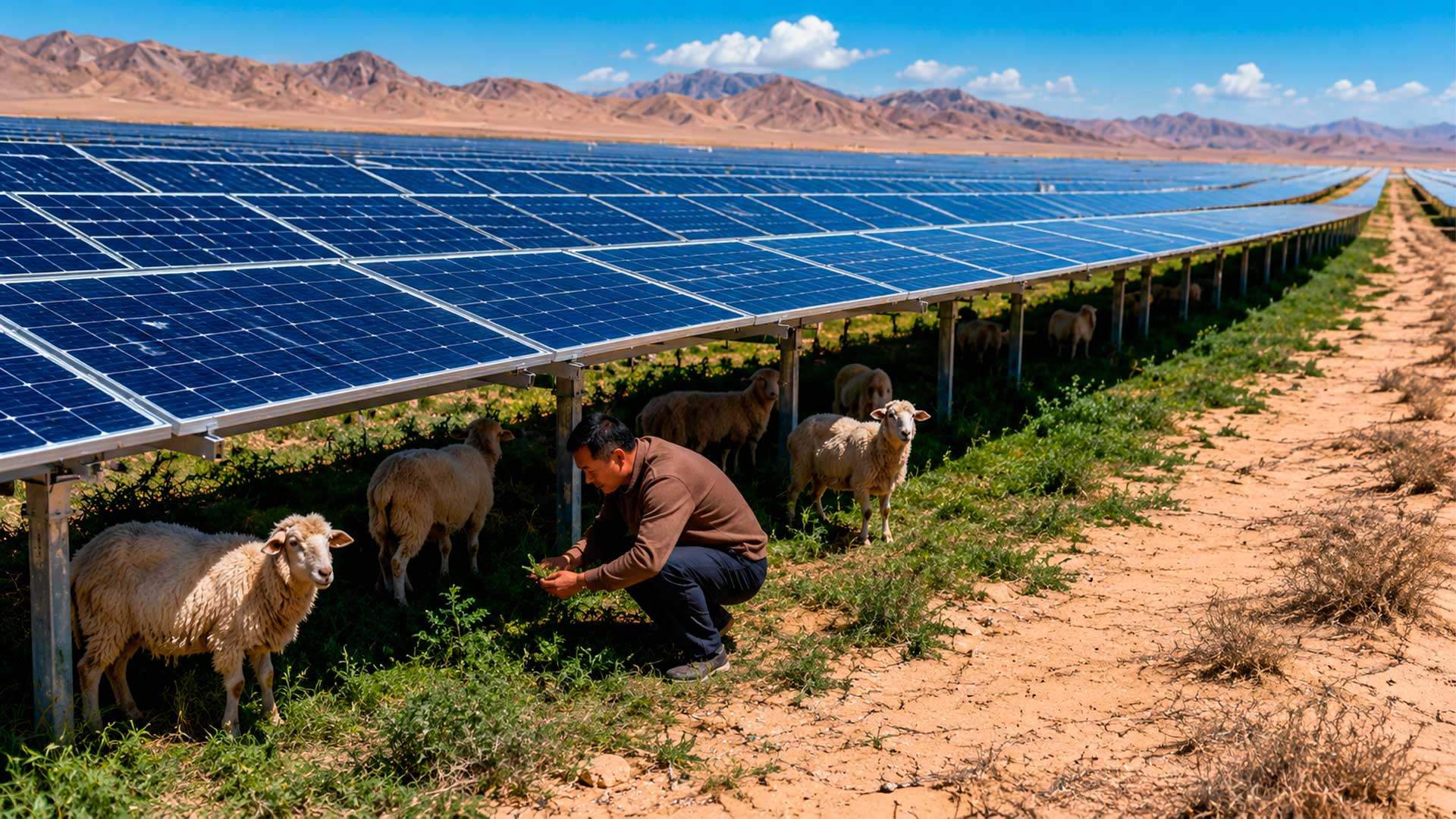
With more vegetation, an unexpected problem arose: the grass needed to be controlled so as not to hinder generation. Instead of relying solely on manual mowing or herbicides, operators began using controlled grazing with sheep.
The People’s Daily Online reported in July 2025 that the park in Talatan gathered 68 photovoltaic companies by the end of 2024, with a grid-connected capacity of 17.73 million kW. The publication also stated that the area produced 118,000 tons of grass per year, enough to feed 200,000 sheep, according to local authorities.
This model became known in China as “photovoltaic sheep” farming. The animals eat the vegetation under the panels, reduce maintenance costs, and help prevent the grass from growing to the point of shading the modules.
For local communities, the change also brought income. The Chinese report mentions jobs in new energy projects in 2024 and the presence of ecological pastures within the park, linking solar generation, desertification control, and livestock farming.
The method used in the study did not only look at plants
The scientific assessment was not limited to counting leaves or measuring shade. The DPSIR model, used by researchers, organizes environmental impacts into five dimensions: driving forces, pressures, state, impact, and response.
The European Environment Agency describes DPSIR as a framework of indicators used to organize relationships between human activities and environmental changes, with categories ranging from causes to responses adopted by society.
In the case of Qinghai Gonghe, the 57 indicators underwent standardization and weight calculation. This allowed for comparing the environmental performance of the area under the panels with the surroundings, even when the data had different units.
The indicators included factors related to the local climate, physical and chemical properties of the soil, biodiversity, vegetation, microorganisms, environmental investment, and control measures. The result favored the plant area, but did not place it in an excellent condition.
The result is encouraging, but it does not close the discussion
The strongest point of the study is showing that a solar plant in a desert environment can alter the soil in a measurable way. The discovery gains weight because China has rapidly expanded solar energy in recent years, and large arid areas have come to be seen as strategic locations for large-scale projects.
The International Energy Agency maintains updated data on new solar and wind energy additions in China between 2024 and 2025, a sign of the speed with which the country has been expanding this type of infrastructure.
But the case of Talatan should not be read as a universal rule. Deserts have soils, winds, temperatures, biodiversity, and rainfall regimes that are very different from each other. What worked in Qinghai may not be repeated in the same way in the Sahara, the Atacama, the Middle East, or the Brazilian semi-arid region.
Researchers also point out that environmental pressure has not disappeared. Some indicators remained low, and long-term effects still need to be monitored to prevent initial gains from hiding future negative impacts.
The main lesson is more practical than spectacular. Solar panels can generate energy and, under certain conditions, create enough shade to reduce evaporation, protect the soil, and favor vegetation. For this to become public policy or an exportable model, it will be necessary to measure case by case, for years, with data on soil, water, fauna, flora, and plant operation.
What do you think of this model of solar park in desert areas? Could it be a solution to recover degraded soils, or are there still little-known environmental risks?