Portuguese
  Spanish


Three-year project aims to test if solar panels, artificial dunes, and humid sea winds can increase rain in coastal deserts. The hypothesis from the University of Hohenheim will be investigated on the Arabian Peninsula with 3D measurements, LiDARs, and high-resolution climate models, without promise of immediate real results.
Solar panels may cease to be seen only as electricity-generating structures and enter a bolder climate hypothesis: helping to form clouds and rain in coastal deserts. The idea will be investigated by researchers from the University of Hohenheim, on the Arabian Peninsula, in a three-year project.
According to Sonnenseite, in a publication on May 16, 2026, the research from the University of Hohenheim aims to confirm a theory presented by Oliver Branch and Volker Wulfmeyer. The topic was also covered by TechRadar, in a report published on April 15, 2026, focusing on the effect of dark panels on desert rain.
Heated solar panels can create air currents in the desert
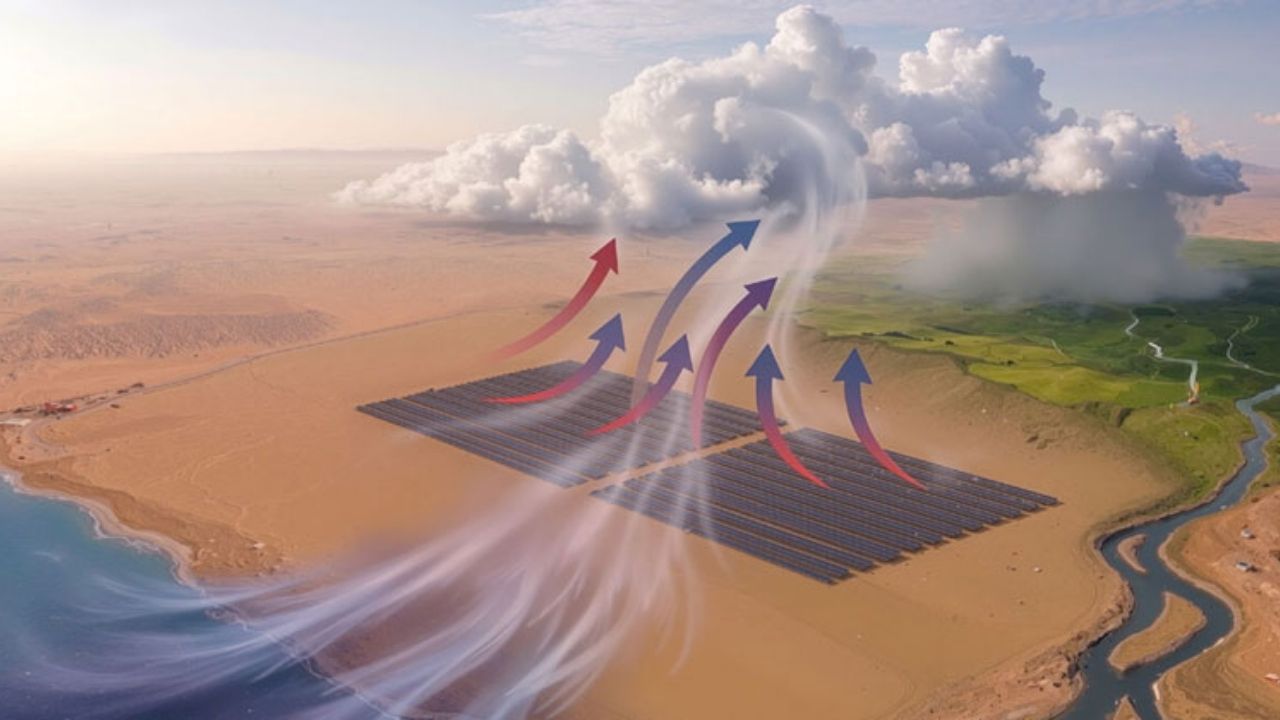
The logic of the study starts from a simple physical difference: dark surfaces heat more than the light desert sand. When large areas are covered by almost black solar panels, the air above these modules can become warmer than the surrounding air.
-
Electric Vehicle Repairs Cost 23% More, But the Battery Isn’t to Blame

-
China’s Solar Panel Installation in Desert Unintentionally Alters Soil, Moisture, and Vegetation Dynamics

-
China’s Plan to Prevent Giant Asteroids from Hitting Earth Involves Deep Nuclear Blasts and 20 Years of Preparation
-
Google Invests Billions in Italian Island’s Innovative Energy Storage Using Liquid CO2 Technology



This heated air tends to rise, increasing turbulence and drawing in humid winds from the sea. If the vertical movement is strong enough, the moisture can reach higher layers of the atmosphere, where condensation and cloud formation occur.
Artificial dunes would act as an extra trigger for clouds
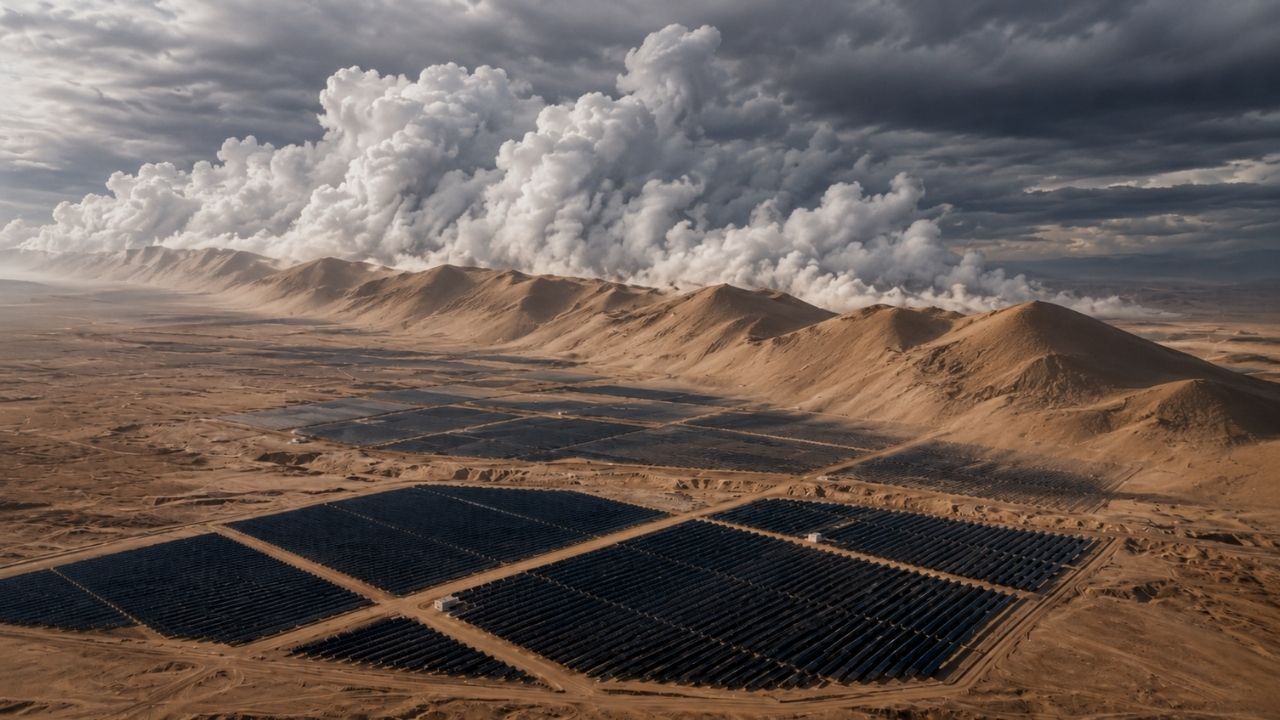
In addition to solar panels, researchers are also studying the possible role of artificial dunes several hundred meters high. The idea is that these structures act as obstacles in the path of the winds, pushing the air upwards similarly to what happens in mountainous regions.
According to Volker Wulfmeyer, research on mountain peaks shows that wind currents can collide, rise, and favor the formation of clouds and rain. The proposal of artificial dunes attempts to reproduce part of this effect in coastal deserts, but still needs to be tested with more detailed measurements and simulations.
Three-year project will measure wind, humidity, and temperature in 3D
The University of Hohenheim plans to use LiDAR systems, laser technology capable of measuring temperature, humidity, and wind dynamics in three dimensions. These devices will be installed near existing solar parks to observe the real behavior of the air between the park, the coast, and the layers where clouds form.
The goal is not only to confirm if the phenomenon can happen but to understand on what scale it would have enough strength to alter precipitation. Researchers want to know what size, shape, and location would make solar panels and artificial dunes more efficient in stimulating rain.
Climate models will simulate scenarios with high resolution
With the data collected in the field, the team intends to develop high-resolution computational models. These models will be adjusted with real measurements and then used to predict what would happen if a solar park were expanded or if an artificial dune had another shape.
According to the text from Sonnenseite, the modeling could represent climate patterns with a resolution of up to 100 meters, using high-performance computers. This is essential because the theory seems simple, but depends on local details, such as sea breeze, accumulated heat, available humidity, and design of the structures.
Previous simulations indicated effect from large solar farms
TechRadar reported that researchers modeled solar panels as almost black surfaces, capable of absorbing 95% of incident sunlight. In the cited simulations, the effect gained strength when solar parks exceeded 15 square kilometers.
In a solar field of 20 square kilometers, the model indicated an increase of almost 600,000 cubic meters of precipitation under ideal conditions. The estimate was compared to 1 centimeter of rain falling over an area the size of Manhattan, but this result still comes from modeling, not from a proven large-scale operation.
United Arab Emirates fund research, but maintain cloud seeding
The project received support from the United Arab Emirates Rain Enhancement Science Research Program. The program funds international research aimed at scientific methods to increase precipitation in deserts and semi-deserts.
Even so, the country remains committed to cloud seeding, with about 300 missions per year, according to TechRadar. This detail shows that the hypothesis involving solar panels and artificial dunes does not yet replace already used methods but enters as a complementary possibility to be tested.
Large solar plants near Dubai aid the study
A favorable point for the research is the presence of some of the largest solar plants in the world in the United Arab Emirates. Among them is the Mohammed bin Rashid Al Maktoum Solar Park, near Dubai, cited as an advantage for the Hohenheim team.
The existence of these structures allows for the study of real solar parks in a coastal desert region, where humid winds can come from the sea. Without this combination of heat, scale, and humidity, rain formation would be much more difficult, even with dark panels and artificial dunes.
Idea could change the role of solar farms in dry regions
If the hypothesis is confirmed, solar farms could gain an unexpected role in arid regions: besides producing electricity, they would help create local conditions for rain in very specific scenarios. Even so, researchers treat the topic as scientific investigation, not as a ready solution.
There are also important limitations. Many modern solar panels are designed to reflect part of the radiation and reduce heating, which could weaken the studied effect. Therefore, the central question now is whether the phenomenon can move from simulation to appear in the real desert.
What this climate gamble brings into discussion
The possibility of solar panels and artificial dunes stimulating rain mixes renewable energy, climate engineering, and water security. In places where almost nothing falls from the sky, any method capable of increasing precipitation sparks interest but also requires caution.
Do you believe that using large solar farms to try to create rain in the desert is a promising solution or a risky interference in the climate? Leave your opinion in the comments and join the discussion.