






 Portuguese
  Spanish


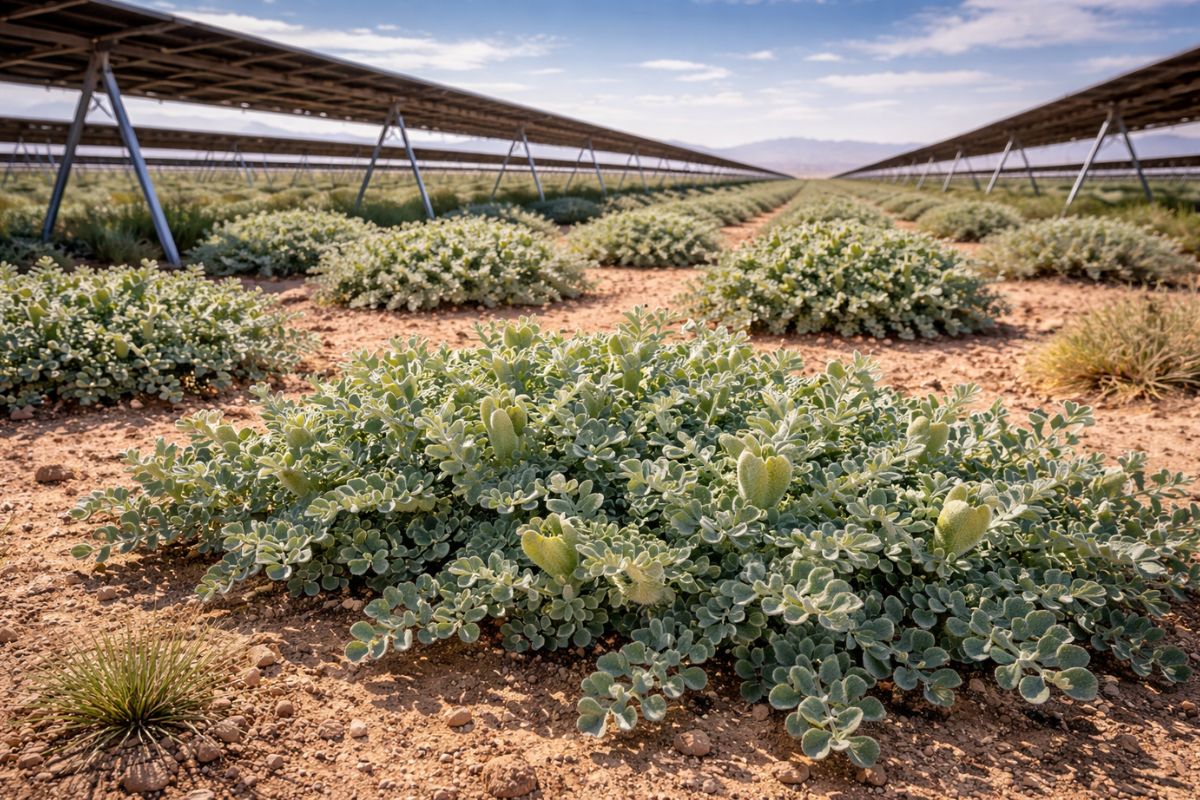


Panels In The Nevada Desert Generate Energy And, At The Same Time, Create Shade, Maintain Moisture, Preserve Seed Bank And Make Rare Native Species Prosper
A new study showed that a rare native plant multiplies eight times after the installation of solar panels in the Nevada desert. Instead of treating the area as “empty,” the case reinforces that there is an entire ecosystem at work, with dormant seeds and species that only appear when conditions become favorable.
The result draws attention for a simple reason: solar energy did not need to destroy the soil to work. With an approach associated with ecoverts, the panels also began to act as microclimate generators, helping to maintain the life that was already there, including a seed bank that preserves the biological memory of the environment.
Living Desert, Not Empty: What Is Hidden Beneath The Soil
The Mojave Desert is often described as hostile and nearly barren, but the foundation makes it clear that the reality is more complex. Beneath the rugged appearance lies a network of plants, animals, and dormant seeds, waiting for the right combination of rain and temperature to germinate.
-
China Develops Custom 140-Ton Electric Mining Truck with 770 kWh Swappable Battery, Deploys 290 Units in Xinjiang’s Largest Zinc Mine

-
Meta to Launch Arena, a New Prediction App Targeting 3.56 Billion Users, Competing with Polymarket and Kalshi

-
Scientist Challenges Famous Human Evolution Theory, Argues Homo Sapiens Evolved Gradually Over Thousands of Years
-
15-Year-Old American Builds Ocean Generator with PVC Pipe and 3D-Printed Propeller for $12, Wins National Prize, Presents at White House, and Makes Forbes 30 Under 30 List




Among the species mentioned is the three-angled astragalus, a rare legume that grows close to the ground and relies on a typical dry-zone strategy: waiting.
It can remain “invisible” underground until conditions allow it to bloom, bear fruit, and reproduce, making the environment highly sensitive to interventions that remove vegetation and disturb the soil.
The Problem of “Leveling and Plowing” In Solar Projects
For decades, many solar energy projects in arid regions have adopted the technique known as “leveling and plowing.” The logic is quick and efficient for construction, but ecologically, the cost can be high.
When vegetation is removed and the soil is leveled, not only the visible plants disappear. The seed bank, which holds the ecosystem’s regenerating capacity, can also be destroyed. And without this seed bank, the life that would remain “on pause” loses the chance to return when the rain arrives.
The Gemini Case: What Changed In The Nevada Desert
In the outskirts of Las Vegas, Nevada, the Gemini solar project followed a different path. Instead of wiping out the landscape, the foundation states that the project was adapted to the local fauna, avoiding the total destruction of habitat and preserving the soil’s recovery potential.
The impact appeared in the count of the rare species. Before construction, scientists located 12 specimens of three-angled astragalus.
After the project began operations in 2024, the number rose to 93. In the Nevada desert, this is not a detail: it’s a scale change for a rare plant.
Shade And Moisture: Why The Plant Grew Bigger And More Productive
The foundation indicates that the plants under and between the panels did not only become more numerous. They also grew larger, taller, and more productive, with more flowers and fruits than plants in nearby areas without solar installations.
The explanation is straightforward: the partial shade from the panels reduces evaporation, conserves soil moisture, and creates a less extreme microclimate.
In the Nevada desert, where water is scarce and rain dictates the rhythm of everything, reducing moisture loss changes the game.
Ecologist Tiffany Pereira from the Desert Research Institute highlights a crucial point: the seed bank survived the construction.
And this applies not only to the three-angled astragalus but also to other native plants that are now germinating, with the soil remaining intact.
Ecovoltaics In Practice: Solar Energy Without Destroying The Soil
The case reinforces a growing idea described in the foundation: solar plants do not have to be dead spaces. Ecoverts propose designing photovoltaic installations that coexist with local ecosystems, integrating native species and supporting pollinators, birds, and small vertebrates.
The logic is not “landscaping” or decoration. It is functional. By considering the ecosystem as part of the project, the infrastructure starts generating energy and, at the same time, acts as a life support in an extreme environment.
Ecologist Lee Walston from the Argonne National Laboratory summarizes the point with a question that guides the entire discussion: if we build with nature in mind, does it respond? The evidence from this case suggests that it does.
What This Can Change In The Environment In Arid Areas
The foundation points to potential impacts that are quite concrete for ecoverts in arid environments. They can reduce soil degradation, contain erosion, and maintain biological cycles that support biodiversity.
By preserving seed banks and promoting more stable microclimates, such installations can act as climate refuges against rising temperatures and irregular rainfall.
Moreover, increased vegetation cover tends to improve carbon retention in the soil, enhance microbial activity, and strengthen a more complete food chain. It is not pure restoration, but it is an intelligent way to prevent an already fragile ecosystem from deteriorating further.
Do you think solar energy projects in the Nevada desert and other arid areas should adopt ecoverts as a rule, or does this make projects too expensive and slow down construction?






ESSE É O CAMINHO PARA TODA RECONSTRUÇÃO DOS BIOMAS DA TERRA.
É a natureza verde desenhando o que de e ser preservado