Portuguese
  Spanish




Discovery Beneath The Croatian City Of Osijek Reveals Seven Skeletons Of Roman Soldiers Thrown Into A Well In The 3rd Century, Possibly Killed In The Bloody Battle Of Mursa During The Crisis Of The Third Century
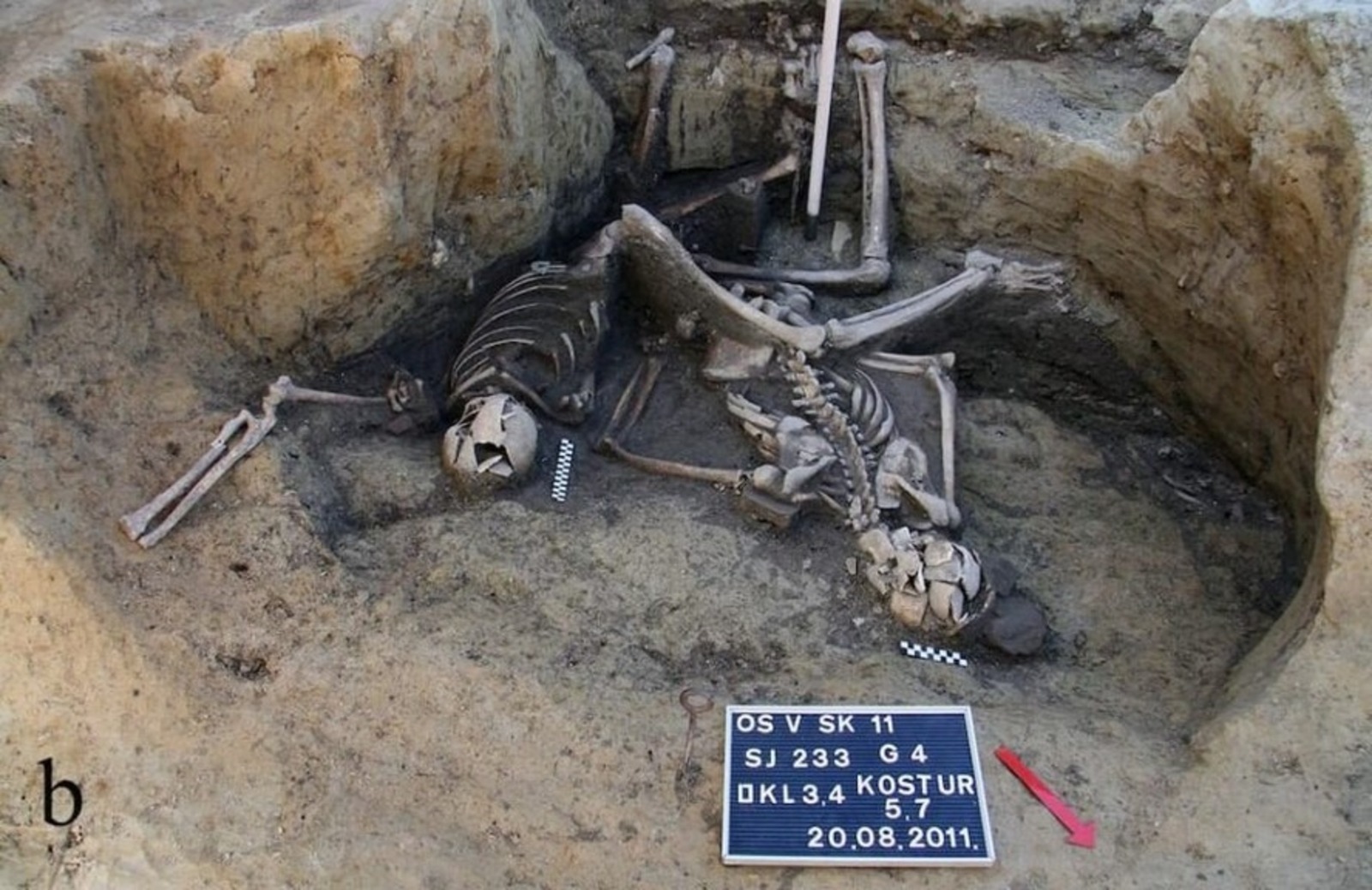
An ancient water well in eastern Croatia has revealed one of the darkest scenes of the Roman period. During archaeological excavations in Osijek, where the city of Mursa used to be, researchers discovered seven skeletons of adult men thrown three meters deep. Analyses indicate that they were Roman soldiers killed in combat during the turbulent Crisis of the Third Century.
An Unexpected Finding Beneath The City Of Osijek
The well, identified as “SU 233/234”, was discovered in 2011 during the construction of a new university library.
At the time, the archaeological team noted that the ancient reservoir had been reused as an improvised burial site, where the bodies were thrown without any ceremony.
-
The battery that promises to change cell phones and electric cars still has a microscopic enemy: researchers discover how lithium dendrites pierce the solid electrolyte and are already testing ways to prevent cracks and short circuits.

-
An old ferry rusted for more than 10 years in New York, almost sank after the engine room was flooded, and now volunteers are rushing to clean the hull, remove wires, life jackets, and loose paint before sinking it in the Atlantic to become an artificial reef full of marine life.

-
SpaceX launch turned Falcon 9 into a giant jellyfish in the night sky, with a colorful plume illuminated by the Sun at high altitude, confusing observers and showing how a routine flight can become a rare spectacle of atmospheric physics over Earth.
-
Advancement in science: a new plastic developed by researchers in the USA combines structural strength and thermal blocking in a single technology, opening new possibilities for construction, transportation, electronics, and sustainable solutions with a direct impact on global energy efficiency.


These skeletons were intact but disposed of chaotically. Some were upside down, others overlapping, suggesting a hasty burial.
A curious detail reinforced the date of the tragedy: a coin minted in AD 251, found among the bones, linked the episode to the second half of the 3rd century.
The discovery led to a comprehensive investigation involving archaeology, physical anthropology, isotopic analyses, genetics, and studies of bone trauma.
The results were published in the journal PLOS ONE on Wednesday (15), revealing strong evidence that the skeletons belonged to soldiers killed in the Battle of Mursa in AD 260.
Brutal Injuries And Military Life Traces
The anthropological analysis showed that all individuals were adult men. Four were between 18 and 35 years old, and three were between 36 and 50.
The physical stature was robust, with signs of repetitive stress on the bones and joints — typical of those undergoing intense military training.
Three exhibited severe injuries. One of them, identified as SK 4, had a deep cut on the humerus, a puncture in the sternum caused by a piercing weapon, and a dental fracture.
Another, SK 5, had a puncture in the hip, likely the result of a blow from behind.
These perimortem injuries, caused shortly before death, indicate that they died in direct combat.
Furthermore, all showed signs of pulmonary infection, suggesting respiratory illnesses common among soldiers living under severe campaign conditions.
The researchers highlight that the combination of evidence — war injuries, military age, and hasty burial — is consistent with executions or deaths on the battlefield.
An Army Composed Of Various Origins
The genetic analysis brought another impressive finding. None of the seven had a direct connection to the local Iron Age population.
Their origins were diverse: there were genetic traces from Northern Europe, the Black Sea, the Eastern Mediterranean, and Central Europe.
This variety reflects the multicultural composition of Roman armies at the time. The Empire recruited warriors from various regions, including Sarmatians, Gauls, and Saxons, to strengthen its ranks and maintain control of the borders.
According to the magazine La Brújula Verde, this heterogeneity was a prominent feature of the late Roman army, which had become dependent on foreign peoples to sustain its military campaigns.
Roman Skeletons: The Link To The Battle Of Mursa
The location of the mass grave and the period of the remains coincide with the Battle of Mursa, fought between Emperor Gallienus and General Ingenuus, a usurper who attempted to take the throne.
Historical sources report that after the victory, Gallienus ordered the execution of the surviving rebel army members.
The seven men from the well in Osijek may therefore have been followers of Ingenuus, killed and discarded after the defeat.
Bioarchaeologist Mario Novak, from the Institute of Anthropological Research in Zagreb and co-author of the study, summed up the conclusion: “The composition of the group — men of military age, with battle injuries and hasty burial — is almost identical to that observed in mass graves from historical conflicts.”
The finding, therefore, not only sheds light on the Battle of Mursa but also offers a rare glimpse into the brutality and diversity that marked the decline of the Roman Empire.
With information from Revista Galileu.