






 Portuguese
  Spanish


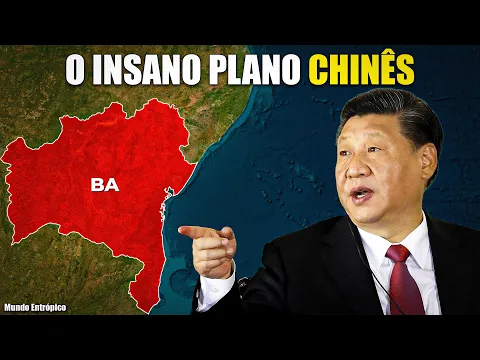
In Less Than A Decade, Megaprojects, Maritime Routes, And Factories Transformed Bahia Into One Of The Main Destinations Of Chinese Capital In Brazil. This Presence Is Shaping The Economy, Infrastructure, And Regional Politics.
Bahia has become one of the main hubs of Chinese presence in Brazil, with a set of construction projects, logistics routes, and industrial plants that have advanced rapidly in recent years.
The movement combines political alignment between the state government and Chinese companies, geographical advantages, and a productive diversification agenda that positioned the state on strategic trade routes.
According to experts, the phenomenon also raises discussions about economic dependency and social and environmental impacts.
-
Brazil’s 2026 Tax Refund: Record 9.58 Million Filers in Largest Payout Ever, But a Key Detail on Priority Recipients Draws Nationwide Attention

-
Itaú Alters Hybrid Work Model, Increasing Office Days from 2028, Prompting Employees to Adjust to New Routine
-
Facing Labor Shortage, Japan Plans to Invest $34 Million to Attract Foreign Workers in Construction, Healthcare, Industry, and Commerce

-
Brazilian City Makes Remarkable Leap, Becomes 4th Wealthiest in the Country with GDP of R$ 134.1 Billion




How The Bahia–China Approach Began
According to a report published by Construction Time, cooperation gained momentum from official missions and direct dialogue between the Bahia government and major Chinese groups, with technical meetings in Beijing and Salvador.
Even during moments of diplomatic tension between Brazil and China, Bahia maintained communication with investors.
The resumption of high-level dialogue after 2023, with official trips and negotiations involving priority projects, consolidated this rapprochement.
In 2025, for instance, Governor Jerônimo Rodrigues met with executives from China Communications Construction Company (CCCC) and China Civil Engineering Construction Corporation (CCECC) to discuss the next steps for the Salvador–Itaparica Bridge.
Logistics And Foreign Trade: The “Golden Channel”
According to an investigation by Construction Time, Bahia’s Atlantic position and the state’s port infrastructure gained prominence with the operation of a direct maritime route between Gaolan (Zhuhai) and Salvador, known as the “Golden Channel”.
The connection, inaugurated in 2025, also serves Santana (AP), reducing costs and transport time between Brazil and Asia.

Foreign trade specialists assert that this connection strengthens Bahia’s position as a strategic point for the flow of grains, minerals, and manufactured products.
Salvador–Itaparica Bridge: Chinese Megainvestment
In an interview with Construction Time, state authorities highlighted that the Salvador–Itaparica Bridge is the most emblematic project of this new phase of cooperation.
With 12.4 km in length over water and an estimated investment of R$ 11 billion, the project will be carried out by a consortium led by Chinese companies.
The agreed schedule in 2025 foresees the beginning of work fronts starting in 2026, after the completion of the executive project.
The state government estimates the creation of thousands of jobs and a direct impact on tourism and mobility between Salvador and the Recôncavo.
FIOL And Porto Sul: The Behind-The-Scenes Of Bahia Infrastructure
The channel also pointed out that the West-East Integration Railway (FIOL) and Porto Sul, both located in the Ilhéus region, form the planned logistics axis to transport ore and grains from the interior to the Atlantic.
Currently, the FIOL 1 (Ilhéus–Caetité) segment is operated by Bahia Mineração (Bamin), controlled by Eurasian Resources Group (ERG) from Kazakhstan.
In 2025, the Ministry of Transport initiated discussions about a redesign of the concession, which may involve Vale and adjustments to the governance model.
According to infrastructure specialists, Chinese interest in the bioceanic corridor — which would connect the Atlantic to the Pacific, up to the Port of Chancay (Peru), operated by Cosco — is in the study phase and is part of a strategy for continental logistics integration.
Automotive Industry And Innovation: BYD Leads The Way
In the industry, the installation of the BYD complex in Camaçari, at the site left by Ford, marked a new phase of automotive production in the state.
In October 2025, the company inaugurated the largest electric vehicle factory in Latin America, with an initial capacity of 150,000 units per year and plans for expansion.
The automaker also presented a flex plug-in hybrid model, which combines ethanol and electricity, technology developed for the Brazilian market.
The total investment is around R$ 5.5 billion, with expectations of creating thousands of direct and indirect jobs.
According to automotive sector specialists, the project reinforces Bahia’s role as a hub of innovation and industrial diversification.
Renewable Energy And Clean Technology
The Chinese presence also extends to the renewable energy sector.
Windey has installed a research and development (R&D) center at Senai Cimatec in Salvador, focused on turbine technologies and storage systems.
Goldwind has projects for wind generation and, in partnership with CGN Brasil, is developing a energy storage system at the Tanque Novo Wind Complex in the interior of the state.
According to sector data, these initiatives consolidate Bahia as one of Brazil’s hubs for clean energy.
Why Bahia Attracts So Much Chinese Investment
The Chinese presence in the state is explained by a combination of factors.
First, the institutional alignment: Bahia governments have maintained constant dialogue with Chinese authorities and companies since the mid-2000s, providing stability to long-term projects.
Second, the logistical advantages: the Atlantic coast, the direct route to China, and the port infrastructure favor cargo movement and foreign trade.
Furthermore, Bahia brings together natural resources and a diversified productive base, highlighting agribusiness in the western part of the state and the industrial park in Camaçari.
These factors, according to international trade analysts, reinforce the interest of Chinese investors.
Governance And Sustainability Challenges
Experts in economics and international relations note that the influx of foreign capital, especially from China, brings opportunities and challenges.
The concentration of investments in sensitive infrastructure requires transparency and management mechanisms to avoid dependency imbalances.
The restructuring under discussion for the FIOL and Porto Sul demonstrates, according to analysts, the need for contractual adjustments and environmental impact assessments.
In ecological terms, clean energy projects coexist with developments that generate controversies among local communities and regulatory agencies.
As highlighted by Construction Time, the Chinese presence in Bahia reflects a global strategy for economic and logistical insertion.
The future of this relationship will depend on the execution of projects, the governance of contracts, and the state’s ability to ensure lasting benefits.
Experts question whether Bahia is facing a new phase of sustainable development or a model of external dependency rehashed in new forms.









O governo deveria valorizar o Planser que era no passado,extremamente valorizado pela rede privada dos hospitais!A saúde estar em primeiro lugar,para depois a educação e a segurança. Se toda essa história de investimento chinês, não for uma pura enganação que seja bem vindo e que não seja uma novela de muitos capítulos!
A fábrica da byd não produz nada, é para chinês ver!