





 Portuguese
  English
  Spanish
  5 min of reading
  0 comments


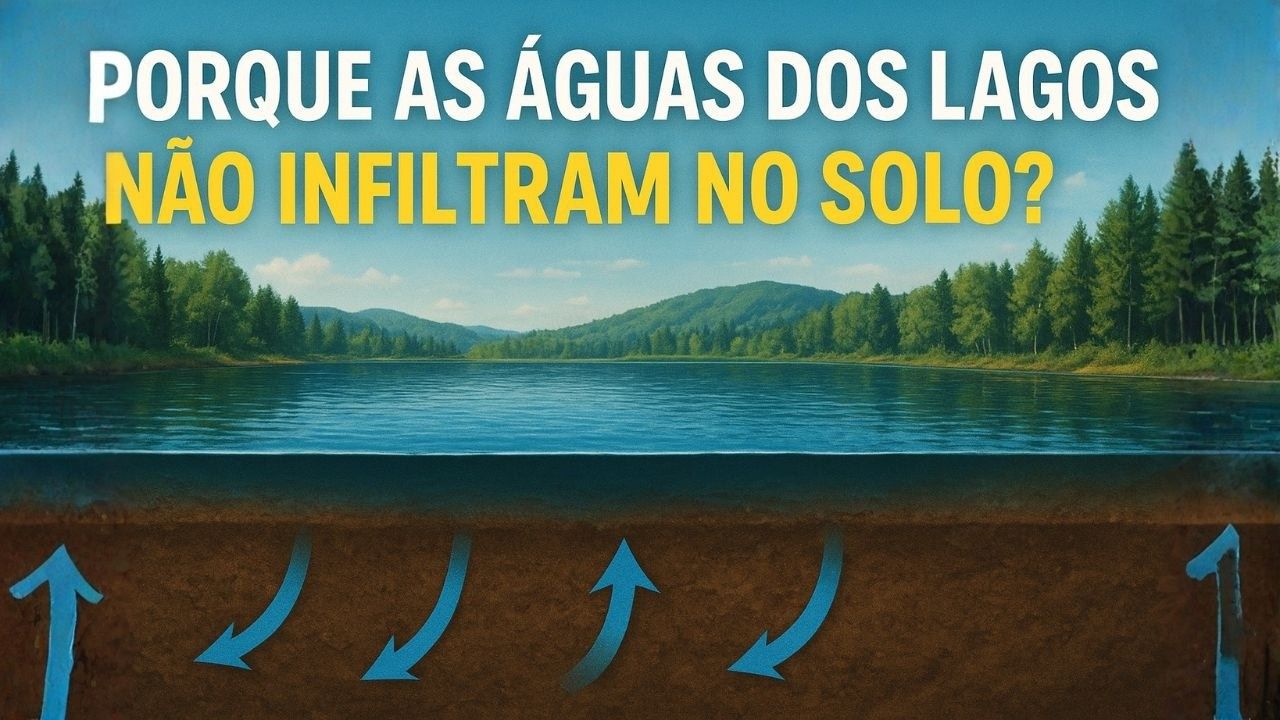
Lakes Around The World Seem To Challenge Logic: Even Though They Are Supported By Soil And Rock, Lakes Do Not Disappear Like Puddles Of Water In Sand. Science Shows That This Is Not A Coincidence, But The Result Of Natural Processes That Create True Impermeable Barriers At The Bottom Of These Water Reserves.
When we look at a large body of fresh water surrounded by land, the question seems inevitable: why do lakes not disappear by infiltrating into the soil, like water that quickly disappears in the sand of a beach or river? If all the lakes on the planet drained all of a sudden, the impact on ecosystems, animals, local climate, and even human supply would be tremendous.
The good news is that this does not happen for a very specific reason. There Is A Set Of Natural Mechanisms That Ensures That Lakes Do Not Disappear, even suffering from infiltration, evaporation, and climate changes. From the natural impermeabilization of the bottom to connections with the aquifer, science can now explain in detail how the water remains there, in balance, for thousands or even millions of years.
How Nature Makes Lakes Not Disappear
The starting point to understand why lakes do not disappear is to look at the bottom. When a lake forms, it is not just a “basin” full of water. Over a long time, fine particles of clay, silt, and organic matter accumulate in the bed.
-
Scientists discover hidden hot water traps beneath Antarctica and reveal why the ice may be melting much faster than it seemed

-
At 55 meters and 240 tons, the US places the USX-1 Defiant in the sea, a military ship without a bridge, without a kitchen, and without space for crew, designed to operate alone on long-duration missions.

-
Fog that many people see as a simple “smoke” may be alive, full of bacteria, and even cleaning air pollution without anyone noticing.
-
Appliance that many people leave plugged in should be turned off after use to avoid an increase of up to 12% in the electricity bill and internal damage caused by electrical fluctuations, technicians warn.


These materials accumulate, compact, and form an almost impermeable layer, which acts like a natural tarp. As the centuries pass, this layer becomes denser, drastically reducing the passage of water to deeper layers of soil. It’s as if nature is gradually building the lake’s “lining.”
Natural Impermeabilization: The “Tarp” That Holds The Water
In many cases, it is not just the sediment that helps explain why lakes do not disappear. Beneath the sediments, there may be impermeable rocks, such as certain types of very compacted clay or crystalline rocks.
These rocks act as a physical barrier, preventing water from infiltrating to deeper levels. The Pressure Of The Water Column Itself Helps To Compact These Layers Even More, reinforcing the impermeable effect. Thus, while infiltration does occur, it happens at such a slow pace that it is easily compensated by the inflow of water from other sources.
Lakes Do Not Disappear Because They Are In Constant Balance

Even with all this natural protection, some water always infiltrates and evaporates. The secret lies in balance. Lakes Do Not Disappear Because They Receive Water From Several Sources At The Same Time, such as:
- direct rain on the surface
- rivers and streams that flow into the lake
- springs that emerge from the bottom or margins
- input from the aquifer itself
When the amount of water coming in compensates for or exceeds what leaves through infiltration and evaporation, the lake remains stable. It is this dynamic balance that allows lakes to stay in the same place for thousands of years, even with variations in levels over the seasons.
Aquifer: The Invisible Support Below Lakes
Another important concept to understand why lakes do not disappear is the so-called saturated zone of the soil. Below a certain depth, all spaces between soil and rock particles are filled with water. This is what we know as the aquifer.
When a lake forms in an area where the aquifer is close to the surface, it begins to “communicate” with this underground water. In many cases, the lake functions as the exposed part of this aquifer. Thus, it is not that the water is trying to “escape” downwards, but rather that the aquifer itself helps sustain the lake’s level, acting as a natural support.
Lakes That Last Millions Of Years
With all these combined mechanisms, it is no surprise that some lakes remain stable for impressive periods. There Are Lakes That Have Been In The Same Place For Millions Of Years, thanks to natural impermeabilization and the balance with the aquifer.
A classic example is Lake Baikal in Russia, which is over 25 million years old. Over this time, geological, sedimentary, and hydrological processes have been continuously acting to keep the water there, demonstrating just how efficient these natural systems are.
When Engineering Copies Nature

Not all lakes rely solely on natural processes. In artificial reservoirs, such as dams and ponds, engineering often needs to “mimic” the mechanisms that cause lakes not to disappear in nature.
To achieve this, geomembranes and other impermeable materials are used at the bottom and sides, reducing infiltration. In some cases, local clay is compacted in a controlled manner to reproduce the effect of the thin, impermeable layer that forms naturally in ancient lakes.
Without these precautions, an artificial reservoir could lose water at a much faster rate than desired, compromising supply, irrigation, or energy generation.
Why It Matters To Understand Why Lakes Do Not Disappear
Knowing why lakes do not disappear is not just scientific curiosity. Lakes are key pieces of ecosystems:
- they are home to a great biodiversity of fish, plants, and microorganisms
- they help regulate the local climate, storing heat and moisture
- they serve as reservoirs of fresh water for human communities
- they act as areas for recreation, tourism, and even scientific research
Even with so much “natural engineering” working in favor of the water’s permanence, lakes are vulnerable to human action. Pollution, deforestation of the margins, and uncontrolled land use can alter sediments, water quality, and even the balance with the aquifer, putting at risk systems that took thousands of years to stabilize.
Therefore, understanding how lakes do not disappear also helps to comprehend why it is so important to protect them. When we destroy the edges, silt the bottom, or contaminate the water, we are interfering precisely with the barriers and processes that keep these environments alive and stable.
And you, have you ever stopped to think about why lakes do not disappear and what role they play in your region?







-

-

-

-

9 people reacted to this.