






 Portuguese
  Spanish


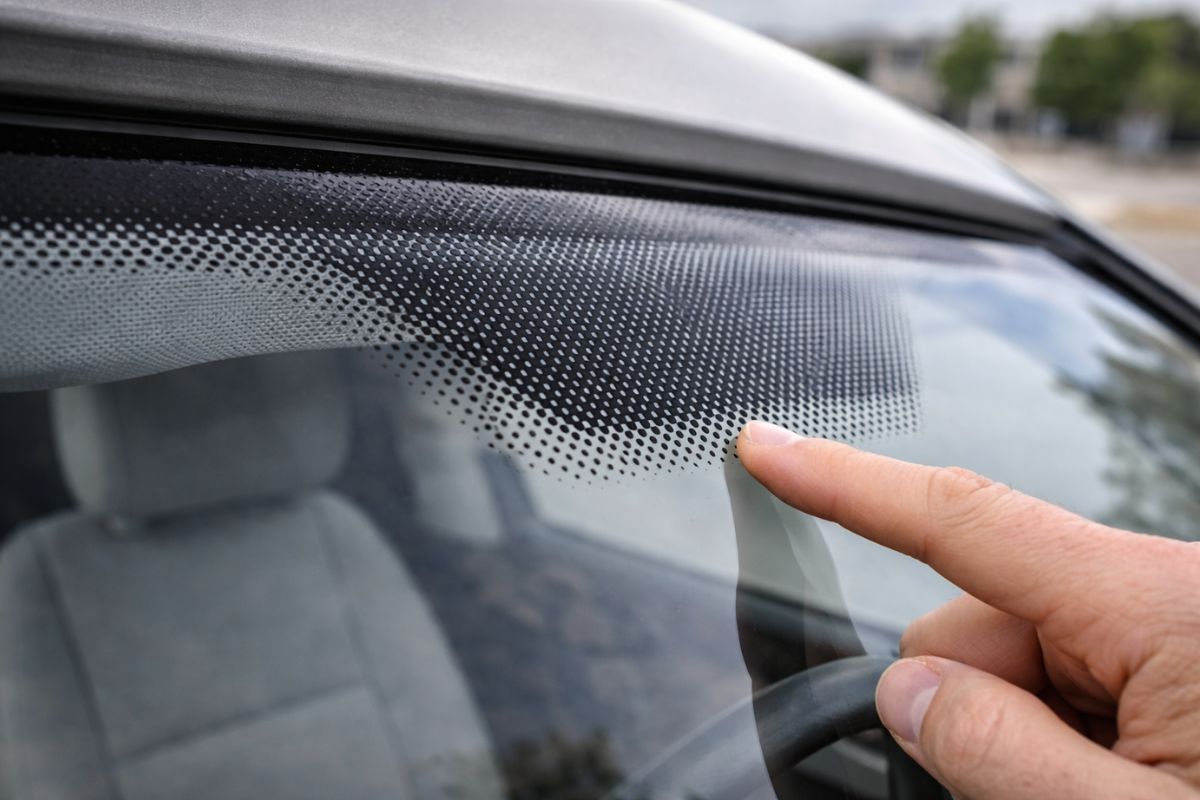


The Dots on the Car Glass Are Part of a Ceramic Frit That Protects the Windshield, Reduces Cracks on the Windshield, and Improves the Work of Sensors on the Windshield.
Few people notice, but the dots on the car glass are part of an engineering solution designed to protect the windshield and those inside the vehicle. They help keep the glass secure to the body, reduce the risk of cracks, protect the adhesive, and also hide sensors and components that are located at the edge.
At first glance, this set of small black circles seems just an ornament, but the dots on the car glass form a gradient made with special ceramic paint, “burned” at high temperature, which controls heat variations, improves the durability of the assembly, and also contributes to the visual comfort of the driver.
What Are the Dots on the Car Glass
When we talk about dots on the car glass, we are referring to that sequence of small black dots that appears near the edge of the windshield and, in many cases, on the other windows of the vehicle.
-
BYD Owners in Brazil Raise Concerns Over Warranty After 87,000 km, Two Repairs in Three Days, and Over $500 in Costs

-
Classic Volkswagen Beetles of Brazilian Presidents to Swap Museums in Historic Partnership

-
British Factory Transitions from Mechanical Parts to Producing 420,000 Electric Power Units Annually, Supplying 70% of Ford’s Electric Cars Sold in Europe
-
Toyota Shifts from Hybrid Cars to Electric Air Taxis with Joby’s 6-Rotor Aircraft, Capable of 322 km/h, Aiming for Mass Production to Electrify Urban Skies


In the industry, this pattern is known as ceramic frit or frit band. Instead of a common paint applied to the surface, a special ceramic paint is deposited on the glass and then goes through a high-temperature burning process.
After burning, this ceramic paint fuses with the glass and becomes practically part of it, without peeling or losing adhesion over the years.
The design is also calculated. In the area closest to the edge, there is a solid black band, and right next to it appears the area where the dots on the car glass are more concentrated and become spaced out as they approach the transparent part.
This gradient is not just aesthetic; it prepares the transition between two very different zones of the glass.
What Are the Dots on the Car Glass For
The most important function of the dots on the car glass is related to the safety and durability of the windshield.
The solid black band that is at the edge of the glass absorbs much more heat than the central transparent part.
If the transition between one area and another were abrupt, the temperature difference would create a region of concentrated stress at the edge.
In this condition, rapid temperature changes, such as pouring cold water on a hot glass or leaving the car in strong sunlight and then using the maximum air conditioning, could cause cracks precisely where the glass is most stressed.
The dots on the car glass act as a kind of “thermal ramp”, gradually spreading the heat between the black band and the transparent glass, reducing thermal shock and helping to prevent cracks.
Additionally, this fritted area protects the area where the windshield adhesive is applied. A well-glued windshield is essential for the structural integrity of the vehicle, as many modern cars have the front glass as part of the body rigidity and as support for the proper functioning of front airbags.
The better this edge is protected against excessive heat and premature aging, the greater the chance that the assembly will remain secure and safe over the years.
How the Dots on the Car Glass Help with Comfort and Aesthetics
In daily life, the dots on the car glass also directly influence the visual comfort of the driver.
The gradient transition between the black band and the transparent glass softens the contrast at the edge of the field of vision. This avoids a “hard cutoff” of light and shadow, which could cause discomfort or distractions when the driver looks at the edge of the windshield.
In certain lighting situations, this dotted area helps reduce glare and make the interior visually more pleasant, especially when sunlight strikes the edge of the glass.
The eye adjusts better to this smooth transition than to a rigid boundary between black and transparent.
The aesthetic function is also relevant. The dots on the car glass help hide the windshield adhesive, which usually forms a visible and not always beautiful line.
They disguise imperfections in cutting and finishing at the edge of the glass and also conceal sensors, mirror bases, internal cameras, adhesive supports, and parts of the body structure that would be visible without this resource.
For those who enjoy seeing all this in practice, the channel Leo650f Foco e Fé, aimed at fans of automotive content and with over 68,000 subscribers, presents a visually educational explanation.


In the video, he shows how the dots on the car glass work together with the black band to influence visibility and the finishing of the windshield, reinforcing that it’s not just a design detail.
How the Automotive Industry Designs These Dots
In current automotive engineering, the windshield has ceased to be just an item of transparency and has taken on structural and safety functions.
In many vehicles, the windshield contributes to the rigidity of the body, influences the car’s behavior in impacts, and also serves as a base for assistance systems and airbags.
Therefore, the dots on the car glass are the result of a joint project between vehicle manufacturers and companies specialized in automotive glass.
The design of the frit band, the intensity of the gradient, the type of ceramic paint, the application method, the combination with the bonding sealant, and the strength tests are all defined.
All of this is planned so that the glass can withstand temperature variations, body twists, impacts from small stones, and natural aging over the years.
In many models, the dots on the car glass also delimit areas where sensors and cameras are installed, helping to reduce reflections on the lens and ensuring a more protected environment against intense light, such as in automatic braking systems, lane assist, and rain or light sensors.
In this way, the ceramic frit takes on a direct role in the performance of these systems.
Care for the Windshield and the Dots on the Car Glass
Even though they are very resistant, the dots on the car glass are part of a sensitive area of the vehicle, where the structural adhesive and important components are located.
They do not require specific maintenance, but some general care for the windshield helps to preserve this critical area.
When cleaning, it is important to avoid excessively abrasive products on the edge of the glass and over the black band, so as not to compromise the visual aspect and the surface integrity of the ceramic frit.
Applying films, adhesives, or supports directly over sensors, cameras, and critical areas without technical guidance can also interfere with the functioning of these systems, in addition to harming aesthetics.
In case of windshield replacement, it is ideal to seek specialized services that use the appropriate sealant, follow the curing time recommended by the manufacturer, and respect the specifications of the original glass, including the pattern of the dots.
Cracks, even small ones, should be evaluated quickly by a professional, especially if they appear in the edge area, where the dots on the car glass work together with the adhesive to keep the assembly secure.
When you understand this entire context, it becomes clear that the dots on the car glass are not a mere finishing detail, but part of an engineering solution that combines protection, comfort, aesthetics, and structural safety.
And you, after knowing all this, will you look at the dots on the car glass differently or do you still think they are just an unimportant embellishment on the windshield?


