






 Portuguese
  Spanish
  5 min of reading
  0 comments


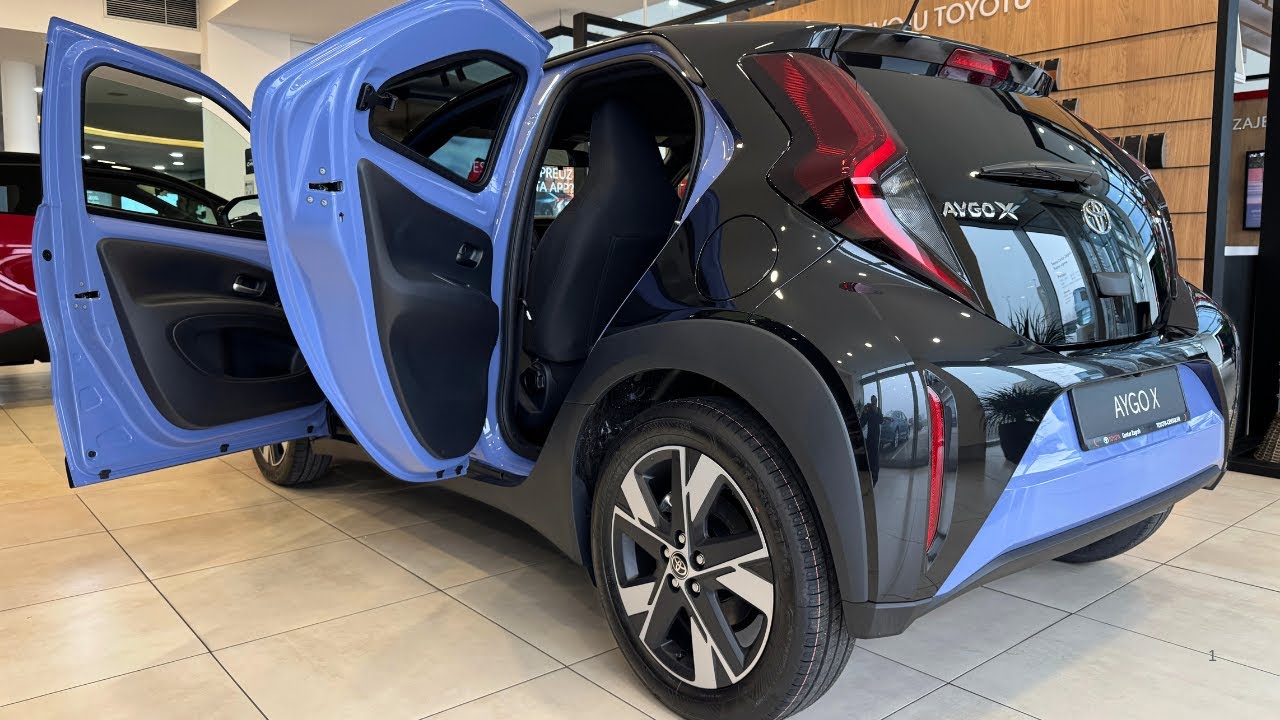
Toyota Aygo X Hybrid debuts in Europe with 1.5 hybrid engine, up to 116 hp, high consumption and an unprecedented urban proposal outside Brazil.
Toyota decided to transform one of its smallest European cars into a full hybrid. The new Toyota Aygo X Hybrid 2026 has arrived in the European market with an electrified set derived from the Yaris, power of 116 hp, extremely low consumption and a total focus on urban use. The model does not exist in Brazil and occupies a rare space in the current market: that of a compact hybrid crossover designed for congested cities, narrow streets, and low emissions. According to Toyota Europe, it is the first full hybrid in the European A segment.
The Aygo X stands out because it mixes compact dimensions with hybrid technology usually reserved for larger and more expensive cars. In some European markets, the starting price ranges around € 20,000 to € 24,000, equivalent to approximately R$ 120,000 to R$ 146,000 in direct conversion, depending on the version and the country.
Toyota Aygo X Hybrid was created for European cities with intense traffic and environmental restrictions
The Aygo X was born as a European urban compact, but Toyota decided to completely update the project by adding a more advanced hybrid system.
-
Three doors, concept look, and FIPE value of R$ 62,524: The 2013 Hyundai Veloster delivers a 1.6 engine with 140 hp, a 6-speed automatic transmission, and a design that still seems too strange to go unnoticed.

-
A Land Rover that used to do 1.8 km per liter now does 8 km per liter after a 34-year-old Kenyan engineer installed an ECU he designed himself, which is already being ordered from Zambia, Canada, and Pakistan.
-
Cheaper than new HB20, Onix, and Argo, this German sedan offers a 510-liter trunk, a 2.0 naturally aspirated engine, a 6-speed Tiptronic automatic transmission, and well-known mechanics; the 2016 Volkswagen Jetta Comfortline still attracts attention in the used market.

-
A mechanic opened the engine compartment of an 11-year-old Ford to replace a part and found a wallet with money, gift cards, and the badge of the worker who had assembled that car at the factory.



The new hybrid generation replaced the old 1.0 aspirated engine with an electrified 1.5-liter set, making the car much more powerful and efficient. According to Toyota Europe, the goal was to increase urban performance without drastically raising consumption or emissions.


This move also follows the new European environmental rules, which pressure manufacturers to reduce average CO₂ emissions in their urban vehicles. The result was a small automatic hybrid crossover with extremely low consumption by current standards.
The 1.5 hybrid engine delivers 116 hp and made the compact much faster than the previous model
The new Aygo X Hybrid uses a hybrid set similar to that applied in larger Toyota models, such as the Yaris Hybrid. According to Toyota Europe, the system delivers 116 hp of combined power, a significant increase compared to the old combustion Aygo.
With this, the compact car now accelerates from 0 to 100 km/h in about 9.2 seconds, performance well above what is expected for an urban car of this size. The transmission is an automatic e-CVT type, a traditional solution from Toyota hybrids, focused on smoothness and efficiency in daily use.
Consumption can exceed 27 km/l in some European cycles
Fuel consumption is one of the biggest selling points of the Aygo X Hybrid. According to Toyota UK, the model achieves up to 76.3 mpg in the European WLTP cycle, a figure that translates to approximately 27 km/l in direct conversion.
Data released in Germany indicates consumption between 3.7 and 3.9 liters per 100 km, which is also close to this extremely economical range. Toyota also states that the Aygo X can operate in pure electric mode for much of urban traffic, especially at low speeds and in traffic jams.

Another important aspect of the Aygo X Hybrid is its emissions. Toyota Europe claims that the model presents about 85 g/km of CO₂, one of the lowest rates among non-plug-in vehicles in the European market.
This figure is strategic because many European countries use emissions to define taxes, incentives, and urban circulation restrictions.
In practice, this helps transform the Aygo X into a car designed to withstand environmental tightening in large European cities.
The model measures less than 3.8 meters and remains extremely compact
Even with a larger hybrid engine, the Aygo X maintained very small dimensions. According to technical data released in model presentations, it has about 3,700 mm in length, approximately 1,740 mm in width, and 2,430 mm in wheelbase.

This places it well below the compact SUVs sold in Brazil. Toyota’s proposal is precisely to offer an elevated driving position and crossover look without turning the car into a large utility vehicle.
Technical specifications of the Toyota Aygo X Hybrid 2026
| Item | Toyota Aygo X Hybrid |
|---|---|
| Country where available | Europe |
| Category | Hybrid urban crossover |
| Engine | 1.5 full hybrid |
| Combined power | 116 hp |
| Torque | Approximately 144 Nm |
| Transmission | Automatic e-CVT |
| Drive | Front |
| Length | About 3,700 mm |
| Width | About 1,740 mm |
| Height | About 1,525 mm |
| Wheelbase | 2,430 mm |
| Trunk | 231 liters |
| CO₂ emissions | About 85 g/km |
| Consumption | Up to approximately 27 km/l |
| 0–100 km/h | About 9.2 seconds |
| Maximum speed | Approximately 172 km/h |
| Price in Europe | About € 20,000 to € 24,000 |
| Equivalent price in reais | Approximately R$ 120,000 to R$ 146,000 in direct conversion |
Values may vary depending on the country, version, and local European taxes.
The Aygo X has become a kind of “mini hybrid SUV” from Toyota in Europe
Although technically an urban compact, Toyota positions the Aygo X as a crossover. The model uses elevated suspension, plastic moldings on the wheel arches, a higher driving position, and a look inspired by the brand’s larger SUVs.
This helps explain why it ended up occupying a different space from the old traditional Aygo. The car also received versions like the GR Sport, with visual adjustments and firmer suspension aimed at sportier drivability.
The model does not exist in Brazil and shows another strategy from Toyota outside the country
In Brazil, Toyota primarily works with Corolla, Corolla Cross, Hilux, SW4, and other medium or larger models. The brand does not currently have a small urban hybrid in this size range.
In Europe, however, the logic is different. Smaller streets, expensive fuel, environmental restrictions, and taxation favor compact and efficient cars. It is in this scenario that the Aygo X Hybrid appears as a highly economical urban alternative.
The launch of the Aygo X Hybrid reinforces an important global strategy for Toyota: to expand electrification even in compact vehicles.
For many years, hybrid systems were reserved for medium sedans and expensive SUVs. Now, the Japanese brand is bringing this technology to extremely small models.

This allows for emission reductions without relying exclusively on pure electric cars, which still face infrastructure challenges in various markets. In practice, the Aygo X has become an example of how Toyota intends to keep efficient combustion engines coexisting with electrification in European cities.
The small European hybrid crossover that stayed away from the Brazilian market
The Toyota Aygo X Hybrid does not impress with size or luxury. Its differential lies precisely in the combination of reduced dimensions, a complete hybrid system, and extremely low consumption.
With less than 3.8 meters, 116 hp, up to 27 km/l, and emissions of about 85 g/km of CO₂, it shows a type of car that practically does not exist in Brazil currently.
And while Brazilian compacts continue to focus mainly on traditional flex engines, the Aygo X shows that in other markets even Toyota’s smallest cars are definitively entering the hybrid era.







Be the first to react!