Portuguese
  Spanish


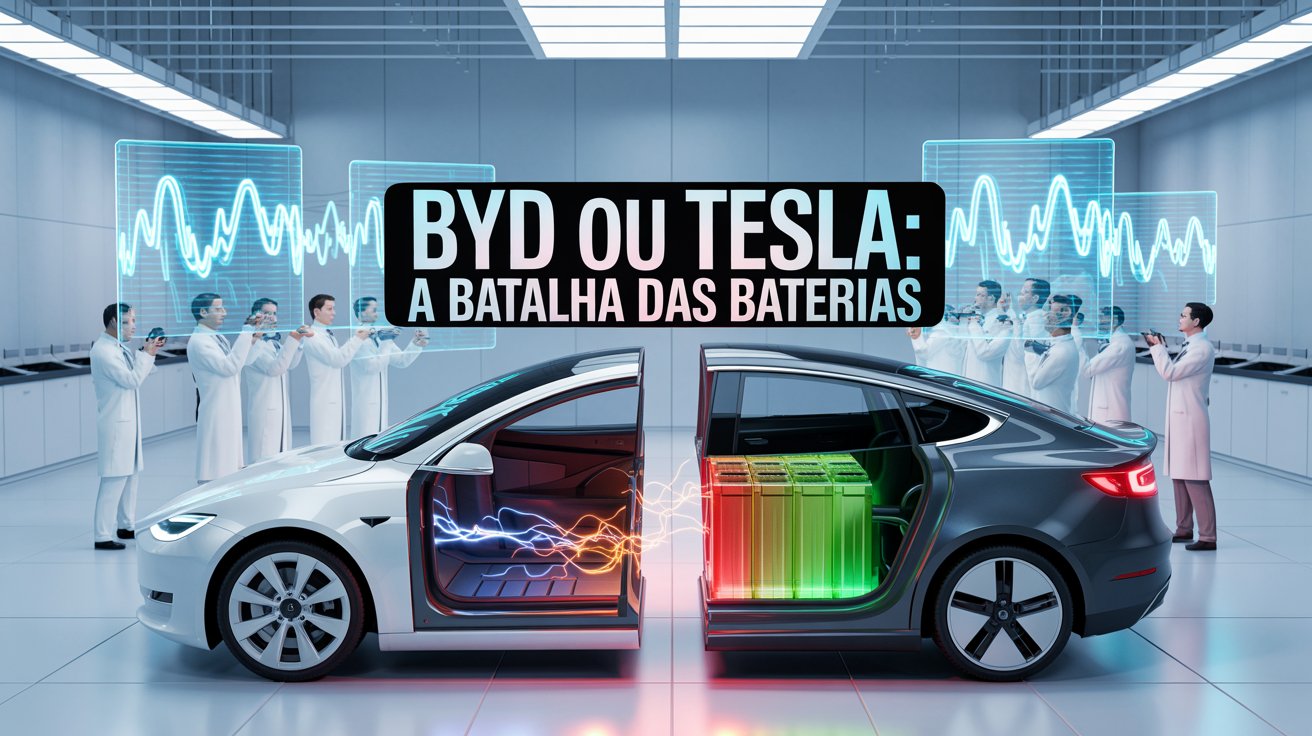

Researchers Reveal Surprising Discoveries After Opening Tesla and BYD Batteries, Analyzing From Chemistry and Design to Cost, Generated Heat, and Structural Efficiency. A Technical Study With Direct Impact on Electric Car Market Decisions.
Two giants of the electric vehicle market had their batteries thoroughly analyzed by scientists to determine which offers better performance, cost-effectiveness, and durability.
The study, published in the journal Cell Reports Physical Science, compared two of the most iconic batteries today: BYD’s Blade and Tesla’s 4680.
The results go beyond chemistry and raise important debates about the future of electric vehicles.
-
Scientists Convert Food Waste into Aviation Fuel, Successfully Test 50% Blend with Conventional Kerosene to Cut Emissions and Promote Sustainable Flights

-
Fiat Cronos Precision 2018: Affordable Sedan with Spacious Trunk and Reliable Maintenance
-
OnePlus N6 Smartphone to Launch in India with 8,000mAh Battery and 45W SuperVOOC Charging, Lasting Up to Three Days
-
Scientists Plan to Release Air Bubbles Underwater to Protect Antarctica’s “Doomsday Glacier” from Melting



The comparison revealed that each manufacturer’s technological approaches reflect very different market strategies.
Tesla bets on high performance and structural innovation, while BYD prioritizes durability, safety, and lower production costs.
Although it is not a definitive contest—since many factors influence the final performance of an electric car—the study offers a unique and detailed analysis of how these batteries operate in practice.
Chemical Differences Reflect Distinct Strategies
The batteries compared are not random: BYD’s Blade uses LFP (lithium-iron-phosphate) chemistry, while Tesla’s 4680 employs NCM (nickel, cobalt, and manganese) composition.
These differences directly impact performance, range, and production costs.
The LFP battery, adopted by BYD, is known for being cheaper, more stable, and having a longer lifespan.
In contrast, its energy density is lower, meaning less range.
The NCM battery, used by Tesla, is more powerful and offers greater range with the same capacity, but costs significantly more to produce and tends to degrade faster over time.
According to researchers, BYD’s choice of LFP chemistry is not just technical, but also geographic and economic.
In China, where the company dominates the market, the use of electric vehicles is primarily urban, making extreme range less relevant.
The robustness, safety, and reduced cost of LFP are ideal for this scenario.
Design Innovation of the Cells Also Matters
In addition to chemistry, the physical structure of the batteries was a determining factor in the analysis.
Tesla developed the cylindrical 4680 cell, five times larger than its predecessors, allowing for greater energy density and more energy volume per module.
Meanwhile, BYD innovated with the so-called “Blade Battery,” a flatter and modular design that favors thermal stability and safety.
This structure allows for better heat dissipation and reduces the risk of overheating—one of the biggest fears in electric vehicles.
According to the data obtained, Tesla’s battery generates twice the heat during charging compared to BYD’s.
Although this does not directly affect immediate performance, it necessitates the use of more sophisticated cooling systems—which increases the weight, cost, and complexity of the vehicle.
Costs: Clear Advantage for BYD
In terms of production, the advantage lies with the Chinese manufacturer.
Based on mineral prices in 2024, the Blade battery costs about US$ 10/kWh less than Tesla’s.
This represents a savings of approximately US$ 685 (about R$ 3,800) per 60 kWh battery.
The main reason for this difference is the high cost of nickel, an essential component in Tesla’s NCM composition.
Additionally, the lower use of metal alloys and the simplified structure contribute to the reduced cost of BYD’s battery.
It is worth highlighting that the weight of the Blade battery is higher, which could suggest lower efficiency.
However, this disadvantage is offset by durability and reduced demand for external components like cooling systems, resulting in a simpler and more reliable product in the long run.
Less Vibrations, Less Demand for Materials
Another factor that favors BYD is the very operation of electric motors.
The absence of vibration, noise, and excessive heat allows the use of simpler materials, such as reinforced plastics, instead of expensive metal alloys.
This directly impacts the vehicle structure and reduces the total production cost.
According to consulting firm Caresoft Global Technologies, many traditional automakers, like Toyota, still view electric cars as a direct evolution of combustion vehicles.
This leads them to oversize components and use expensive materials that are not necessary in the new electric paradigm.
Tesla and BYD, on the other hand, design their vehicles from the ground up as 100% electric.
This mindset results in more efficient, lighter, and cost-effective solutions—both in assembly and long-term maintenance.
And What About Range?
Despite the technical analysis of the batteries, the researchers did not address range in kilometers, as this variable depends on multiple factors—such as the motor used, vehicle aerodynamics, and driving style.
Therefore, a direct range comparison would not be fair between the two technologies.
However, it is known that NCM batteries, like Tesla’s, offer higher energy density.
That is, a car with an NCM battery tends to travel more kilometers on a single charge than one with an LFP battery—provided that the other vehicle components are equivalent.
A Market in Transition
The competition between BYD and Tesla is far from over.
Both companies lead the electric vehicle sector and are heavily investing in innovation.
Tesla dominates in North America and Europe, while BYD is rapidly advancing in emerging markets like Latin America, Southeast Asia, and Africa.
Currently, BYD’s progress in exporting models with LFP batteries is troubling competitors and forcing traditional automakers to reassess their strategies.
Companies like Volkswagen, Ford, and GM have already announced investments in partnerships with Chinese LFP technology suppliers.
Meanwhile, Tesla is also not ignoring this trend and has started offering more affordable versions of its models with LFP batteries for the Chinese and European markets.
Which Battery Wins?
The answer depends on what the consumer prioritizes.
If the goal is range, power, and engineering innovation, Tesla’s 4680 battery has the advantage.
On the other hand, if the focus is on cost, durability, and safety, BYD’s Blade is the more logical choice.
The study does not aim to declare a definitive winner but shows how different engineering philosophies can generate competitive solutions.
Both batteries have strengths and weaknesses, and the global market will likely continue to accommodate both types for many years to come.
And you, if you could choose, would prefer more range or a more economical and durable battery?