






 Portuguese
  Spanish
  4 min of reading
  1 comment


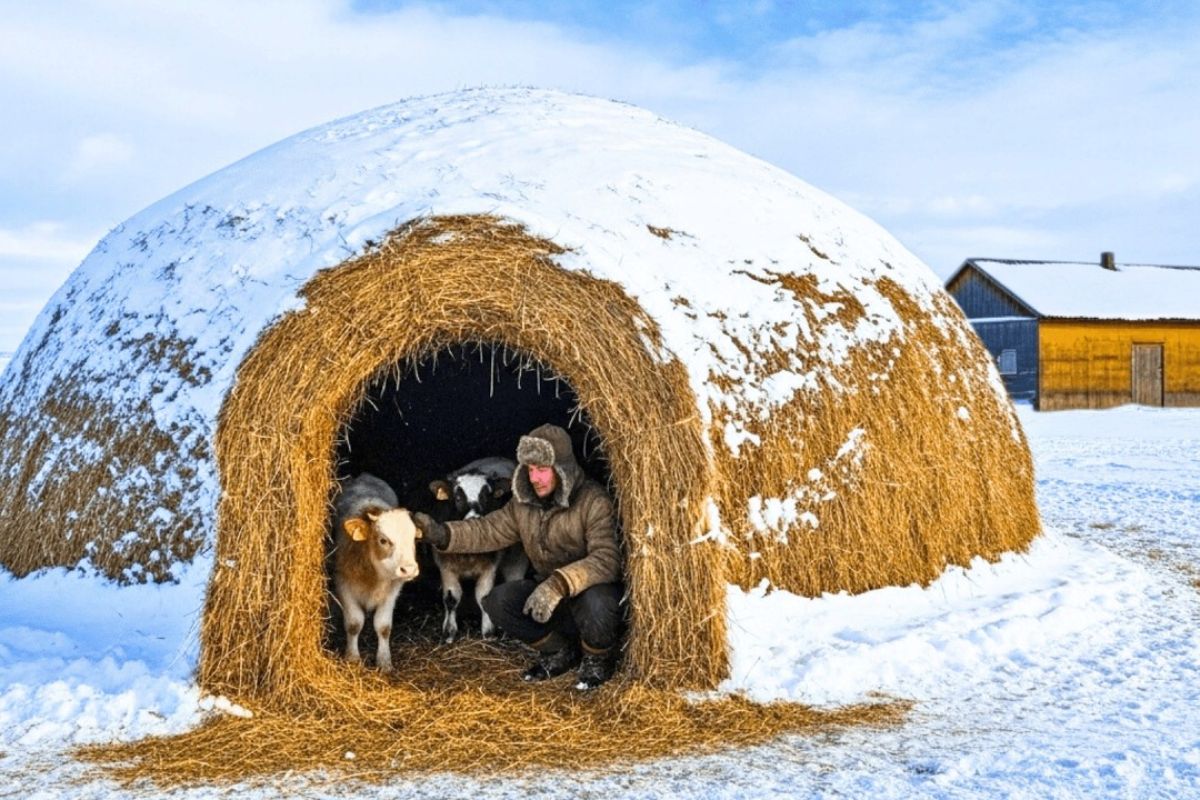


At The Peak Of Extreme Cold, A Hay Igloo Made With About 200 Bales Became An Improvised Shelter In North Dakota, Retaining Body Heat And Reducing Losses. The Winter Storm Exposed Failures In Traditional Barns And Accelerated A Local Wave Of Duplicates For Newborn Calves During Critical Days
The hay igloo emerged as a direct response to the extreme cold that hit North Dakota during a winter storm described as the deadliest in decades. Reed Carrigan, a rancher in the area, had newborn calves in a critical risk phase and decided to create an unconventional shelter to keep the animals alive.
The decision was met with scorn from neighbors, led by Clay Kingsworth, who relied on wooden barns and heaters. Within hours, however, the extreme cold dropped temperatures to reported levels of -30°C by dawn and -40°C by noon, and the winter storm began to practically test every available protection method.
The Operational Trigger And What The Shelter Changed On The Ranch

The turning point was logistical: the old barn on the property had cracks, wind infiltration, and rapid heat loss.
-
In Sweden’s Jukkasjärvi, Artists Transform the Frozen Torne River into the Icehotel, a Seasonal Ice Structure That Melts Back into Nature

-
Innovative Heat Storage Tower in Finland Uses 2,000 Tons of Crushed Soapstone to Warm Cities
-
17-Year-Old Homeschooler from the Bahamas Solves 40-Year-Old Math Puzzle, Earns Direct PhD Admission
-
Giant South American Tree Stores Water in Its Trunk, Survives for Years in Dry Regions


In an extreme cold scenario, this means that the large internal volume and imperfect sealing require constant energy to compensate for thermal exchange, something that is not always possible when the winter storm interrupts movement and maintenance.
The hay igloo was sized for six newborn calves, with thick walls and a low entrance that could be closed with a tarp.
The structure reached about 2.4 meters in height at the center and used more than 200 bales, organized in a dome shape, which reduced the area exposed to the wind compared to flat surfaces and typical corners of conventional buildings.
Why The Hay Igloo Works In The Physics Of Cold

The performance of the hay igloo depends on a simple principle: compressed hay creates pockets of air and increases the thermal resistance of the whole, reducing conduction and dampening convection caused by the wind.
In extreme cold, every air infiltration becomes a multiplier of thermal loss, so sealing and thickness are as relevant as a heat source.
Inside the shelter, the body heat of the newborn calves acts as a continuous thermal load.
Instead of trying to heat an entire barn, the strategy concentrates the animals in a smaller volume, where the internal temperature rises and stabilizes if the rate of loss through the walls is less than the rate of heat generation by the animals themselves, even during a prolonged winter storm.
Measures, Materials And Controls To Reduce Risk
The choice not to use fire or heaters inside the hay igloo appears as a safety measure: hay is flammable, and ignition would be an immediate risk.
The reported design prioritizes a thick straw bedding, minimal circulation through the entrance, and inspections when the weather allows, a critical routine when extreme cold prevents long movements.
There is also a practical limit: the entrance can become buried, and snow can seal the tarp.
When this happens during a winter storm, the operation requires manual opening to ensure access and prevent the external closure from hindering air exchange.
The observed solution was to dig, clear the entrance, and check the breathing and body temperature of the newborn calves before returning to the shelter.
From Ridicule To A Race For Copies In North Dakota
The social effect was swift. After the first check, the rancher reported a warm interior, with all six newborn calves sleeping, while other producers were accumulating losses in traditional barns. Clay Kingsworth returned to the site after recording deaths in his own herd, and the conversation shifted from tradition to survival in extreme cold.
With the winter storm still active, neighbors arrived with trailers and bales to build new domes next to the first hay igloo.
In a short time, multiple similar structures emerged on the property, and North Dakota began to treat the technique as a local reference, discussing wall thickness, internal volume size, and standardizing entrance for different batches of newborn calves.
What The Solution Does Not Prove And What Doubts Remain
The hay igloo does not eliminate risk, nor does it replace basic management, colostrum, monitoring, and protection against moisture.
It reduces exposure to wind and improves the microclimate, but weakened newborn calves may not respond, even with shelter.
Furthermore, if the construction is made with thin walls or excessive openings, the extreme cold will again dominate the internal environment.
Another issue is scalability. The report describes a module for six animals, while the ranch was handling more newborn calves during that time.
In a winter storm, this may require multiple hay igloos, stockpiling bales, and labor for rapid assembly, something that not every operation has available in North Dakota.
The case of the hay igloo in North Dakota exposes a recurring dilemma in winter storms: traditional methods are not always the most resilient when extreme cold disrupts predictability.
By concentrating newborn calves in a reduced and isolated volume, the solution leveraged basic physics, logistics, and response time and became a regional standard in a few days.
If you had to choose a single change before the next winter storm, which would it be: invest in barn sealing, build a hay igloo, or adapt a smaller space just for newborn calves, considering the extreme cold that arrives without warning?


Great idea amazing