






 Portuguese
  Spanish


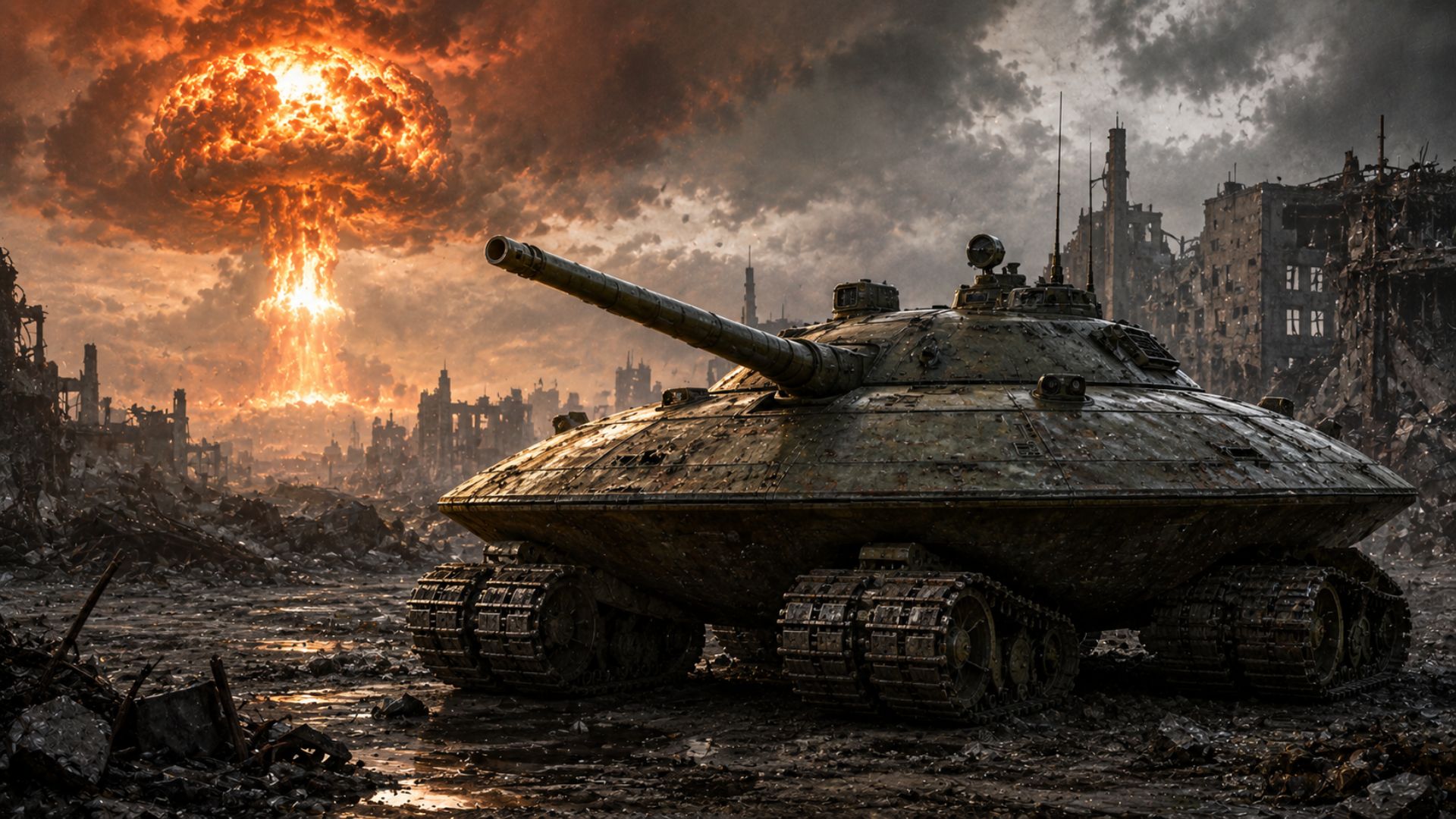


At the height of the Cold War, the Soviet Union designed a tank to fight after the nuclear apocalypse: the Object 279, a machine of almost 60 tons with a flying saucer-shaped hull and four tracks. The armored vehicle was designed not to overturn in the face of the shockwave of an atomic bomb and to traverse devastated terrains.
At the end of the 1950s, at the height of the Cold War, Soviet engineers from the Kirov Factory in Leningrad, now Saint Petersburg, began developing one of the most bizarre and fascinating tanks in military history: the Object 279. Development began in 1957, under the leadership of engineer L. S. Troyanov, and resulted in a prototype completed in 1959, designed for an extreme mission, to continue advancing and fighting in a battlefield devastated by nuclear explosions, exactly the scenario that Soviet generals considered likely in a possible Third World War.
The concept behind this tank was as grim as it was ingenious. The Soviet military doctrine of the time, inherited from World War II, was obsessed with deep offense, the idea of breaking through enemy lines and pouring masses of armored vehicles towards Western Europe before NATO could reorganize. The problem is that this advance would have to cross a terrain turned into a radioactive desert, with the ground churned up by craters and the shockwave of the bombs capable of flipping an armored vehicle upside down. The Object 279 was the most radical answer to this troubling question.
Why the Soviet Union created a tank for the end of the world

By the late 1950s, both superpowers already had hydrogen bombs, and the military doctrine of both sides treated the use of nuclear weapons on the battlefield as something probable, and even inevitable. In this context, planning a war meant, literally, planning how to survive and fight after an atomic detonation.
-
Boeing Buys Back Spirit AeroSystems for $8.3 Billion After 737 Mid-Flight Door Incident

-
Nike’s Old Shoes Recycled into Courts, Tracks, Playgrounds, Gym Floors, and New Footwear in Program Transforming 67,000 Tons of Sports Waste into a Global Industry

-
Canadian Woman Who Donated Savings to Haiti Earthquake Victims at Age 5 Wins $48 Million in Lottery 13 Years Later
-
118-Year-Old Brazilian Man, Living in a Care Home for 55 Years, May Become World’s Oldest Man Pending Guinness Validation


The question the designers asked themselves was direct and daunting: how to keep a tank advancing intact and manned at the exact moment and in the exact place where a nuclear bomb has just exploded? The answer required rethinking everything, from the shape of the hull to the way the vehicle touched the ground. The Object 279 was not born alone, but as part of a family of experimental heavy tanks that included Objects 277, 278, and 770, all designed to use the same 130 mm gun, although only the 279 followed such a radical path.
The flying saucer-shaped hull of the Soviet tank
The first thing that shocks anyone looking at Object 279 is the hull: a cast, curved, flattened piece with the silhouette of an ellipsoid, resembling a flying saucer. This shape was not aesthetics, but pure engineering applied to survival, with three main objectives. The first was to deflect the nuclear shock wave, with the curvature calculated so that the pressure wave of an atomic explosion would slide over the machine, instead of toppling it. The rounded and low shell functioned, in practice, as an aerodynamic shield against the nuclear blast.
The second objective was maximum ballistic protection with the minimum of weak points. The curved surfaces increased the effective thickness of the armor against projectiles and reduced the chance of a perpendicular impact, which is the most penetrating. The armor reached an impressive 305 millimeters at the front of the turret and 269 millimeters on the hull. The third objective was that the ellipsoidal profile, formed by thin curved plates over the main hull, functioned as an anti-cumulative screen, detonating the hollow charge ammunition jet before it hit the tank’s body.
The four tracks that made the tank unique
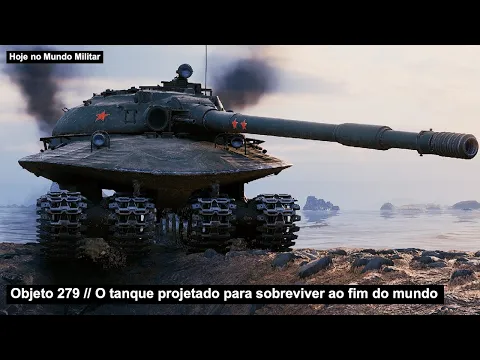

If the hull was already strange, the running gear was even more unusual. Object 279 did not have two tracks, like practically all tanks, but four, mounted in two pairs over two hollow longitudinal beams under the hull, which also served as fuel tanks. This configuration solved a concrete problem of the nuclear battlefield: distributing the weight of a machine of almost 60 tons over a much larger contact area with the ground.
The result was ground pressure of only 0.6 kilograms per square centimeter, very low for such a heavy vehicle. Combined with a hydropneumatic suspension that allowed adjusting the height and absorbing rough terrains, this solution made the tank capable of crossing deep mud, snow, craters, and plowed fields without sinking, precisely where conventional armored vehicles would get stuck. It was mobility designed for post-apocalyptic chaos, where roads would have disappeared and the terrain would be covered with debris.
The Firepower and Crew of Object 279
Object 279 was not just armor. Its main armament was the 130-millimeter rifled M-65 cannon, an extremely heavy caliber for the time, capable of destroying any Western armored vehicle at great distances. To handle that enormous and heavy ammunition, the tank featured a semi-automatic loading assistance system, ensuring a firing rate of five to seven shots per minute, with a reserve of 24 shells. There was also a 14.5-millimeter coaxial machine gun.
The technological level was cutting-edge for 1957, with a firing stabilizer for shooting on the move, optical rangefinder, night vision system with infrared spotlight, and protection against nuclear, biological, and chemical agents for the crew. However, the four crew members were cramped in an extremely tight and uncomfortable space. Propulsion was provided by a diesel engine of about 1,000 horsepower, sufficient to propel the nearly 60-ton tank to approximately 55 kilometers per hour, with a range of around 300 kilometers.
Why This Tank Never Went Into Production
If Object 279 was so advanced and the risk of nuclear war seemed real, why was it never mass-produced? Part of the answer lies in its own ingenious design, which came at a high price. The four tracks, which solved the problem of getting stuck, created a mobility and maintenance nightmare. The system was complex, heavy, and expensive, and maneuverability was poor, especially in turns, as turning a vehicle with two pairs of tracks required much more effort than a conventional tank.
Maintaining and repairing all that in the field would be a huge logistical headache. But the fatal blow came from the political side. Around 1959 and 1960, then-Soviet leader Nikita Khrushchev, an enthusiast of missiles, began to see heavy tanks as expensive and outdated pieces in the face of the new nuclear era. He effectively determined the end of heavy tank development, setting a weight limit of around 37 tons for new armored vehicles, which immediately excluded a nearly 60-ton machine like Object 279.
The Legacy of Object 279 in Tank History
Only one prototype of Object 279 was ever built, and it has survived, preserved to this day at the Kubinka Tank Museum near Moscow, Russia. In 2022, images released by the museum itself showed the tank restored and moving on its own, emitting smoke and roaring with its diesel engine, more than six decades after its creation. The vehicle has become one of the most revered pieces by military history enthusiasts worldwide.
To a large extent, the Object 279 was a technological dead end, and the concept of a heavy tank with four tracks for the nuclear battlefield was abandoned and never revisited. Still, some ideas from that generation of prototypes survived indirectly, such as the hydropneumatic suspension, mechanical loading assistance systems, and the Soviet obsession with layered armor, which reappeared in later tanks. Its greatest legacy, however, may not be a specific piece, but a doctrinal lesson on how far a military power is capable of going when designing weapons for the worst imaginable scenario.
The Object 279 is the most extreme portrait of Cold War military thinking: a machine literally designed to keep fighting after the apocalypse. With its flying saucer hull, four tracks, and absurd armor, it encapsulates the fear and ambition of an era when nuclear war was treated as a plausible scenario. More than a historical curiosity, this tank is a reminder of how the political and technological context shapes, and sometimes condemns, even the most audacious engineering ideas.
Have you ever heard of this Soviet tank designed for the end of the world? Do you think the Object 279 was a genius ahead of its time or an exaggeration doomed to failure from the start? Leave your comment, tell us which armored vehicle in history fascinates you the most, and share the article with those who enjoy military history, engineering, and the behind-the-scenes of the Cold War.


