






 Portuguese
  Spanish




Surprising discovery reveals how one of the continent’s oldest civilizations used advanced knowledge of the sky to predict natural cycles and ensure its survival in a challenging environment
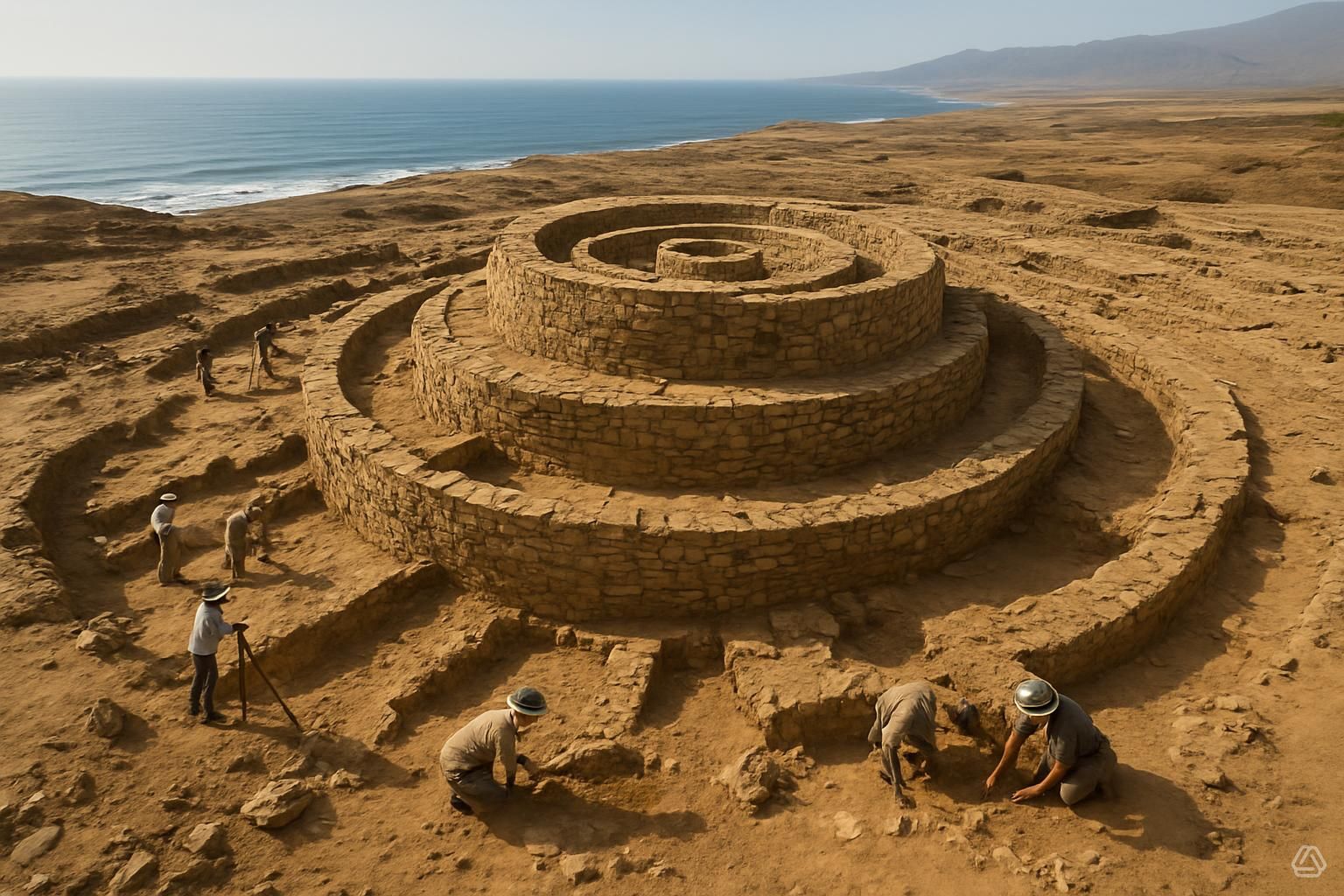
In an archaeological find already considered one of the most important in recent years, researchers identified a millennia-old structure at the Áspero archaeological site in Peru, which could completely transform how we understand the scientific development of ancient civilizations in the Americas. The information was released by “Andina – Peru News Agency”, based on studies conducted by specialists from the Caral Archaeological Zone, revealing impressive details about the advanced use of astronomy over 4,000 years ago.
Initially, the discovery might seem like just another common excavation. However, as work progressed, it became evident that it was something much larger. The stone structure, strategically located near the main pyramidal constructions of the settlement, proved to be a sophisticated astronomical observatory used by specialists of the Caral civilization — one of the oldest in the Americas, dated between 3000 BC and 1800 BC.
Furthermore, the Áspero site, located in Supe Puerto, in the province of Barranca, covers about 19 hectares and houses more than 20 architectural complexes, which reinforces the high level of social organization of this ancestral society. Thus, the new find is impressive not only for its size but also for the level of technical knowledge involved.
-
Digital Transformation Essential in Energy, Oil, and Gas Industries, But IT Infrastructure Often Overlooked

-
Brazilian Students Repurpose Clay Tea Cups to Create Cooler That Lowers Room Temperature by Up to 10°C Without Air Conditioning or Fans
-
353-Year-Old Mystery Deepens as Archaeologist Arrested with Teeth and Bone Fragment Possibly Linked to d’Artagnan, the Real Musketeer Behind Alexandre Dumas’ Inspiration

-
16-Year-Old Invents CoolTowel, a Fitness Towel That Stays Cold for Up to 2 Hours, Wins Global Alibaba Competition with Over 15,000 Participants, Earning $1 Million



How the Áspero observatory worked and its direct link to the survival of the Caral civilization

From detailed analyses, researchers identified that the structure was carefully designed to cast specific shadows throughout the day. Consequently, this allowed the ancient inhabitants to precisely monitor the movements of the sun, moon, and other celestial bodies.
According to archaeologist David Palomino, responsible for the study at the site, this systematic observation was essential for determining fundamental natural cycles. In other words, the mastery of astronomy was not just theoretical knowledge, but a practical tool for planning productive activities such as fishing and shellfish gathering — the basis of the local economy.
It is worth noting that the elevated location of the observatory provided a privileged view of both the Pacific Ocean coast and the lower part of the Supe Valley. Thus, specialists could anticipate environmental changes, such as tides and more favorable periods for natural resource exploration.
Furthermore, studies on the city of Caral, which is about 5,000 years old, already indicated that astronomical knowledge was directly linked to agricultural and marine cycles. Therefore, this new discovery further reinforces this vital connection between science and survival.
Structure went through four phases and reveals impressive evolution over time

Another noteworthy point is that the observatory went through at least four distinct construction phases, highlighting its importance over the years. Initially, it is believed that the space functioned as a public ceremonial area.
Subsequently, an oval platform was added, approximately 3.18 meters in diameter and 63 centimeters high. In the center, there was a vertical stone known as huanca, an element traditionally associated with ritual practices in Andean cultures.
Over time, the structure evolved into an even more complex form. A double-tiered platform was built, with the lower level approximately 9.40 meters in diameter and the upper level 4.80 meters. In the center, archaeologists found a rectangular stone and a space that functioned as a ceremonial fireplace, similar to the approximately 5,000-year-old fire altars already identified at other Caral civilization sites.
Interestingly, this two-tiered design is considered unique among constructions related to the Caral culture. According to specialists, this characteristic may be directly linked to its proximity to the coast, as tide prediction was essential, especially between the months of April and November, when the Supe River experiences water scarcity.
Center for exchange, knowledge, and advanced social organization impresses specialists

With the advancement of research, it became clear that Áspero was not just an isolated fishing village. On the contrary, it was a true center of interaction between different regions. The Norte Chico civilization, of which Caral is a part, operated as a complex network of interconnected communities.
Evidence found in tombs and residences revealed the presence of elements from both the Amazon region and the Andes. This indicates a constant flow of exchange of goods and knowledge between different areas.
Furthermore, previous discoveries at the site, such as the high-status burial known as the “Lady of the Four Tupus” and other burials dating back about 4,500 years, point to a highly structured society, with a defined social hierarchy and organized activities.
Finally, in its final phase, the observatory was covered and transformed into residential areas. This change suggests significant social transformations and a possible loss of the specialized function of the structure.
Still, the impact of the discovery is undeniable. It confirms that sky observation was part of the daily life of these ancient populations, being essential for organizing work, understanding the environment, and ensuring survival in a challenging scenario.


