Portuguese
  Spanish


BMW’s electric project revives a rare idea in urban scooters, combining roof, seatbelt, and automatic balance in a concept aimed at commuting in large cities, with industrial design already registered in Brazil.
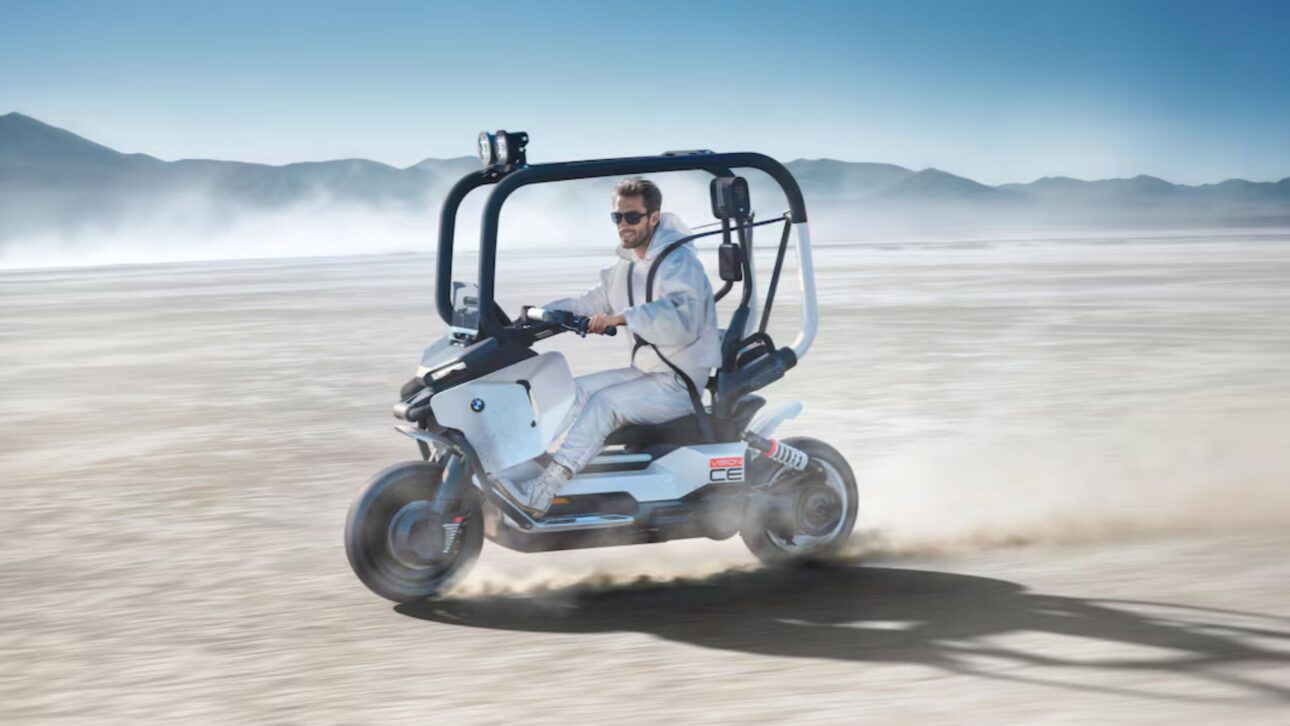
BMW Motorrad has registered the industrial design of the Vision CE with the National Institute of Industrial Property, INPI, a conceptual electric scooter with a protective structure over the rider and an automatic balance system when stationary.
The registration was published on June 2 and does not, by itself, confirm sales in Brazil.
The project revives the idea of the BMW C1, a scooter with a roof launched in the early 2000s, but now within the German brand’s electrification strategy.
-
Resident left tap running to prevent freezing, but woke up to ice in the sink after -1.8°C cold snap in Brazil’s Serra Gaúcha region.

-
Man Inherits Old House in France and Discovers 100 kg of Hidden Gold Throughout the Property
-
Humanoid Robots Transition from Demonstrations to Real Work in Factories

-
Pyramid-Shaped Apartment Building in China Stands Out with 18 Floors, 45-Degree Inclined Facade, and Terraced Design Inspired by Traditional Rice Paddies





The Vision CE was globally presented in September 2025, during the IAA Mobility in Munich, as a two-wheeled urban mobility study for large cities.
The central point of the proposal is the attempt to reduce dependence on external protective equipment.
According to BMW Motorrad, the Vision CE combines electric motorization, a seat with a belt, and a tubular structure called a cage by the brand, designed to surround the rider and enhance protection in urban commuting.
The manufacturer also highlights another uncommon feature for a scooter: the balancing function.
This system allows the vehicle to remain upright even when stopped, without requiring the rider to put their feet on the ground at traffic lights, in traffic jams, or during low-speed maneuvers.
BMW Vision CE updates the C1 concept
The Vision CE did not emerge as an isolated proposal within the history of BMW Motorrad.
The concept directly dialogues with the C1, a model that tried to bring together motorcycle and car features by adopting a rigid roof, windshield, protective bars, and seatbelt.
Launched about 25 years ago, the BMW C1 attracted attention precisely for allowing helmet-free riding in some European countries, thanks to the integrated protection set in the vehicle.
The solution was uncommon for a scooter and sought to attract urban users who wanted practicality without giving up a greater sense of security.
Despite the bold proposal, the C1 had a short commercial life.
The model faced resistance due to its high weight, price above conventional scooters, and unfamiliar design for some of the public.
Production ended in 2002, after just over 33,000 units were manufactured.
With the Vision CE, BMW resumes this same philosophy but replaces the more enclosed interpretation of the C1 with a visually lighter structure.
Instead of a complete rigid cabin, the new concept uses an open tubular frame, which preserves the typical exposure of two-wheeled vehicles and reinforces the futuristic appearance.
BMW’s electric scooter has a protective structure
The so-called cage is the most visible element of the Vision CE and defines much of the project’s identity.
The metal structure surrounds the occupant and works in conjunction with the seat and seatbelt, forming a protective cell aimed at urban use.
According to BMW Motorrad, this architecture was designed to dispense with the use of helmets and traditional protective clothing under certain driving conditions.
Even so, the practical application of this concept would depend on local regulations, approval, and safety requirements of each market.
The brand has not released complete technical data on power, range, top speed, or battery of the Vision CE.
There is also no confirmation that the model will reach production lines, as the public presentation treated the vehicle as a design and technology concept.
Visually, the scooter bets on clean lines, minimalist-looking surfaces, and apparent use of coated aluminum.
The combination of matte white, black, and neon red details reinforces the proposal of an urban vehicle with a language closer to futuristic studies than traditional scooters.
Automatic balancing system keeps scooter upright
Besides the protective structure, the automatic balancing feature is one of the most relevant differentials of the Vision CE.
BMW states that the function allows the scooter to be completely balanced when stationary, dispensing with the kickstand in some situations and facilitating use in urban traffic.
In practice, the technology targets one of the common difficulties for beginner motorcyclists or users unfamiliar with two-wheeled vehicles.
By keeping the scooter stable when stopped, the system can make starts, short stops, and slow maneuvers less demanding for the rider.
This function also helps reinforce the proposal to transform the scooter into a more accessible mobility alternative for daily commutes.
The project seeks to reduce barriers associated with conventional motorcycles, such as the constant use of specific equipment and the need for manual balance at low speeds.
Even so, BMW has not detailed the mechanical or electronic operation of the system.
The manufacturer limited the description to the vehicle’s behavior when stopped, without informing whether there is action by gyroscopes, sensors, auxiliary motors, or another type of embedded solution.
Vision CE Registration in Brazil Does Not Confirm Launch
The industrial design registration at INPI indicates intellectual property protection for Vision CE in Brazil.
This type of procedure is common among global manufacturers, especially when a project has strategic relevance or can inspire future products, accessories, and design solutions.
BMW Motorrad of Brazil stated that it monitors opportunities for the national market but emphasized that the registration does not mean immediate commercialization.
The company also stated that there is no confirmation of the launch of the maxi scooter with a roof in the country at this time.
This caution is important because prototypes presented at international shows do not always reach stores.
Often, concepts serve as showcases of technology, test public reaction, and anticipate solutions that may later appear in production models.
In the case of Vision CE, the brand seems to use the study to reinforce its presence in urban electric mobility.
The project adds to a line that already includes the C evolution, presented in 2014, the CE 04, commercially launched in 2022, and the CE 02, later presented as a compact electric option for short trips.
Urban Electric Mobility Gains New Showcase
The Vision CE expands BMW Motorrad’s investment in electric vehicles aimed at individual urban transportation.
The brand has been treating this segment as a laboratory for design, connectivity, rider assistance, and new ways of using motorcycles and scooters.
By revisiting the C1 proposal, the manufacturer also reopens the debate on an old topic: to what extent can the safety of two-wheeled vehicles be transferred from the rider’s body to the machine’s structure itself.
The Vision CE does not definitively answer this question but shows a possible direction for future projects.
The industrial design registered in Brazil protects the concept’s lines and keeps BMW legally safeguarded should it decide to advance with derivatives or similar solutions.
For now, however, the vehicle remains a study, without a price, complete technical specifications, production timeline, or official forecast for arrival in the Brazilian market.