Portuguese
  Spanish


The water shortage in Puerto Rico affected thousands of residents in June 2026, impacting bathing, cleaning, laundries, and family routines, while the National Guard began supporting the distribution of supply trucks in areas affected by the crisis.
Residents of Puerto Rico faced a water shortage in June 2026 and had to endure a heavy routine to handle basic household tasks. In buildings, families carried buckets up stairs, bought gallons, and had to pay laundries to get clothes washed.
The information was published by AP News, news agency. The supply crisis hit populous areas, including San Juan, and exposed a problem that goes beyond the dry tap: without water, bathing, food, hygiene, cleaning, and family routines became a daily concern.
The water shortage hit hardest on the elderly, people with disabilities, and families without a cistern. For those living in apartments, each bucket carried became part of a repeated effort every day.
-
Former Truck Driver from Brazil Builds Logistics Company Aiming for $70 Million Revenue with 11 Branches, 700 Monthly Clients, and $10 Million Fleet Investment

-
World’s First Plasma Dress Turns Fashion Show into Scientific Spectacle with Controlled Electric Discharges and Ionized Gases in Iris Van Herpen’s Groundbreaking Tech-Fashion Creation

-
Phone Falls from Plane at 300 Meters in Rio de Janeiro, Continues Recording for 15 Seconds, Found by Environmentalist Next Day in Unbelievable Twist
-
8-Year-Old Finds 900-Year-Old Viking Bronze Buckle on Swedish Beach While Fossil Hunting




Water shortage in Puerto Rico turned simple tasks into physical effort and extra expense
The crisis changed the routine of residents who depended on normal supply to wash dishes, take baths, flush toilets, and clean the house. Without enough water, many families had to buy gallons and seek paid alternatives.
In San Juan, Jeannette Mercado Rodríguez, a 52-year-old resident, reported the weight of the situation. She stated: “This is really exhausting, it’s maddening.”
The resident needed to carry five buckets and 10 2-liter bottles to the apartment on the third floor every day. The repeated effort caused a shoulder injury.
The lack of water also affected the family’s clothes. Without regular supply, laundries became an extra expense for those already struggling to keep the house running.
Almost 40,000 customers were without water on the first weekend of June 2026
The supply crisis left almost 40,000 customers without water on the first weekend of June 2026. Customers, in this case, refers to accounts served by the water service.
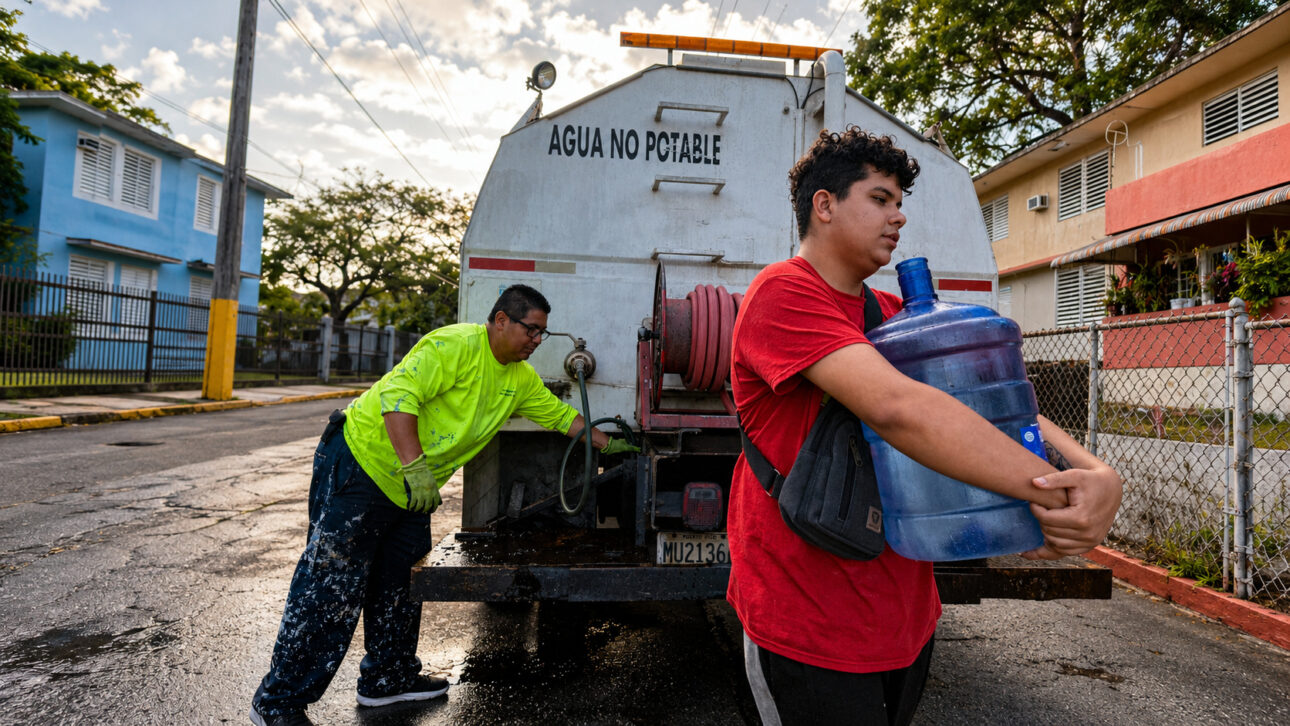
Governor Jenniffer González called in the National Guard to support emergency distribution. The response involved water trucks in affected communities.
The operation included four trucks, each with a capacity of 2,000 gallons, or 7,570 liters. The presence of the vehicles became a sign of relief for residents waiting for water for basic needs.
The Puerto Rico Tourism Company also brought extra trucks, with a capacity of 12,800 gallons, or 48,453 liters, to serve hotels and short-term rentals.
Water trucks became a lifeline in the streets, but not everyone could organize in time
The arrival of the trucks was celebrated in some communities. Residents called municipal workers “heroes” when the water finally appeared.
Even so, the distribution did not solve all the difficulties. Some residents complained about the lack of notice regarding the time the trucks would pass by.
Those who were out of the house for work risked missing the delivery. This increased insecurity because the family did not know when they would have another chance to get water.
Even the Puerto Rico Department of Agriculture sanitized two large trucks used for transporting milk to deliver potable water. The adaptation showed how the crisis required solutions outside the normal supply routine.
Elderly, bedridden people, and families without cisterns felt the weight of the crisis more
The lack of water affected everyone, but not in the same way. For the elderly, people with disabilities, and families without cisterns, dependence on trucks and buckets made the routine even more difficult.
Marcia Soler París, a community leader of 61 years, stated: “We are exhausted. We shouldn’t live like this. We don’t deserve this.”
Her house included children of 13, 10, and 4 years. With more people depending on the same water, basic consumption became more difficult to organize.
Soler reported spending US$ 40 on laundry and the purchase of plastic cups and plates. On an island of 3.2 million people, where more than 40% live below the poverty line, any extra expense weighs more on the budget.
Crisis exposed failures in water infrastructure in populous areas
AP News, a news agency, detailed that authorities have not publicly presented a single cause for the crisis. The water shortage mainly affected urban and populous areas, including San Juan.
The public company responsible for the service draws water from rivers, reservoirs, and underground aquifers. Aquifers are water reserves located below the ground and help supply when the system is working well.
The problem also opened a debate about water infrastructure without investment and maintenance for decades. Infrastructure, in this case, means pipes, pumps, equipment, and systems that make water go from the source to homes.
Some customers in San Juan had already reported irregular service for more than a year. In May 2026, the mayor Miguel Romero, head of the municipal government of San Juan, filed a lawsuit against the public water and sewage company of Puerto Rico.
Government announced US$ 217 million to try to fix network problems
The governor announced that projects aimed at correcting the water infrastructure began with an investment of US$ 217 million. The amount was presented as part of the response to the supply problem.
The crisis also reached the Judiciary. A committee appointed by a judge started working with the responsible agency to investigate and tackle the chronic water shortage.
In February 2025, Luis González Delgado was appointed executive president of the island’s water and sewage authority. The crisis generated public demands and requests for explanations about the system’s management.
While residents sought water from trucks, some reported that they continued to receive bills for the service. For those who paid for laundry, bought gallons, and carried buckets, the water bill became another point of strain.
Without water, the entire city feels the problem inside their homes
The supply crisis in Puerto Rico showed how a network failure directly enters people’s lives. The dry tap appears in the interrupted shower, the piled-up dishes, the dirty clothes, and the difficulty of caring for children, the elderly, and people with reduced mobility.
The deployment of the National Guard, the supply trucks, and the announced investment of US$ 217 million show the magnitude of the problem. Even so, the most striking image remained in the residents’ routine: buckets climbing stairs to ensure the minimum inside the house.
When the water disappears and the solution depends on trucks on the streets, is the problem just a lack of supply or a sign of a city at its limit? Share your opinion and share this post.