Portuguese
  Spanish


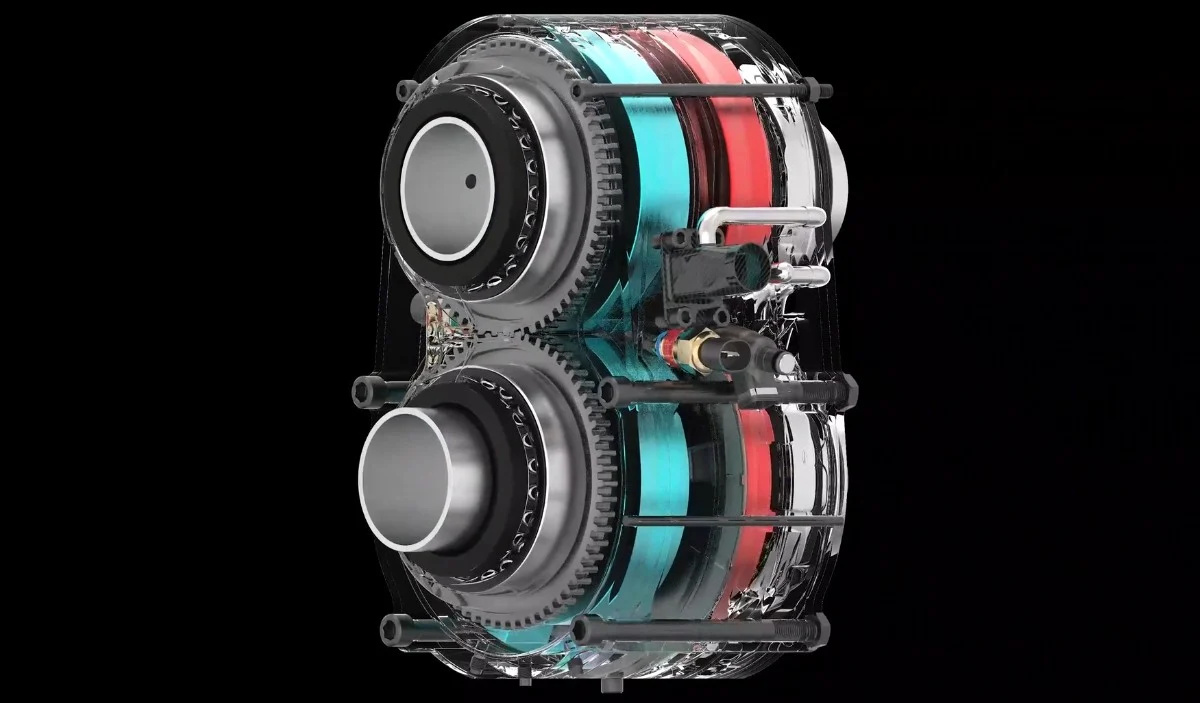

Omega 1 from Astron promises 600 hp, 1,355 Nm, and high efficiency with hydrogen, but still depends on real validation and commercial application.
Astron Aerospace put the Omega 1 on the automotive sector’s radar by advocating a motor concept that mixes elements of a rotary engine, combustion engine, and turbine-inspired architecture. In material cited by the Australian WhichCar, the company claimed that the proposal could reach 447 kW, about 600 hp, along with 1,355 Nm and 80% thermal efficiency in computational modeling.
The central point, however, is the stage of the technology. WhichCar itself reported that, at that time, Astron’s work was still focused on design and development, while the company’s official website today highlights H2 Starfire as its newest hydrogen technology, focusing on technical presentation and partnerships, not on mass automotive production.
How the Omega 1 engine reorganizes intake, compression, combustion, and exhaust in a different rotary architecture
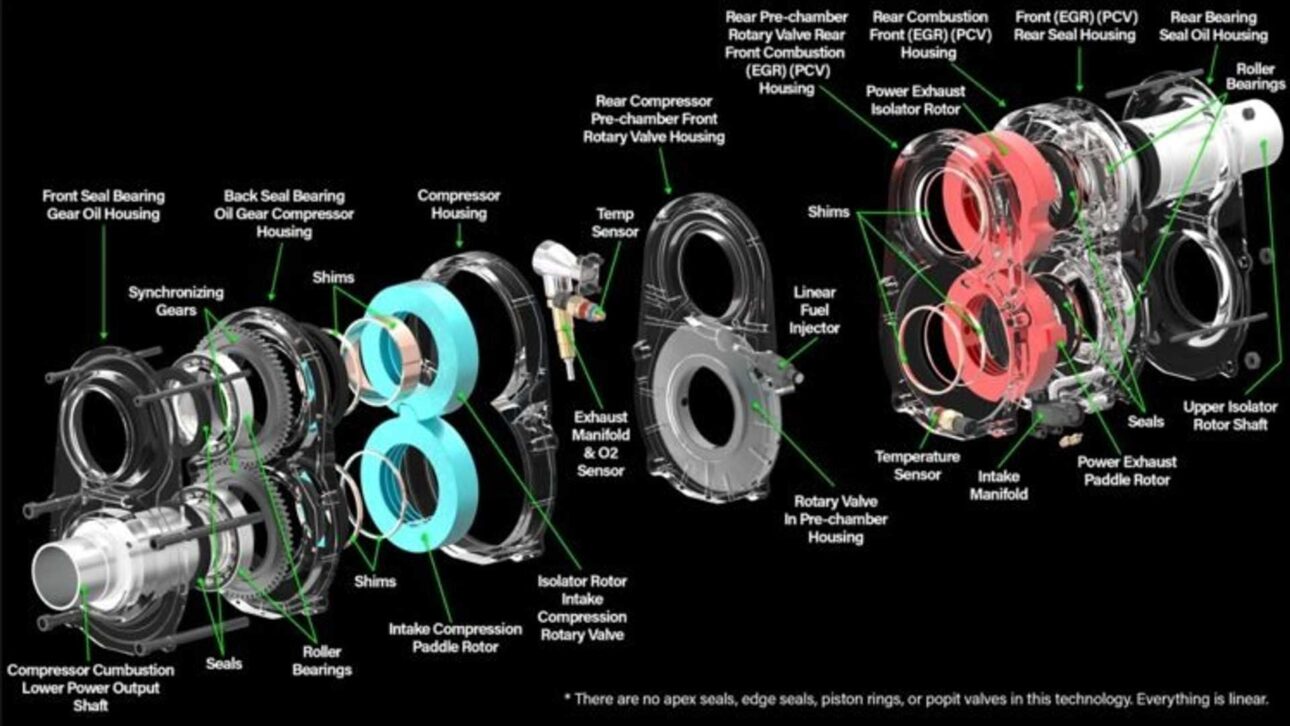
The technical basis of the Omega 1 is the physical separation of the combustion cycle stages. Astron’s patent describes a set with compression assembly and combustion assembly connected to each other, in which the compression rotor operates from the beginning of intake to the end of compression, while the power rotor follows from the beginning of combustion to the end of exhaust.
-
1983 Chevrolet Runs Over 100,000 km Without Gasoline, Powered by Wood Chips, Reaches 125 km/h in Airport Test

-
Workshop Converts Giant Tractor Tire Tricycle into a Three-Wheel Drive Hybrid with 36,000-Watt Electric Motor Capable of Climbing Hills

-
Sales of Brazil’s Cheapest Electric Car Halted Before First Deliveries: E-Motors Suspends Emova Easy Due to Import Tax Increase and Rising Freight Costs

-
Nissan Discontinues Qashqai SUV Amid Cost-Cutting, Chinese Competition, and Product Line Review






In practice, this approaches the explanation published by WhichCar, according to which the engine divides the four phases of the cycle into two distinct and independent chambers, instead of concentrating everything in the same space as a conventional engine does.
The WhichCar text also states that the design uses extremely tight tolerances, below 0.1 mm, to dispense with the typical seals that marked rotary engines of the past.
This reorganization is part of the project’s efficiency argument. By separating intake and compression from combustion and exhaust, Astron attempts to reduce losses and improve the way the charge is prepared before ignition, without resorting to the traditional piston and crankshaft architecture.
Power, torque, and efficiency numbers of the Omega 1
The figures that made the Omega 1 surprising came from estimates released by the company itself.
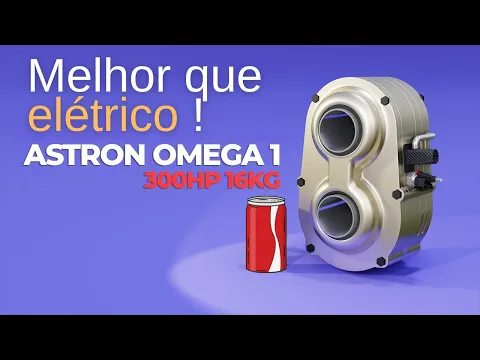
According to WhichCar, a single module weighing about 16 kg was described as capable of delivering 119 kW, 230 Nm, idle speed of 1,000 rpm, and a limit of 25,000 rpm, while the most ambitious configuration appeared with 447 kW, 1,355 Nm, and 80% thermal efficiency in simulation.
WhichCar also highlights that Astron still needed to turn these plans into something real and face significant engineering challenges, especially the extremely fine tolerances of the assembly and the need for more sophisticated materials to withstand thermal variations without compromising functionality and durability.
This places the Omega 1 in a zone common to many emerging mobility technologies: a project with striking numbers, but still needing to pass the decisive stage of validation outside the computer, under load, temperature, wear, and industrial cost.
Hydrogen, low weight, and near-zero emissions form the core of Astron’s technological bet
Astron has always presented the concept as a multi-fuel engine, with hydrogen at the center of the strategy.
WhichCar reported that the company treated hydrogen as the ideal fuel for the Omega 1, with emissions “close to zero,” while the current H2 Starfire is described by Astron itself as a high-efficiency alternative, emitting water vapor and zero NOx according to the technical communication published on the website.
In the company’s most recent material, the H2 Starfire appears with 60% thermal efficiency, about 400 hp, weight of 54 kg, up to 25,000 rpm, and only 82 parts, which shows that Astron’s communication remains focused on compact, lightweight, hydrogen-oriented rotary engines.
This move does not prove that the Omega 1 has reached the market, but indicates that the company has maintained the same technological direction: high-revving rotary engines, low weight, few parts, and an environmental discourse centered on hydrogen.
International patents and current focus on H2 Starfire show that the technology remains in development and not at a commercial scale
The intellectual protection of the concept is real. Google Patents lists Astron’s patent family for “Rotary engine, parts thereof, and methods”, with publications and grants in the United States between 2020 and 2024, as well as international extensions in different jurisdictions.
At the same time, the public material available does not show the Omega 1 as an automotive engine ready for sale at scale.
WhichCar described the project as something still in the realization phase, and Astron’s official website today emphasizes demonstrations, videos, technical PDFs, and the search for OEM partners around the H2 Starfire.
The result is a case that remains relevant to the industry for a simple reason: it concentrates, in a single project, the three major promises that still allure the advanced combustion sector, high efficiency, low weight, and hydrogen compatibility, but without yet delivering public proof of commercial production or large-scale adoption.