






 Portuguese
  Spanish


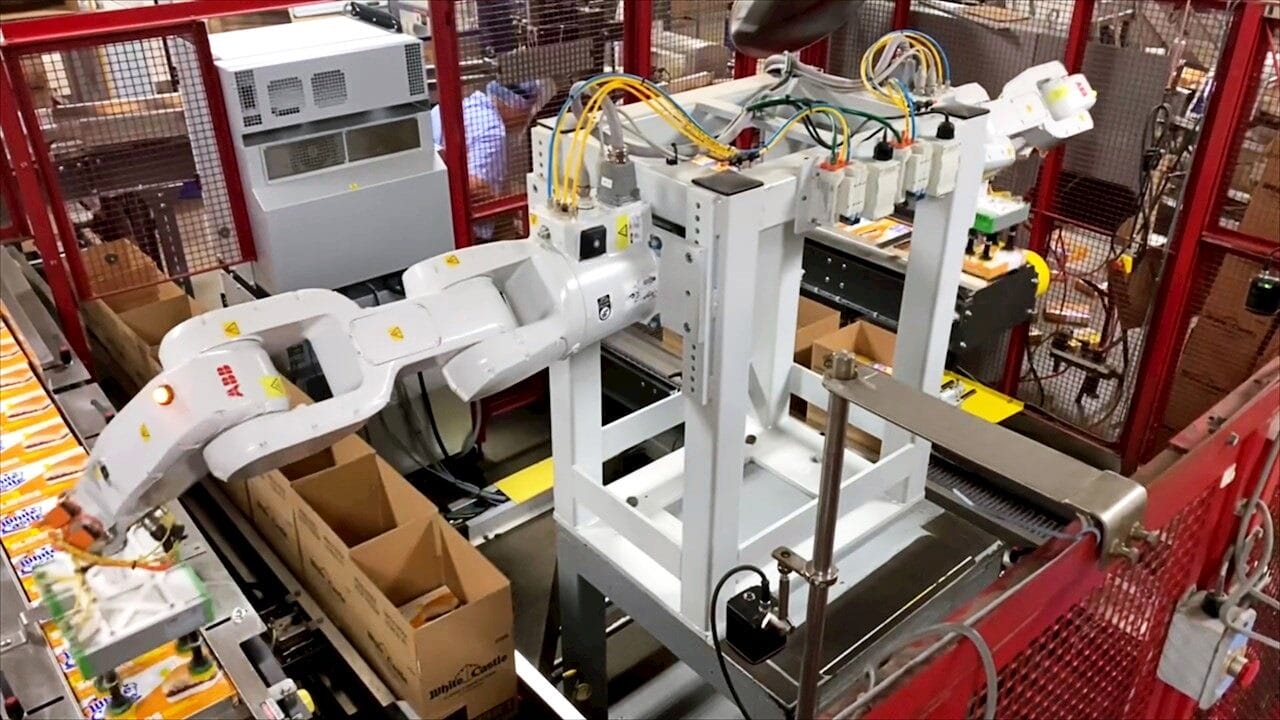

Streamlining Packaging and Palletizing in the Food Sector
The food industry constantly faces challenges to optimize its operations, especially in tasks such as packaging and palletizing. A well-known frozen burger manufacturer in the United States found the perfect solution to these challenges with the help of ABB robots, a leading company in automation technologies. The goal was to accelerate the packaging and palletizing process of burgers while minimizing the risk of injury to workers and enhancing the automation of the process.
Innovation in the Production Process
The company, originally part of a fast-food chain and now focused on selling its famous frozen mini-burgers, or “sliders,” needed a solution to handle the increased demand. At its factory in Louisville, Kentucky, production begins with the arrival of blocks of meat, which are transformed into individual burgers and manually assembled with bread, onion, and cheese. After packaging, the products are sent to an ultra-rapid freezer before being distributed to stores nationwide.
Robotics Improving Efficiency
The installation of ABB robots at the factory was a milestone in the company’s history. The IRB 340 FlexPicker® and IRB 360 models, equipped with advanced technologies, were essential in overcoming bottlenecks in packaging mini-burgers. These robots, operational for over two decades, were described by factory manager Tony McGraw as the “best investment ever made,” highlighting their speed, accuracy, and reliability.
-
China Develops Custom 140-Ton Electric Mining Truck with 770 kWh Swappable Battery, Deploys 290 Units in Xinjiang’s Largest Zinc Mine

-
Meta to Launch Arena, a New Prediction App Targeting 3.56 Billion Users, Competing with Polymarket and Kalshi

-
Scientist Challenges Famous Human Evolution Theory, Argues Homo Sapiens Evolved Gradually Over Thousands of Years
-
15-Year-Old American Builds Ocean Generator with PVC Pipe and 3D-Printed Propeller for $12, Wins National Prize, Presents at White House, and Makes Forbes 30 Under 30 List




Continuous Evolution with ABB Technology
Later, to tackle the obsolescence of the original robots, White Castle hired CIM SYSTEMS INC., an ABB-authorized robotic systems integrator, to find replacement solutions. CIM used RobotStudio®, an ABB offline programming software, to design the palletizing cell. This innovative system involved the use of an IRB 660 palletizing robot, capable of handling 180 kilograms and with a reach of 3.15 meters, ideal for the factory’s palletizing operations.
New IRB 1200 robots were installed to package retail boxes, further optimizing the process. These robots, more efficient and with advanced capabilities, replaced an older model, allowing workers to focus on more strategic tasks. CIM again relied on RobotStudio to ensure the optimal positioning and performance of the robots on the production line.
The use of these ABB robots not only accelerated production but also significantly contributed to worker safety by reducing the need for manual handling of frozen products and increasing overall efficiency. This success story in the food industry illustrates how robotics and automation can be transformative, especially in sectors where demand and the need for efficiency are constantly growing.
Conclusion: The Future of Automation in the Food Industry
White Castle’s journey with ABB robots highlights the importance of continuous innovation in the food industry. The strategic use of advanced robotics and programming tools such as RobotStudio® demonstrates a proactive approach to solving production challenges and improving operational efficiency. With these technologies, the company not only optimized its production but also ensured a safer and more efficient working environment for its employees, paving the way for future innovations in the sector.
Source: Tamer Comunicação






