Portuguese
  Spanish


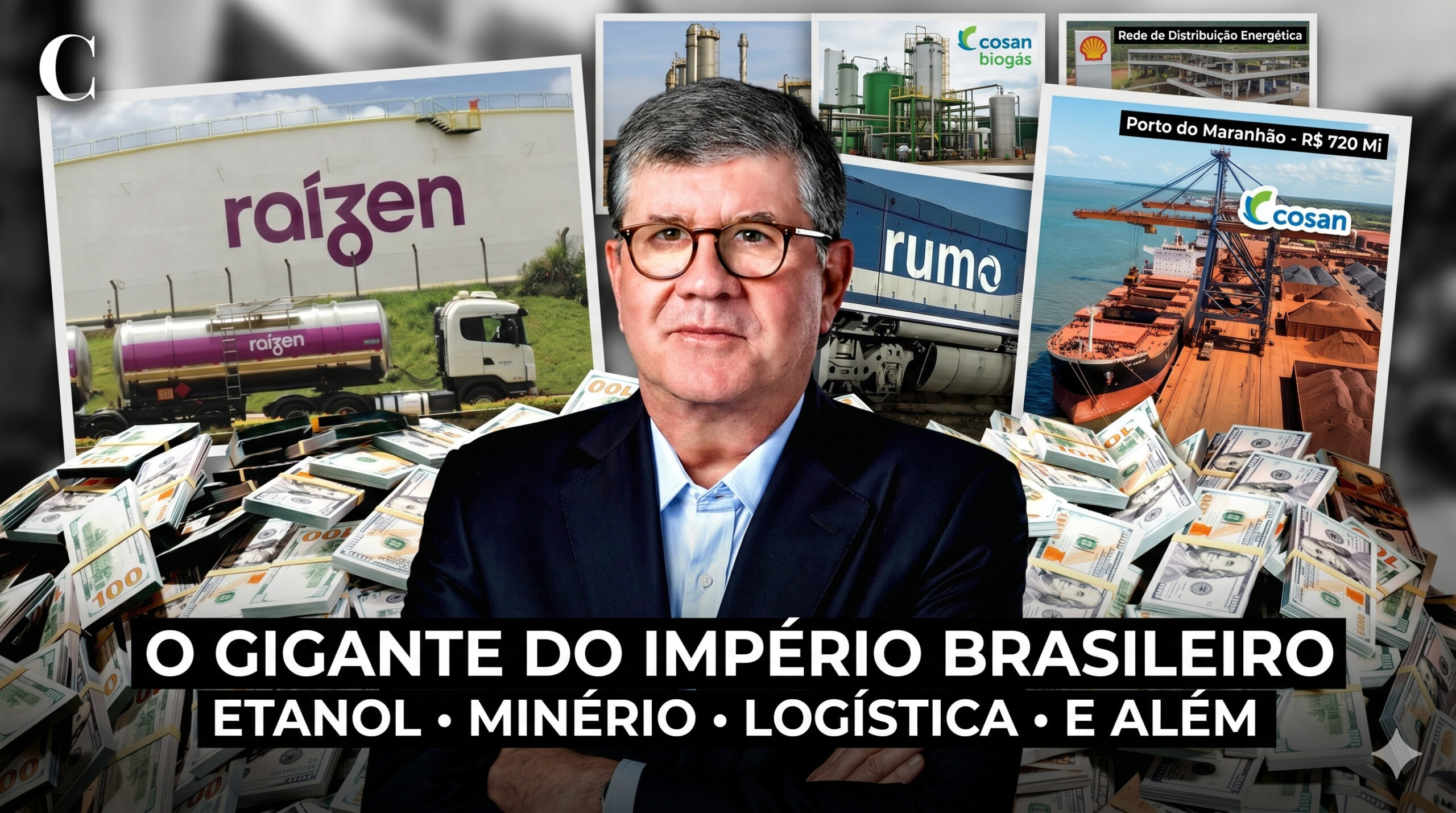

Cosan bought the Port of São Luís for R$ 720 million, entered iron ore mining in Pará, and is now evaluating selling the asset amid a R$ 18 billion debt.
According to NeoFeed, Cosan announced on August 23, 2021, the purchase of 100% of the operations of the Port of São Luís, in Maranhão, for R$ 720 million, in a transaction closed with the China Communications Construction Company group, CCCC, then controlling shareholder of the terminal. At the same time, the company created a joint venture with Grupo Paulo Brito, controller of Aura Minerals, to explore iron ore in three projects in Pará.
The operation was born with an initial projected capacity of 10 million tons per year and a goal of reaching 50 million tons in the future. It was Cosan’s fifth business vertical, after ethanol and sugar through Raízen with Shell, gas through Compass, lubricants through Moove, and railways through Rumo.
A conglomerate with an annualized revenue of R$ 100 billion silently entered one of the world’s most disputed commodities. Few noticed. Years later, with net debt reaching R$ 18 billion, Cosan began trying to sell the same port bought from China, and the main interested party would be the Chinese trading company COFCO.
-
21-Year-Old Brazilian Student Turns Homemade Popsicle Hobby into $100,000-a-Month Business

-
Australia Dumps Hundreds of Thousands of Tons of Gravel into Rivers to Restore Natural Barriers and Reverse 150 Years of Erosion

-
Bird-Inspired Robot Glides on Air Currents up to 10 m/s, Balances Itself, and Aims to Save Energy in Industrial Inspections and Meteorological Balloons
-
Eight Artists Secretly Lived in a Hidden 70m² Apartment Inside a Shopping Mall in Brazil for Four Years



Cosan: Rubens Ometto’s group goes beyond Raízen, Shell, sugar, and ethanol
To understand what the entry into mining represents in Cosan’s trajectory, it is necessary to understand what this company is, and also what it appears to be, but is not entirely.
The name Cosan is associated by the general public with ethanol, sugar, and Shell gas stations. Raízen, a joint venture with the British oil company, is the group’s most visible face. But Rubens Ometto’s Cosan goes far beyond this operation.


Rumo is one of Brazil’s largest private railway operators, with over 14,000 km of network connecting the interior of the Midwest and North to the Port of Santos. Compass operates with natural gas, Moove manufactures and distributes Mobil lubricants, and Atlântico Participações functions as the group’s new investment arm.
Port of São Luís placed Cosan in Pará’s iron ore corridor
Cosan’s expansion logic follows an identifiable pattern: entering sectors where its logistical experience creates a competitive advantage. It was this logic that helped explain its entry into the mining sector.

The Port of São Luís has direct access to the Carajás Railway, Vale’s railway that connects the mines of Pará to the Maranhão coast. Whoever controls a terminal in this corridor has a strategic position to transport iron ore at a competitive cost.
This was exactly the kind of advantage Cosan had already built in grain logistics over decades. The company was not just entering mining, but an integrated chain of mining, railway, and maritime export.
TUP São Luís was built by Chinese CCCC and bought by Cosan for R$ 720 million
TUP São Luís, São Luís Private Use Terminal, was built by the CCCC group, the China Communications Construction Company, one of the world’s largest infrastructure construction companies. The Chinese company held 51% of the terminal, while the remaining 49% was divided among Brazilian minority investors.
The terminal is located in São Luís, Maranhão, in a geographical position described by Itaú BBA as strategic due to its direct access to the Carajás Railway. The railway is about 900 km long and connects Parauapebas, in the heart of the Carajás mineral province, to the Maranhão coast.
The joint venture’s first mineral project was precisely in Parauapebas, the same city where Vale operates one of the world’s largest iron mines. The goal was to produce ore with an iron content above 67%, a product with higher added value than conventional ore.
Cosan’s mining joint venture aimed for 50 million tons per year
A joint venture created by Cosan with the Paulo Brito Group had a clear ambition: to build an integrated mining, railway logistics, and maritime export operation on a relevant scale.
Juarez Saliba de Avelar, former Vale and former CSN, took over as CEO of JV Mineração. The mission was to structure from scratch an operation capable of competing in a sector dominated by giants, with an initial capacity of 10 million tons per year.

The future goal of 50 million tons placed the project on a scale comparable to that of relevant mining companies. Cosan was no longer seen merely as an energy, sugar, and logistics group, but was entering a central commodity of the global economy.
R$ 18 billion debt changed Cosan’s course and put the port up for sale
What seemed like a strategic expansion encountered a significant financial obstacle: indebtedness. The frustrated attempt to acquire a stake in Vale in 2022 left the group with a net debt that reached R$ 18 billion.
To reorganize its finances, Cosan initiated an asset sale plan, and the Port of São Luís was included in the list. According to the Restricted Report cited in the base text, the offers presented by interested parties would have been below the R$ 720 million paid by Cosan in 2021.
The main candidate for the purchase would be COFCO, the largest Chinese state-owned agricultural commodities trading company. The irony is direct: Cosan bought the port from a Chinese company and is now trying to sell it to another Chinese company, possibly for a lower value than originally disbursed.
COFCO targets the Port of São Luís to export grains from MATOPIBA
COFCO does not look at the Port of São Luís for the same reasons as Cosan. While Cosan wanted to export iron ore from Pará, the Chinese trading company is targeting soybeans, corn, and cotton from MATOPIBA, an agricultural frontier formed by Maranhão, Tocantins, Piauí, and Bahia.

For COFCO, the terminal would be another link in a logistics chain already connected to Brazilian agribusiness. The company has a presence in terminals, railway contracts, and operations aimed at exporting agricultural commodities to the Asian market.
The TUP São Luís, therefore, is more than a port terminal. It is a logistical position in one of the country’s most disputed commodity corridors, connecting mining, grains, railway, port, and Chinese demand.
Sale of the terminal could weaken the logistical integration of Cosan’s mining operations
The sale of TUP São Luís, if concluded, does not automatically end Cosan’s mining plans. The joint venture with the Paulo Brito Group has its own legal entity, and the mining assets in Pará are separate from the port.
But without the export terminal, the integrated operation envisioned by Rubens Ometto loses one of its central pillars. The ore would then depend on negotiation with third parties in the Carajás Railway corridor.
This change alters the original business thesis. The strength of Cosan’s entry into mining lay precisely in controlling a significant part of the logistics, and not just in producing ore in the interior of Pará.
Cosan shows how large Brazilian groups operate outside the public radar
Cosan’s trajectory in mining and port logistics shows how large Brazilian business groups build substantial businesses in sectors that the public does not directly associate with their name.
When someone refuels at a Shell station, they think of Shell. When they see a freight train in the interior of Mato Grosso, they might think of Rumo. When they use a Mobil lubricant, they hardly associate the product with Cosan.

This invisibility is structural. The best-known brand captures public attention, while other verticals operate with autonomy, scale, and little exposure. In the case of mining, this became even more evident: port bought from Chinese, joint venture with a mining group, former Vale and former CSN CEO, and a goal of 50 million tons per year.
Port of São Luís could complete China, Brazil, and China cycle in less than a decade
If the sale to COFCO materializes, the Port of São Luís will have completed an unusual cycle: built by a Chinese company, bought by a Brazilian group, and then acquired by another Chinese state-owned company in less than a decade.
What changes between these moments is not necessarily the physical structure of the terminal, but the flow of commodities it is expected to handle. First, Chinese engineering built the asset. Then, Cosan tried to integrate it with iron ore from Pará.
Now, COFCO can use it to strengthen the outflow of grains from MATOPIBA. The same terminal has come to represent three different strategies: Chinese infrastructure, Brazilian mining, and Chinese food security via Brazilian agribusiness.