






 Portuguese
  Spanish


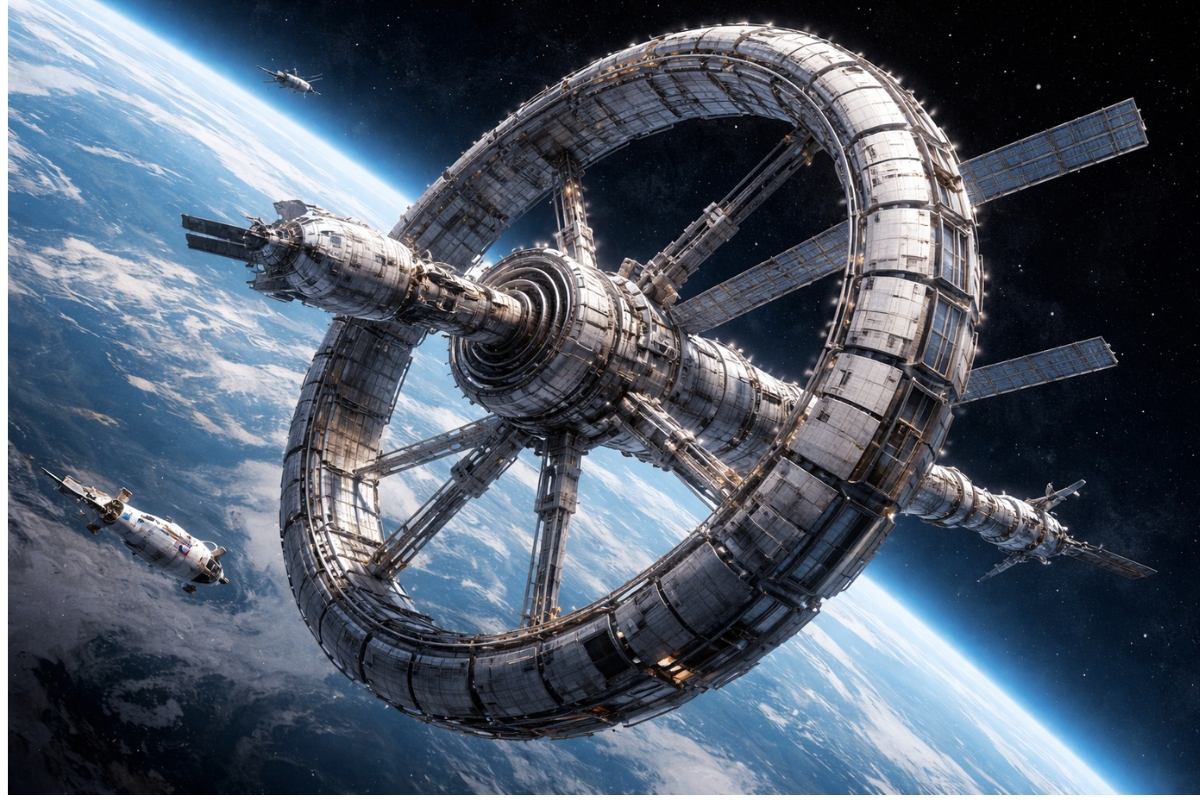


Idea With Artificial Gravity of 0.5 g Seeks to Reduce Muscle and Bone Mass Loss in Long Missions and Points to What May Come After the End of Russian Participation in the ISS.
Russia has entered the spotlight with a project for a rotating space station aimed at a straightforward objective: creating artificial gravity to protect the health of astronauts.
The movement gains momentum as the International Space Station approaches the end of its operation and Russian participation is set to conclude in 2028.
The proposal targets one of the major problems of space: the human body suffers under zero gravity, losing strength and endurance over time.
-
China Develops Custom 140-Ton Electric Mining Truck with 770 kWh Swappable Battery, Deploys 290 Units in Xinjiang’s Largest Zinc Mine

-
Meta to Launch Arena, a New Prediction App Targeting 3.56 Billion Users, Competing with Polymarket and Kalshi

-
Scientist Challenges Famous Human Evolution Theory, Argues Homo Sapiens Evolved Gradually Over Thousands of Years
-
15-Year-Old American Builds Ocean Generator with PVC Pipe and 3D-Printed Propeller for $12, Wins National Prize, Presents at White House, and Makes Forbes 30 Under 30 List




What Happened and Why It Caught Attention
The Russian state rocket company Energia has obtained a patent for a large rotating space complex. The concept seeks to simulate gravity through rotation, like a centrifuge.
The logic is simple: by rotating, the structure generates centrifugal force that pushes occupants toward the floor. This creates a sense of weight and increases the physical load on the body.
The idea addresses the challenge of keeping the crew healthy for extended periods away from Earth.
Why Zero Gravity Wears Down the Body
In space, gravity acts as a constant support for muscles and bones. Without this load, the body loses part of what it uses to stay strong.
On the International Space Station, astronauts need to train for hours every day to reduce conditioning loss and manage to walk more safely upon return.
Artificial gravity appears as an alternative to mitigate this wear during long trips and prolonged orbital stays.
How Artificial Gravity of 0.5 g Would Work
The project aims for 0.5 g, equivalent to 50 percent of Earth’s gravity. The station would have a large, modular rotating structure.
The design deviates from a tube shape and resembles a set that looks like a fan, with fixed parts and parts rotating around a central column.
The connection between habitable areas and the rotating center is described with hermetic and flexible joints, allowing the modules to be linked to the rotation system.
The Design of the Station and the Project Numbers
The habitable modules appear attached radially, like spokes of a wheel. The goal is to keep living spaces away from the center to enhance the effect of rotation.
To achieve 0.5 g, the inhabited areas would need to be 40 meters from the center, and the structure would have to rotate at five revolutions per minute.
In this arrangement, centrifugal force would help keep astronauts anchored to the ground, creating an environment with constant gravity.
Points of Attention and Common Questions
Building something of this scale requires many launches and a complex assembly process in orbit. The size of the structure raises the level of difficulty and operational cost.
Safety is also a concern. One of the challenges is coupling transport ships to a station that rotates continuously, as any mistake can lead to a severe collision.
Nevertheless, the topic is not exclusive to Russia, as there is interest in stations with artificial gravity, and similar concepts have been studied over the decades.
What May Happen From Now On
There are still no resources or timelines set to bring the project to fruition, but the patent signals an intention to develop such a station.
The scenario aligns with the final cycle of the ISS, which is heading for a controlled reentry in 2030, destined for an aquatic grave.
At the same time, the Roscosmos agency is working on the Russian Orbital Space Station, ROSS, and there is a possibility of separating and reusing Russian segments of the ISS.
The intention includes highlighting newer components, such as the multipurpose laboratory Nauka and the node Prichal, just before the planned deorbiting for 2030.
The strategy avoids the complete loss of Russian technological investment in the current station and paves the way for a future with more autonomous operations.
The proposal for a rotating station with artificial gravity reinforces the search for solutions for long missions when daily exercises may not be sufficient to counteract the effects of zero gravity.
With the end of the ISS cycle approaching and the planned exit in 2028, the topic is likely to gain traction, whether through the ROSS or new orbital engineering projects.







Ah coitada! A Rússia tá ****,está raspando o fundo do cofre p manter a guerra na Ucrânia,como vai fazer um projeto desses?
Se não for igual o submarino kursk kkkk
Vai encher linguiça de outro, seus comunista hipócritas, viu que com o governo americano não se brinca. Sou a favor do a capitalismo sim , pois dar dinheiro aos pobres através de benefício, não vai levar o ser humano a lugar nenhum. Temos que dar educação, saúde e emprego pra que essas pessoas sejam dignas de seguirem sua vida com dignidade. Fora ideologia que não seja a de Deus
Primeiro: A Rússia não é comunista.
Segundo: Você se diz capitalista, reclama de dar dinheiro aos pobres, mas pede que o estado gere educação, saúde e emprego, isso não é contrário??
Afinal no capitalismo a única coisa fornecida pelo estado é a segurança, saúde, educação e empregos devem ser gerados pela iniciativa privada.
Decide logo o que que você deseja.
Vai lá rezar para pneu. Amém.
Pessoas como vc são tão fáceis de manipular que chega a ser triste de ver… Repete coisas que ouve por aí sem a menor noção e mínimo entendimento do mundo em que vive… Prefere repetir que nem um papagaio os clichês que ouviu dos seus “mitos” e perdeu a capacidade de analisar a realidade por conta própria. Deixa de ser um **** mandado e vai procurar entender o mundo de verdade, por conta própria ao invés de repetir a ideia de pessoas que vem vc como uma simples estatística…
Uy, qué pelot….udo que sos!! Justamente educación, salud y trabajo es lo que NO DA, NI LE INTERESA DAR a los gobiernos de extrema derecha. Y ya que hablás de Dios, te recuerdo que Jesús echó a patadas a los mercaderes del templo, así que si no querés quedar como un nabo que mezcla todo sin sentido, mejor dejá de escribir sandeces. Y por otro lado, investigá muy bien a ver qué tan comunista es Putin, libertario descerebrado.
Russia não é comunista nem socialista, bicho tonto.
Russia é até de direita…e católico ortodoxo….
Mudando de assunto…
“Dar dinheiro” não é socialismo…
Dar educação, saúde e emprego que sim, fazem parte do socialismo…
Vc está confundindo com assistencialismo…. que não é socialismo….por sinal ele existe mais no capitalismo justamente pq o capitalismo não consegue oferecer trabalho, saúde e educação para todos, pois o dinheiro é afunilado para o acúmulo…logo bilionários ganham mais dinheiro…. exponencialmente