Portuguese
  Spanish


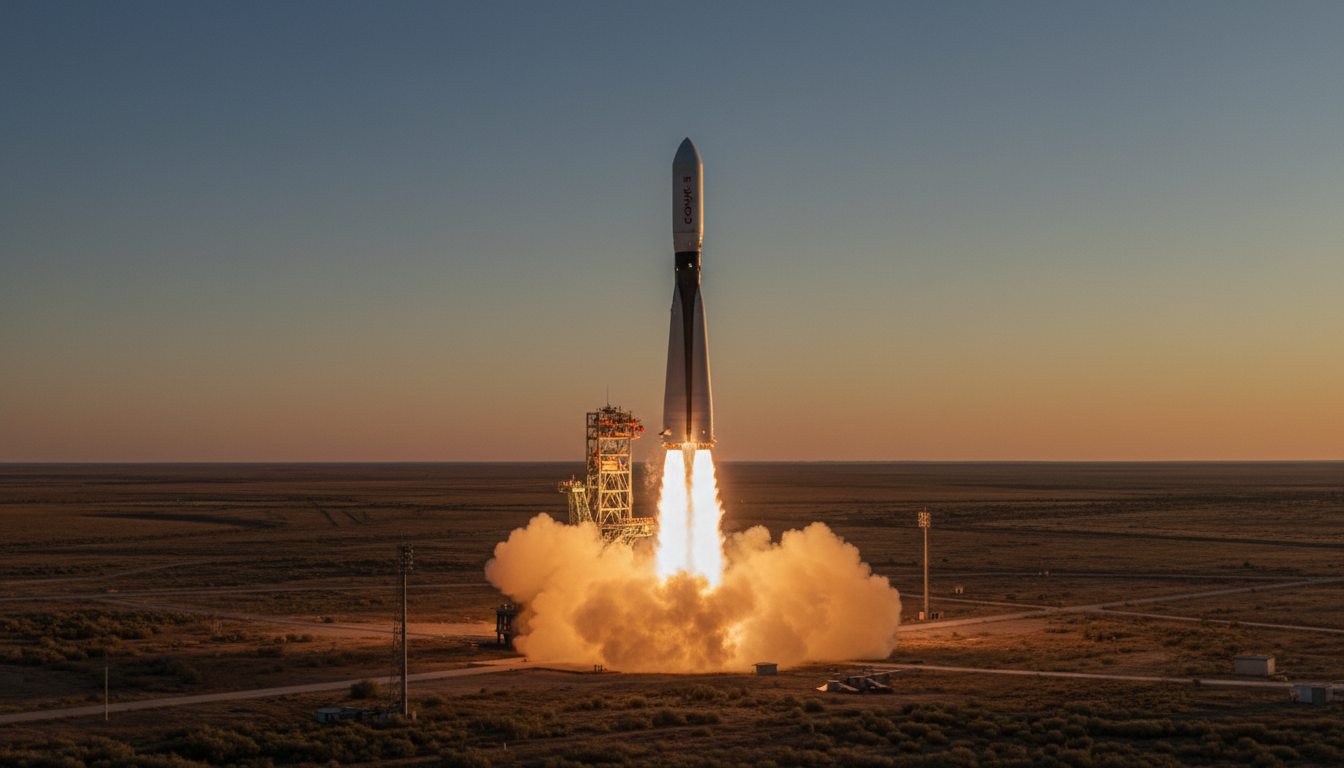


Russia launches Soyuz-5 from Baikonur Cosmodrome with 65 meters and the world’s most powerful liquid-fueled engine
On April 30, 2026, at 11:00 PM local time, the Soyuz-5 rocket lifted off from the Baikonur Cosmodrome in Kazakhstan on its first test flight.
As reported by Euronews, the mission marks the official successor to the old Zenit rocket.
The vehicle is 65 meters long and has a launch mass of 530 tons.
-
Strawberry Moon to Be Visible in Brazil on Monday (29th); Here’s When and How to Watch

-
Driver Crosses 100-Year-Old Railway Bridge Over Uruguay River, Encounters Rural Couple Preserving Traditional Farming Methods
-
Rural Producer Returns to Brazilian Farmland, Builds Family Agricultural Business with Children’s Support and Industry Backing
-
Goiás Couple Boosts Artisan Cheese Production from 25 to 70 Kilos Daily with Technical Support, Transforming Family Life in Rural Brazil




According to the Russian space agency Space Voyaging, the payload capacity reaches 17 tons in low Earth orbit.
Subsequently, the first and second stages operated normally. The simulated payload followed a suborbital trajectory before falling into the Pacific Ocean, as planned in the flight plan.
Soyuz-5 debuts in Baikonur 65 years after Gagarin with the most advanced Russian rocket of the decade
The rocket took off from Site 45 of the Baikonur Cosmodrome, the same facility that hosted Yuri Gagarin’s historic launch in 1961.
At that moment, the new launcher marked exactly 65 years of manned and cargo operations from Kazakhstan.
Indeed, Russia maintains a presence in Baikonur through a leasing agreement with the Kazakh government.
Under the Baiterek program launched in 2004, the contract was extended in 2021 until the year 2050.
On the other hand, Kazakhstan also gains prominence. Similarly, the partnership involves technology transfer and training of local engineers.
In other words, the country aims to advance from a launch pad operator to an autonomous space power.
RD-171MV engine is the most powerful liquid-fueled rocket engine in the world

The heart of the Russian vehicle is the RD-171MV engine. According to Roscosmos, the assembly delivers about 8 meganewtons of thrust.
As a result, the Russian agency classifies it as the most powerful liquid-fueled rocket in the world.
Additionally, the RD-171MV uses kerosene as fuel and liquid oxygen as an oxidizer. In comparison, similar engines in the competition require multiple combustion chambers to achieve similar thrust.
Therefore, the engine represents a direct evolution of the RD-170/171 that equipped the Zenit in the 1980s and 1990s.
Other programs maintain intense development of new platforms, such as SpaceX’s Dragon CRS-34 which departed for the International Space Station on May 13.
Soyuz-5 replaces Zenit and doubles payload capacity in low orbit
The new rocket inherits the operational niche of the Zenit, a rocket developed by the Yuzhnoye Institute in Soviet Ukraine in the 1980s.
According to program data, the Zenit had a launch mass of 430 tons and a capacity of 12 tons in low orbit.
According to Roscosmos, the new vehicle increases the mass to 530 tons. The payload capacity rises to 17 tons.
In other words, the rocket carries about 40% more than its predecessor.
On the other hand, Russia had to develop the entire internal production chain after the rupture with Ukraine in 2014.
Thus, the program was delayed by more than a decade from the initial schedule.
- Length: 65 meters
- Launch mass: 530 tons
- LEO Payload: 17 tons
- First stage engine: RD-171MV (8 MN thrust)
- Predecessor: Zenit (430 tons, 12 ton payload)
- Location: Baikonur Cosmodrome, Site 45, Kazakhstan
Baiterek program unites Russia and Kazakhstan until 2050 in Baikonur

The Baiterek program emerged in 2004 as a joint venture between Moscow and Astana.
According to the original design, the goal was to modernize Baikonur’s infrastructure and create local capacity to support the vehicle.
Subsequently, the agreement was renewed in 2021. As a result, the Russian lease of the base was extended until 2050.
Thus, Russia maintains guaranteed access to the only facility capable of launching large rockets from Kazakh territory.
According to the Diplomat, Kazakhstan earns annual rental revenue and invests in the training of aerospace engineers.
Therefore, the country aims to position itself as a regional hub for launch services in Central Asia.
Zenit ceased production in 2014 after rupture with Ukraine
The Zenit was one of the most used rockets of the post-Soviet era. Similarly, the vehicle carried out military and commercial missions between 1985 and 2017.
According to industry records, it flew in partnership with the Sea Launch consortium from a floating platform in the Pacific Ocean.
On the other hand, Russia’s annexation of Crimea in 2014 cut off the Ukrainian supply chain.
In other words, Moscow lost access to the Yuzhnoye Institute and the manufacturing of key components.
Therefore, the development of the new launcher gained priority in the Russian space plan.
At that moment, the goal became to build a vehicle independent of the Ukrainian industry, with competitive capacity in the commercial market.
Brazil has no direct cooperation with Baikonur in the Soyuz-5 era

Brazil maintains space cooperations with China, the USA, and European countries through the Brazilian Space Agency (AEB).
In comparison, there is no active bilateral agreement with Kazakhstan or Russia for the use of Baikonur.
According to AEB program data, Brazil operates the Alcântara Launch Center in Maranhão.
Other powers like China are advancing in autonomous cargo missions, with Tianwen-2 traveling 45 million kilometers towards an asteroid.
As a result, recent Brazilian launches involved partnerships with SpaceX and Arianespace, not with Roscosmos.
Similarly, Brazilian satellites like CBERS-6 depend on commercial windows with Asian and European suppliers.
Therefore, the Russian vehicle opens potential for future commercial proposals to AEB in the medium payload market.
Next steps: planned orbital flight and commercial partnership under study
Roscosmos plans to conduct the first full orbital flight of the new rocket still in 2026.
Subsequently, cargo missions to the International Space Station and communication satellites are expected to use the vehicle starting in 2027.
According to the disclosed schedule, the manned version is expected to fly in 2028. At that moment, the rocket could replace the veteran Soyuz MS in sending cosmonauts to orbit.
On the other hand, there are recognized limitations. The program faces cumulative delays since 2017. Western sanctions and the war with Ukraine restrict Russian access to advanced electronic components.
Will Russia be able to replicate, with the vehicle, the commercial success it had with the Proton and traditional Soyuz for decades?
Or will sanctions and the loss of the European market prevent the vehicle from competing in the medium segment? The answer begins to appear over the next two years.