






 Portuguese
  Spanish


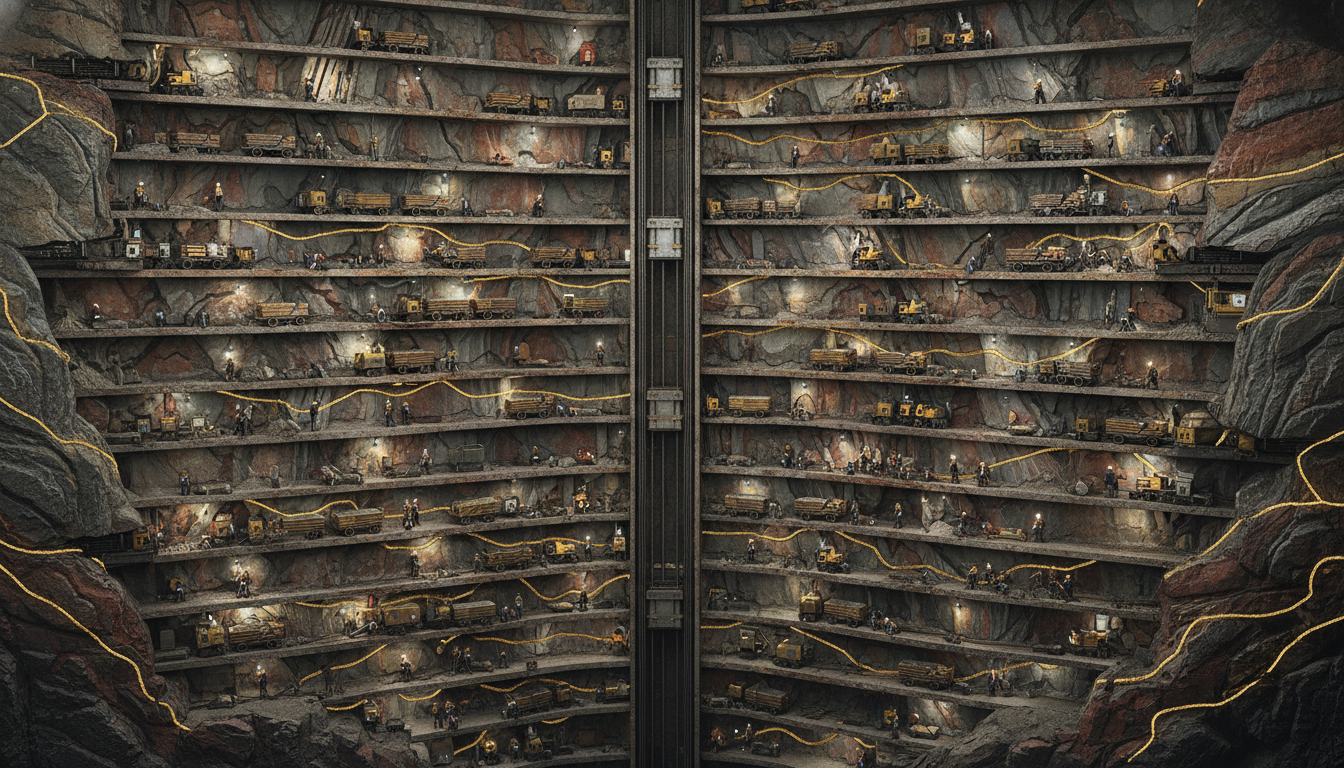


The Mponeng mine in South Africa extracts 5,400 tons of rock per day up to 3,840 meters below the surface and is preparing for expansion to 4,220 meters, where the natural temperature of the rock reaches 66°C — one of the most extreme operations the global mining industry has ever attempted.
The Mponeng gold mine is located in the Witwatersrand Basin, in the western Gauteng province, South Africa.
According to Harmony Gold, the current operator, the mine is the deepest on the planet in production.
According to official data, the current extraction front operates between 3,160 and 3,840 meters below the surface.
-
Engineers Develop Fridge-Sized Machine to Produce 95-Octane Synthetic Fuel from Air and Water, Aiming to Sustain Combustion Engines Without Oil

-
Two-Armed Robot Uses AI to Reassemble Destroyed Pompeii Frescoes, Solving an “Impossible” Puzzle
-
New Law in Brazil Requires Breaks for Type 1 Diabetes Management at Work, School, and Public Exams

-
Scientists Confirm “Greening” of Antarctica: Ice on the World’s Coldest Continent Turns Green as Mosses Multiply Over Tenfold in Four Decades


In comparison, Mount Everest is 8,849 meters high — Mponeng is practically half that depth below ground.
Therefore, equipment needs to descend and ascend in specialized elevators that travel 7.5 kilometers between the surface and the work point.
Subsequently, Harmony announced a plan for an additional deepening of 380 meters to reach 4,220 meters.
The rock reaches a natural temperature of 66°C and requires cooling with ice slurry
At the bottom of the mine, the temperature of the rock reaches 66°C due to the geothermal gradient.
According to Harmony’s engineers, this would be unfeasible for human work without cooling.
According to the installed system, more than 6,000 tons of ice slurry are pumped down daily.
Firstly, the ice melts and absorbs heat from the tunnel walls.
Secondly, this keeps the environment at a tolerable temperature close to 30°C.
On the other hand, the relative humidity exceeds 90% and requires equipment with IP67 protection.

The Mponeng gold mine holds a confirmed reserve of 1,300 tons of gold
According to Harmony Gold, the confirmed reserve is 46 million ounces, equivalent to 1,300 tons of gold.
In comparison, the second deepest mine in the world, Driefontein, has a reserve eight times smaller.
According to market data, at a gold price of US$ 3,250 per ounce (May/2026), the reserve is worth US$ 149.5 billion.
In other words, the mine contains the equivalent of Uruguay’s annual GDP in confirmed gold.
In fact, Harmony paid only US$ 200 million in 2020 to buy the mine from AngloGold Ashanti.
As reported by Bloomberg, the deal became one of the biggest successes in the mining sector in the last decade.
The engineering risks in extreme mining and the increase of “rockburst”
At a depth of 3.8 kilometers, the lithostatic pressure reaches 100 megapascals.
Firstly, this causes spontaneous rock explosions called “rockburst.”
According to the company, Mponeng recorded 17 fatal accidents between 2020 and 2024 due to this phenomenon.
According to the South African Council of Mining Engineers, the statistic is considered acceptable within industry standards.
In comparison, mines in Witwatersrand have accumulated 35,000 deaths since the beginning of the 20th century.
On the other hand, Harmony invested US$ 80 million in real-time seismic monitoring systems.
- Current depth: 3,160 to 3,840 meters
- Future depth: 4,220 meters
- Natural temperature: 66°C in the rock at the bottom
- Cooling: 6,000 tons/day of ice slurry
- Production: 5,400 tons/day of rock
- Confirmed reserve: 1,300 tons of gold (46 million oz)

The gold price above US$ 3,000/oz in 2026 encourages the expansion of the Mponeng mine
The gold price closed May 2026 at US$ 3,250 per ounce, a historic record.
According to the World Gold Council, central bank demand grew 28% between 2023 and 2025.
According to analysts at Goldman Sachs, gold is expected to reach US$ 3,500 by the end of 2026.
Therefore, Harmony Gold accelerated the schedule for expansion to 4,220 meters.
Subsequently, the company projects doubling gold production by 2030.
Similarly, other deep mines around the world are resuming projects shelved during the period of low prices.
In Brazil, the deepest mine is in Vale-Ribeira, at 1.2 km
According to the National Department of Mineral Production, the deepest mine in Brazil is in Vale-Ribeira, São Paulo.
In direct comparison, Vale-Ribeira reaches only 1,200 meters — three times shallower than Mponeng.
According to the National Mining Agency, Brazil produces 60 tons of gold/year compared to 130 tons from South Africa.
In other words, South Africa produces more than double what Brazil does, with fewer mines in operation.
On the other hand, Brazil has estimated gold reserves of 2,400 tons, still underexplored.
As reported by CBMM, Brazilian niobium is worth more per ton than gold in specific markets.

The CPG collection covers extreme mining and the relationship with the energy sector
CPG recently published about gold mining in Brazil, in the site’s collection.
Subsequently, the site also published an analysis on gold as a reserve for central banks, with data from the World Gold Council.
In other words, Mponeng is a central chapter in the global gold economy.
On the other hand, experts argue that extremely deep mines have a high carbon footprint due to electrical consumption.
Next steps: 380 additional meters by 2030 and robotization technology
Firstly, Harmony Gold is investing US$ 410 million in the expansion to 4,220 meters.
Next, the company is testing electric autonomous vehicles to reduce oxygen consumption in the tunnels.
Finally, the goal is to deliver the new front between 2028 and 2030.
However, some warn of the risk of more frequent “rockburst” at extreme depths.
Nonetheless, industry executives argue that the gold price justifies the investment. Still, mining 4 km below the surface exposes the Witwatersrand industry to a physical limit never surpassed.





Remarkable!! However it’s concerning that a statistic of deaths can be considered acceptable.
Hopefully with these financial stats, the labourers are being fairly recompensed.
Agreed, Janet. South African mining unions have pushed hard on this — current wages at that depth are far from proportional to the risk. The article focuses on the engineering side, but the labor question deserves its own piece.