Portuguese
  Spanish


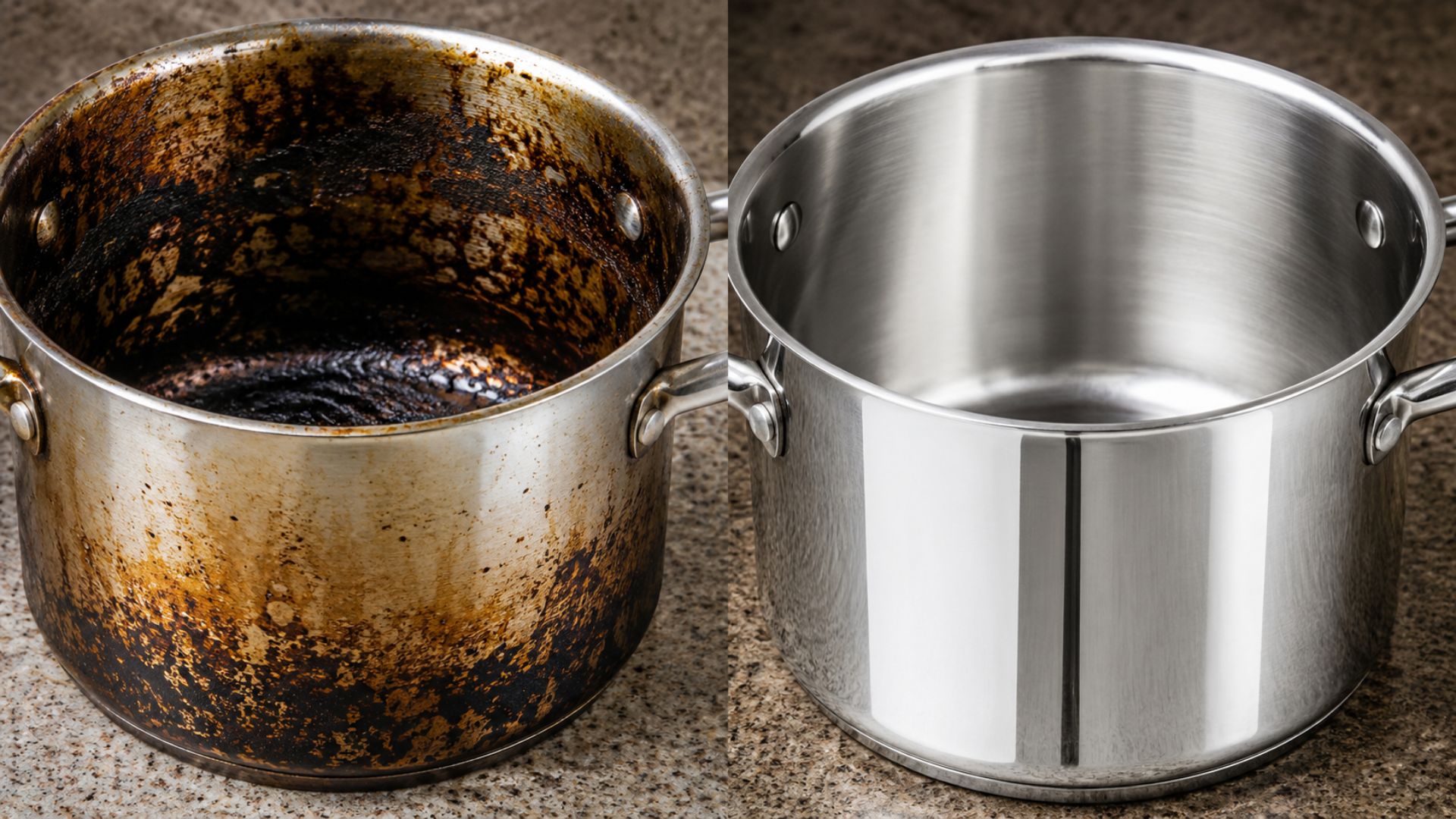


Home tutorial shows how to restore burnt stainless steel pan with oven cleaner, vinegar, sponge, and polishing paste, reducing manual effort and removing old grease. The method requires gloves, ventilation, caution with chemicals, and complete final cleaning to restore shine before considering unnecessary disposal at home with basic safety.
The stainless steel pan that seemed lost due to burning, old grease, and stains can look clean again with a domestic cleaning sequence. The procedure uses oven cleaner, vinegar, sponge, and polishing paste to remove heavy dirt, restore external shine, and prevent the utensil from being discarded prematurely.
The method is recommended when the pan accumulates old crusts and loses its original appearance, especially in kitchens with frequent use of gas flame. The logic is simple: the oven cleaner softens the thicker dirt, the vinegar helps in removal, the sponge works the surface, and the polishing paste restores the stainless steel finish. The central point is to recover value with less brute force and more of the right product.
Burnt pan doesn’t need to become immediate waste
A very burnt pan often seems beyond recovery, especially when old grease darkens the bottom, sides, and seams of the stainless steel. But the tutorial shows that a bad appearance doesn’t necessarily mean the utensil is lost.
-
After a court-ordered shutdown years ago, Onça Puma nickel mine in Brazil’s Pará region restarts, boosting production from 25,000 to 40,000 tons annually, becoming the largest ferronickel operation in Brazil while staying 13% under budget.

-
World’s Largest Playing Card Manufacturer is Belgian, Producing Everything from Market Decks to Pokémon, Magic, and Las Vegas Casino Cards
-
World’s Largest Cork Producer in Portugal Harvests Over 5 Billion Corks Annually from Trees Without Cutting Them Down
-
Most of the world’s wigs and hair extensions are made from Indian human hair and assembled in a single Chinese city, the global wig capital, where 300,000 people rely on this billion-dollar industry.


This case applies especially to stainless steel pans, which do not rely on non-stick coating to function. When the material is stainless steel, the dirt may look bad on the outside, but the structure can still be recovered with proper cleaning.
Oven cleaner comes in as a heavy removal step
The oven cleaner appears as the most impactful product in the initial removal of dirt. Its function is to loosen much of the embedded grease, reducing the manual effort that would be necessary if cleaning started only with common detergent.
Even so, its use requires attention. The product should be handled with gloves, in a ventilated environment, and always according to the label. It’s not a cleaning to do on the fly, because a strong product requires real caution.
Vinegar and sponge help to loosen what is stuck
After the initial action of the oven cleaner, the vinegar comes in as support to clean the loosened dirt. The sponge helps spread the product, reach the surface, and remove residues that have already been softened.
In corners and seams, dirt tends to resist more. Therefore, cleaning may require a second application and more patience. The secret is not to scrub with extreme force, but to let the product act and repeat the process when necessary.
Care with scratches changes depending on the part of the pan
On the inside of the pan, the use of more abrasive materials tends to be less concerning, because this area already undergoes frequent wear during food preparation. The outside, however, requires more caution if the goal is to maintain a beautiful shine and finish.
The anti-scratch sponge can be an alternative when the intention is to preserve the appearance of stainless steel. The tutorial also mentions more abrasive materials, but the editorial caution here is clear: if external shine matters, any strong friction can leave marks.
Polishing paste restores stains and shine of stainless steel
After the thick dirt is removed, the polishing paste plays an important role. It is applied to the surface to reduce yellowish stains, heat marks, and loss of shine, especially on the sides of the pan.
This polishing can be done manually or with the help of a simple tool, as long as care is taken not to overdo it. The polishing paste does not replace heavy cleaning; it comes in afterward, when the stainless steel is already free of the main crust.
Final cleaning prevents product residue in the kitchen
After using oven cleaner, vinegar, sponge, and polishing paste, the final step needs to remove all residues. Common detergent and careful rinsing are important to make the pan ready to return to use.
This point should not be treated as a detail. Cleaning products cannot remain in contact with utensils used for food preparation. The pan is truly recovered when it is clean, without a strong smell, and without apparent chemical residue.
Daily maintenance avoids repeating heavy cleaning
The tutorial also leaves a practical lesson: heavy cleaning should not become routine. When the pan receives frequent maintenance, bluish, whitish, or yellowish stains usually come off with simpler products, such as detergent, vinegar, lemon, or cleaners specifically for stainless steel.
Heavy cleaning is reserved for extreme cases, when grease has accumulated for a long time. Taking care a little after each use avoids spending a lot of time when the dirt has already turned into crust.
Gas stove can accelerate external stains


Pots used on a cooktop or gas stove can darken faster due to the direct flame, especially on the bottom and sides. This helps explain why some stainless steel pieces look aged even when they remain functional.
This visual wear does not mean the pot is doomed. In many cases, stainless steel allows for better recovery than materials with damaged paint or coating. The difference is that a good stainless steel pot can endure years of use and still look well-maintained.
Recovering may be better than buying another
The main economic message of the method is to avoid unnecessary disposal. A stainless steel pot usually costs more than simple models, but it can also last a long time if well maintained.
Therefore, restoring shine, removing grease, and prolonging its lifespan may make sense before buying another. What seemed like trash may just be an expensive piece waiting for the right cleaning.
Safety must come before visual results
Even with striking results, cleaning should not ignore safety. Oven cleaner is a strong product, and should be used with gloves, ventilation, and attention to the label. It is also wise to avoid direct product mixtures without proper rinsing between steps.
The final shine does not compensate for unnecessary risk. The pot needs to be recovered with method, calm, and thorough cleaning. At home, true efficiency is the one that removes dirt without creating another problem.
The burnt pot does not need to go straight to the trash when the material still allows for recovery. The method with oven cleaner, vinegar, sponge, and polishing paste shows that stainless steel can regain its shine after old grease, stains, and heat marks.
Cleaning requires care, gloves, ventilation, and complete removal of products before use. But the idea is strong: before discarding, it’s worth assessing if the pot is lost or just very dirty. Would you try to recover a pot like this at home or prefer to buy another? Share your opinion.