Portuguese
  Spanish


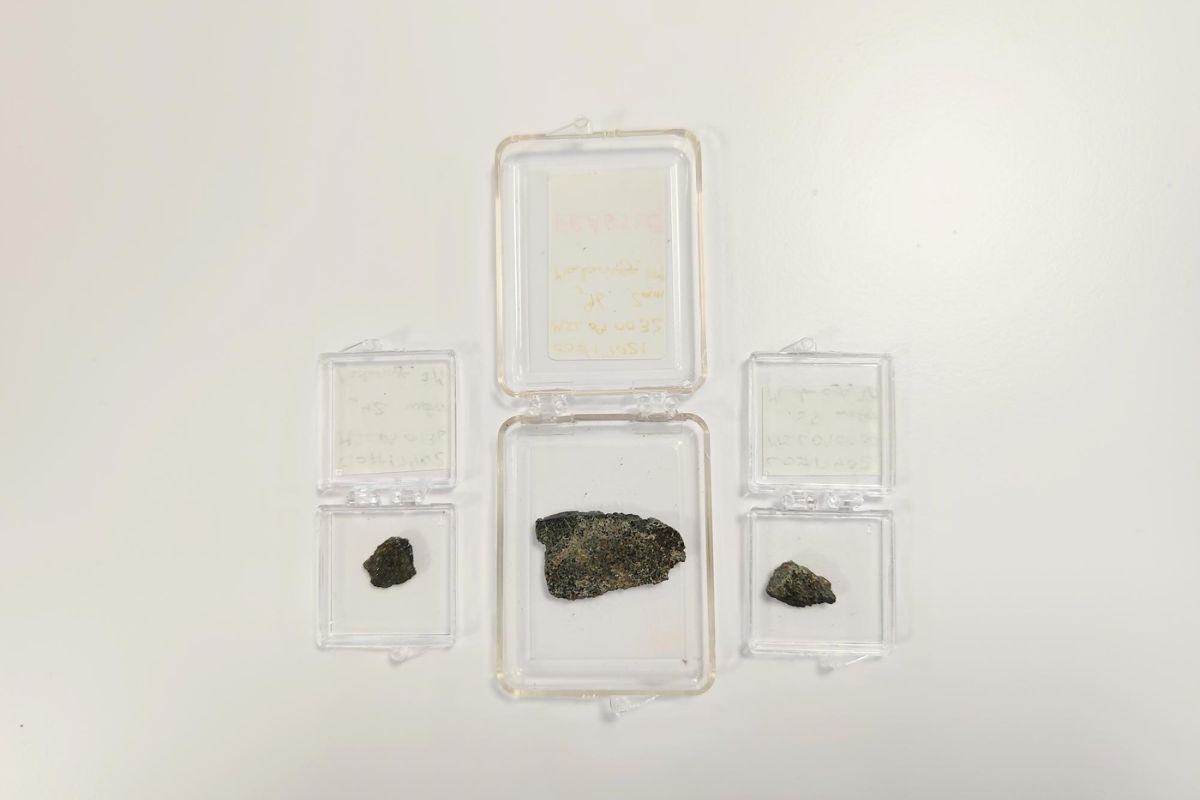

Researchers detected ink residues from a pen in Martian meteorites processed from material from the Johnson Space Center and advocate for more unified protocols for cleaning and preparing rare samples
It seems impossible, but it’s not. Scientists found traces of pen ink in samples of meteorites from Mars. It wasn’t a “message from Martians,” or anything like that. It was a very earthly reminder of how rare samples can accumulate residues during preparation, even when everyone tries to do everything right.
The group received the samples from the Johnson Space Center, NASA, and published the results in a study in Applied Geochemistry. The conclusion is not “distrust science.” It’s the opposite: science is good, but it needs to tighten the screws on protocols even more, especially now that sample return missions are advancing.
Why meteorites “collect” dirt so easily
A rock that crosses space does not arrive on Earth as if it just came out of a display case. The passage through the atmosphere alters the surface and forms an outer layer modified by heat and pressure. Therefore, before studying the interior, scientists remove this outer part and go through cleaning and preparation steps.
-
She spent 73 years breathing inside an iron lung, survived the aftereffects of polio, and became the last woman in the United States dependent on the equipment before dying at 78 years old.

-
Brazilian students created a $1 filter using pine bark, cotton, and 3D-printed parts to clean cassava wastewater, reduce the toxicity of a hazardous waste, and transform contaminated water into biofertilizer.

-
Astronaut from Artemis II steps down after mission to the Moon and decision surprises after a record of 406,771 km, a historic 10-day journey, and an unprecedented achievement for Canada.

-
A fossil kept for years in a small museum in Montreal concealed 450-million-year-old soft tissue, a discovery that has only happened once before in history.


The problem is that each laboratory may have a different way of doing this preparation, and this leaves room for small residues to remain on the material. And meteorites, being rare, are almost “magnets” for anything that touches them.
How samples are prepared before analysis
The study describes that the protocols may involve ultrasonic cleaning, diamond saw cutting, baths in solvents, and even polymer lubricants, depending on the type of sample.
This is where the main point of the alert comes in: the variety of methods shows that there is a lack of stronger standardization, already thought of from the beginning to avoid contamination. Without this, it becomes more difficult to compare results and also more difficult to be sure of what is “signature of space” and what is “signature of the laboratory.”
What the researchers did and why the ink garnered so much attention
The team analyzed six slices of Martian meteorites that had already undergone processing for scientific studies between 2001 and 2014. For comparison, they also included a meteorite that had never been processed.
They used Raman spectroscopy, a common technique to analyze the chemical composition of extraterrestrial materials. Along the way, they found contaminants that were already expected and traceable, such as traces of diamond and ethyl alcohol, which may appear due to tools and procedures.
But the part that makes headlines is different. The team identified a copper compound and a synthetic organic molecule associated with inks used in ballpoint pens and gel pens. A resin linked to a type of printer ink and even blue polyester also appeared, likely coming from some textile material.
In other words: the Mars sample “carried” a bit of the journey it took on Earth.
This means that everything that has been discovered about Mars could be wrong
No. The study is very clear in stating that the chance of someone confusing these residues with something truly originating from Mars is low, because current techniques usually separate contaminants well from legitimate signals.
However, there is a sensitive point: the rarer and more valuable the material, the less margin for noise it allows. And when it comes to looking for specific chemical traces, any unexpected “dirt” becomes a risk factor that deserves to be controlled.
Why this alert becomes more serious with the next Mars samples
The study draws attention to the current moment. With planetary sample return missions advancing, creating unified and “contamination-aware” protocols ceases to be a detail and becomes a requirement.
The authors advocate for more caution and suggest steps to reduce residues from preparation, but also remind that there is no one-size-fits-all solution: the method may need to change depending on the type of meteorite and the mineral being analyzed. The team also states that they intend to continue testing better cleaning methods.
And there is a very practical reason for this concern: researchers from the University of the Basque Country are among the groups that will receive new Martian samples when the Perseverance rover returns material to Earth. They want that when this happens, the question “is this from Mars or is it from here?” is as easy as possible to answer.
If this type of contamination can happen with such rare meteorites, do you think the priority should be to have a single cleaning rule for everyone to follow, or to let each laboratory use its own method as long as it can prove it removed the residues?