






 Portuguese
  Spanish


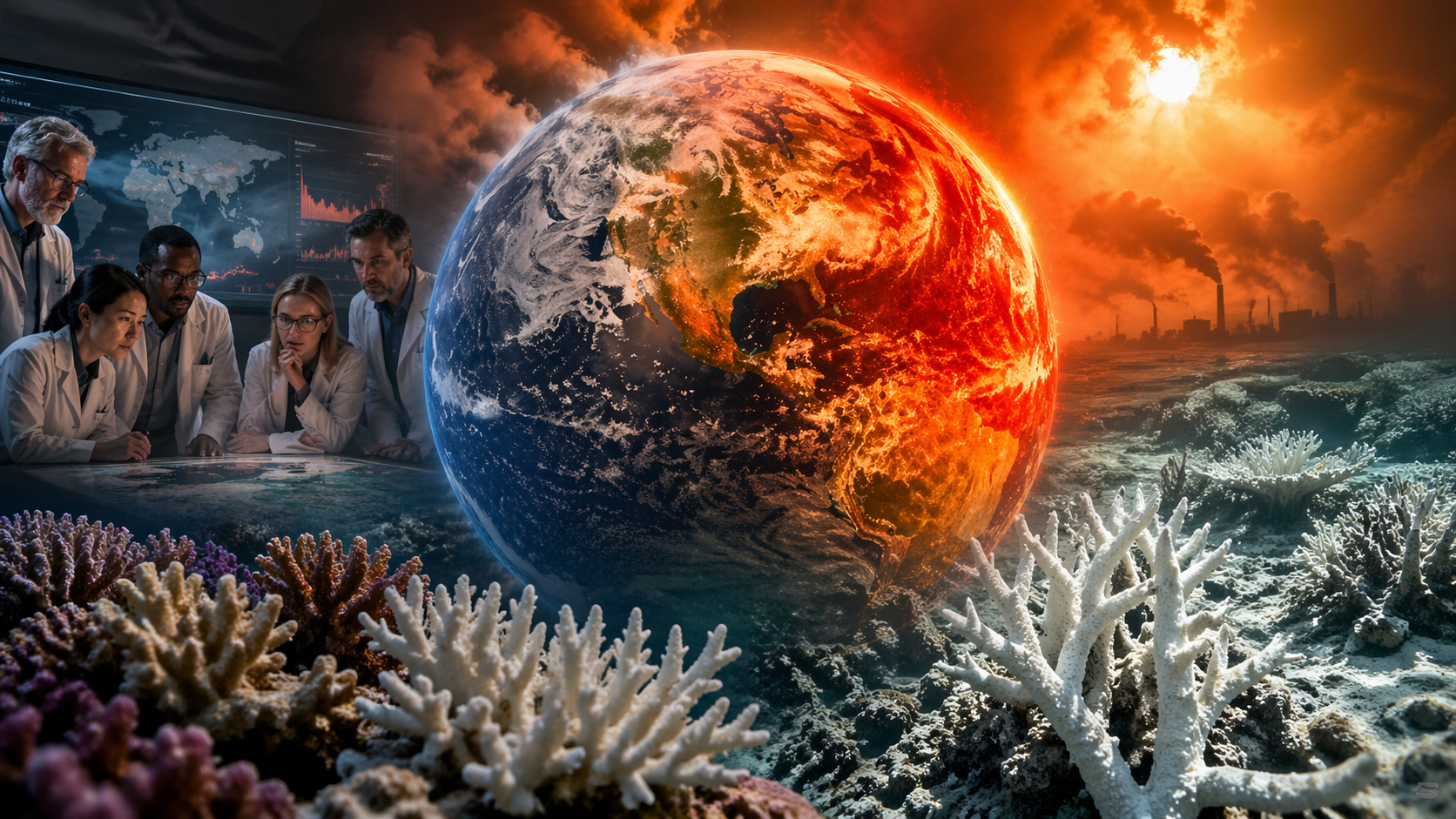

Report of 2025 reveals that 84% of coral reefs are already suffering extreme bleaching and scientists warn of a point of no return climate.
According to the Global Tipping Points Report 2025, prepared by 160 scientists from 87 institutions in 23 countries and led by the University of Exeter, the Earth crossed in 2025 the first of a series of climate points of no return: the widespread death of warm-water coral reefs. The report, released on October 13, 2025, days before COP30 in Belém, does not present future projections but describes a collapse already underway.
According to Steve Smith, lead author of the study, it is no longer a risk but a consolidated reality, indicating that certain natural systems have already entered an autonomous process of degradation.
What is a climate point of no return and why does it completely change the dynamics of global warming
The concept of a climate point of no return, known as a tipping point, describes the moment when a natural system exceeds a critical limit and begins to degrade independently, even if external conditions stop worsening.
-
Snowman-shaped asteroid captured by Hayabusa2 probe during flyby just 10 km away

-
Scientists Discover Clue in Rodent Brains Explaining Why Early Childhood Memories Fade Over Time

-
Revolutionary Fan Model Offers Pedestal or Tabletop Use, Wireless Operation, 20-Meter Airflow, and 24-Hour Battery Life for Indoor and Outdoor Cooling
-
Chinese Scientists Develop Green Technology Turning Agricultural Waste into 50,000 Tons of Biochar Annually, Now Eyeing Aviation Fuel





In the case of coral reefs, this limit is associated with water temperature. Once exceeded for a sufficient time, the system enters a progressive collapse, with no possibility of reversal under the current conditions of the planet.
This type of phenomenon completely alters the logic of global warming, as it transforms controllable processes into self-sustaining dynamics.
Global warming has already exceeded critical limit for survival of tropical reefs according to scientific study
The report indicates that the critical threshold for coral reefs is around 1.2°C above pre-industrial levels. The planet has already reached approximately 1.4°C of average global warming.
Even if warming were stabilized immediately at 1.5°C, there would still be over a 99% probability of collapse of tropical reefs. To allow for significant recovery, it would be necessary to reduce warming to below 1°C, a scenario considered unfeasible within current projections.
Between January 2023 and March 2025, about 84% of the world’s coral reefs were affected by thermal stress, according to data compiled by international institutions.
The phenomenon was driven by marine heatwaves intensified by El Niño and the historical accumulation of greenhouse gases. In February 2024, the average ocean surface temperature reached 21.06°C, the highest value ever recorded.
NOAA has officially declared the fourth global mass bleaching event since 1998, with this one being the most extensive ever observed.
Mechanism of coral bleaching involves collapse of symbiosis with microalgae essential for survival
Corals maintain a symbiotic relationship with microalgae called zooxanthellae, responsible for providing between 70% and 90% of the energy needed for their survival.


When water temperature exceeds critical limits, this relationship breaks down. The coral expels the algae, loses its main energy source, and turns white.
If thermal stress persists, the organism dies, leading to the degradation of the entire associated ecosystem.
Interval between bleaching events has drastically decreased and prevents natural reef recovery
Scientific data indicates that in the 1980s, reefs had between 25 and 30 years to recover between bleaching events.
Currently, this interval has dropped to less than six years in several regions. As a consequence, many reefs are affected again before completing their recovery, compromising their long-term survival.
Brazil is home to the only coral reefs in the South Atlantic, distributed along approximately 3,000 kilometers of coastline.
Between 2023 and 2025, approximately 99.9% of these areas experienced thermal stress. Six of the seven monitored regions recorded alert levels for bleaching.
The reefs of the Brazilian Northeast generate up to R$ 167 billion per year in ecosystem services, including coastal protection, tourism, and fishing. Each square kilometer of living reef can represent approximately R$ 941 million annually in avoided damages.
Arctic ice melt and ocean acidification intensify global coral reef crisis
The accelerated warming of the Arctic, which occurs at a rate up to four times higher than the global average, alters ocean circulation patterns and contributes to temperature increases in tropical regions.
Moreover, the absorption of carbon dioxide by the oceans causes acidification, reducing the ability of corals to form their calcium carbonate skeletons. These processes act in combination, increasing the vulnerability of reefs.
Scientists warn of domino effect among climatic systems with risk of chain collapses
The report indicates that coral reefs may be just the first system to cross a critical threshold.
Other monitored systems include the Atlantic Meridional Overturning Circulation (AMOC), the polar ice caps, and the Amazon rainforest. The interaction between these systems can generate cascading effects, accelerating processes of global degradation.
The study also identifies significant advancements in areas such as solar energy and electric vehicles, classified as potential positive tipping points.
However, these advancements are still not occurring at a fast enough pace to offset the accumulated impacts of climate change on critical natural systems.
Now we want to know: is the collapse of reefs an isolated event or the first sign of an irreversible change in the global climatic system?
The 2025 report presents evidence that profound transformations are already underway in the climatic system.
In your assessment, do these events represent an isolated point or indicate the beginning of a sequence of irreversible changes on a global scale?


