Portuguese
  Spanish


The James Webb Space Telescope identified a supermassive black hole with 50 million solar masses that existed just 700 million years after the Big Bang, in the early universe, and which represents two-thirds of the total mass of the object around it. The discovery, published in Nature and in the Monthly Notices of the Royal Astronomical Society, challenges the classical model of black hole formation and suggests that the object emerged before the galaxy itself. The black hole is in the object Abell2744-QSO1, a “Little Red Dot” magnified by the gravitational lens of the Pandora Cluster, more than 13 billion light-years from Earth.
For the first time in the history of astronomy, scientists have managed to directly measure the mass of a black hole that existed in the first billion years after the Big Bang, and the result is disturbing. The object, called QSO1, contains a supermassive black hole with approximately 50 million times the mass of the Sun, and this gravitational monster alone represents two-thirds of all the mass existing around it. The proportion is thousands of times greater than that observed in nearby galaxies, where the central black hole accounts for a tiny fraction of the total mass, and suggests that in this case, the black hole emerged first and the galaxy is being born after it.
Roberto Maiolino, from the University of Cambridge and co-author of the studies, classified the discovery as “a paradigm shift, a total revision of the classical scenarios of how black holes form and grow”. The James Webb observed QSO1 more than 13 billion light-years away, with the light from the black hole having traveled since a time when the universe was only 700 million years old. The object is magnified by a gravitational lens effect caused by the galaxy cluster Abell 2744, known as the Pandora Cluster.
How scientists measured the mass of the black hole

The team used the James Webb’s NIRSpec instrument to map the movement of gas around the black hole and identify the chemical composition of the region. The hydrogen surrounding QSO1 exhibits a pattern called Keplerian rotation, the same type of movement that planets make when orbiting the Sun, which allowed for the direct calculation of the object’s mass using known gravitational laws.
-
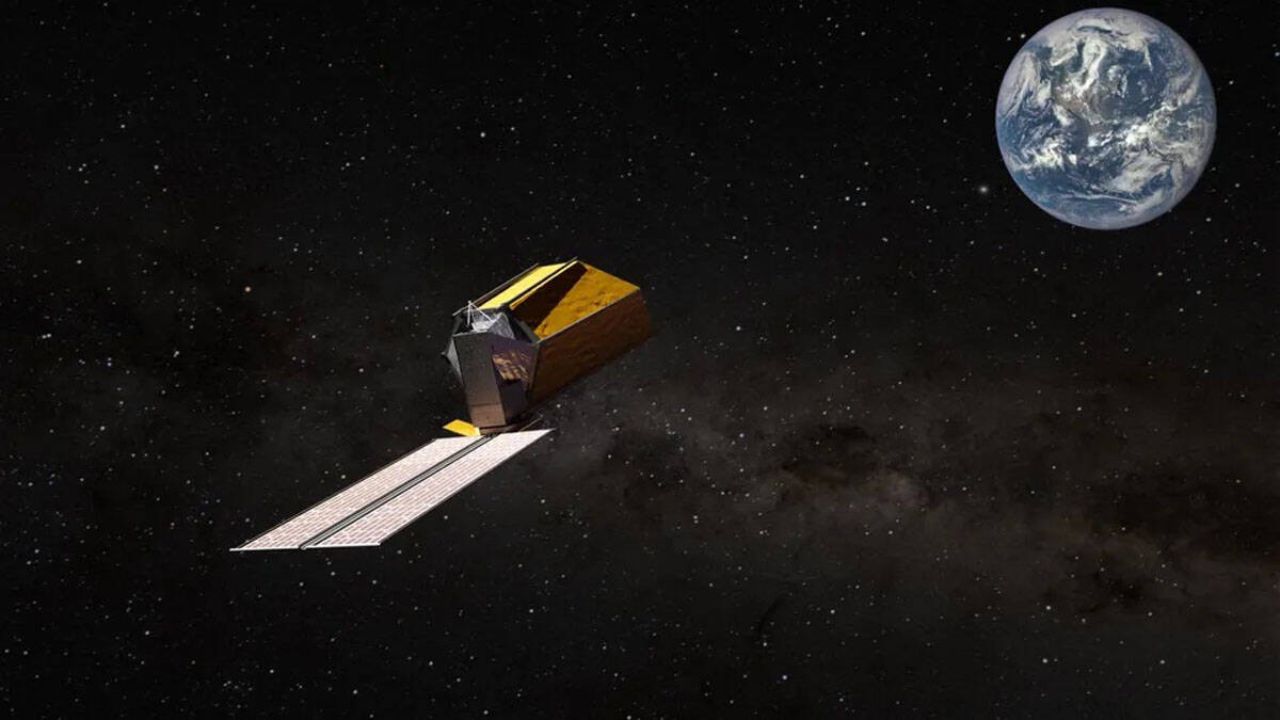
NASA Plans Telescope That Can Be Repaired by Robots 1.5 Million Kilometers from Earth

-
China Launches First Oceanic Medical Rescue Ship with Advanced Facilities to Serve Remote Regions

-
Midea Unveils Portable PortaSplit Air Conditioner: 12,000 BTUs, Quiet Mode, Heating, Dehumidification, App Control, and AI Efficiency Without Professional Installation
-
Singapore Turns Incinerated Waste Ash into Construction “Sand” in Ambitious Project to Revolutionize Megacity Waste Management


Researcher Ignas Juodžbalis explained that Keplerian rotation is significant because it indicates that most of the mass is concentrated in the central black hole. If the mass were distributed among many surrounding stars, the gas would not have this perfect orbital pattern. The direct measurement confirmed that the black hole has approximately 50 million solar masses, a value consistent with previous indirect estimates of 40 million.
The black hole that was born before the galaxy
For decades, the accepted model stated that supermassive black holes arose from the collapse of large stars within already existing galaxies and gradually grew by consuming matter and merging with other black holes. The problem has always been explaining how some of these objects reached masses of millions or billions of suns so early in the universe’s history, when there simply wasn’t enough time for gradual growth.
QSO1 challenges this scenario because the black hole represents two-thirds of the total mass of the system, a proportion that would be impossible if it had arisen within a previously formed galaxy. Juodžbalis stated that “we found a black hole that does not have a substantial host galaxy and that preceded stellar processes,” classifying the discovery as “evidence of primordial or direct collapse black holes, which had been theorized but not confirmed.”
The most primitive environment ever observed around a black hole
Chemical composition maps revealed that the gas around the black hole is composed almost entirely of hydrogen and helium, with minimal amounts of heavier elements like oxygen. The metallicity of QSO1 is less than 0.5% of that observed in the Sun, making the environment one of the most “primitive” ever measured in the entire history of astronomical observation.
This composition is significant because elements heavier than hydrogen and helium are produced within stars. The near-total absence of these elements around the black hole reinforces the idea that the object formed in an environment where stars had not yet enriched the surrounding gas. According to Maiolino, “it is the first direct measurement of the mass of a black hole within the first billion years after the Big Bang.”
What the discovery changes about the origin of black holes
Scientists believe that QSO1 may have originated from a “heavy seed” formed in the first moments after the Big Bang or from the direct collapse of a gigantic cloud of primordial gas. In both scenarios, the black hole would have been born enormous, without needing billions of years of gradual growth, which explains how it was already supermassive when the universe was still young.
QSO1 may be in the early stages of forming a galaxy around it, reversing the order scientists assumed: instead of the galaxy creating the black hole, it is the black hole that is creating the conditions for the galaxy to exist.
If this hypothesis is confirmed with more observations from James Webb, the model of structure formation in the universe will need to be rewritten. James Webb has already identified dozens of “Little Red Dots” similar to QSO1, and each one may contain a supermassive black hole that challenges the classical scenario.
Did you know that a black hole with 50 million solar masses may have emerged before the galaxy itself? What impresses you more: the age of 13 billion years, the proportion of two-thirds of the total mass, or the primitive composition of the gas? Tell us in the comments.