Portuguese
  Spanish


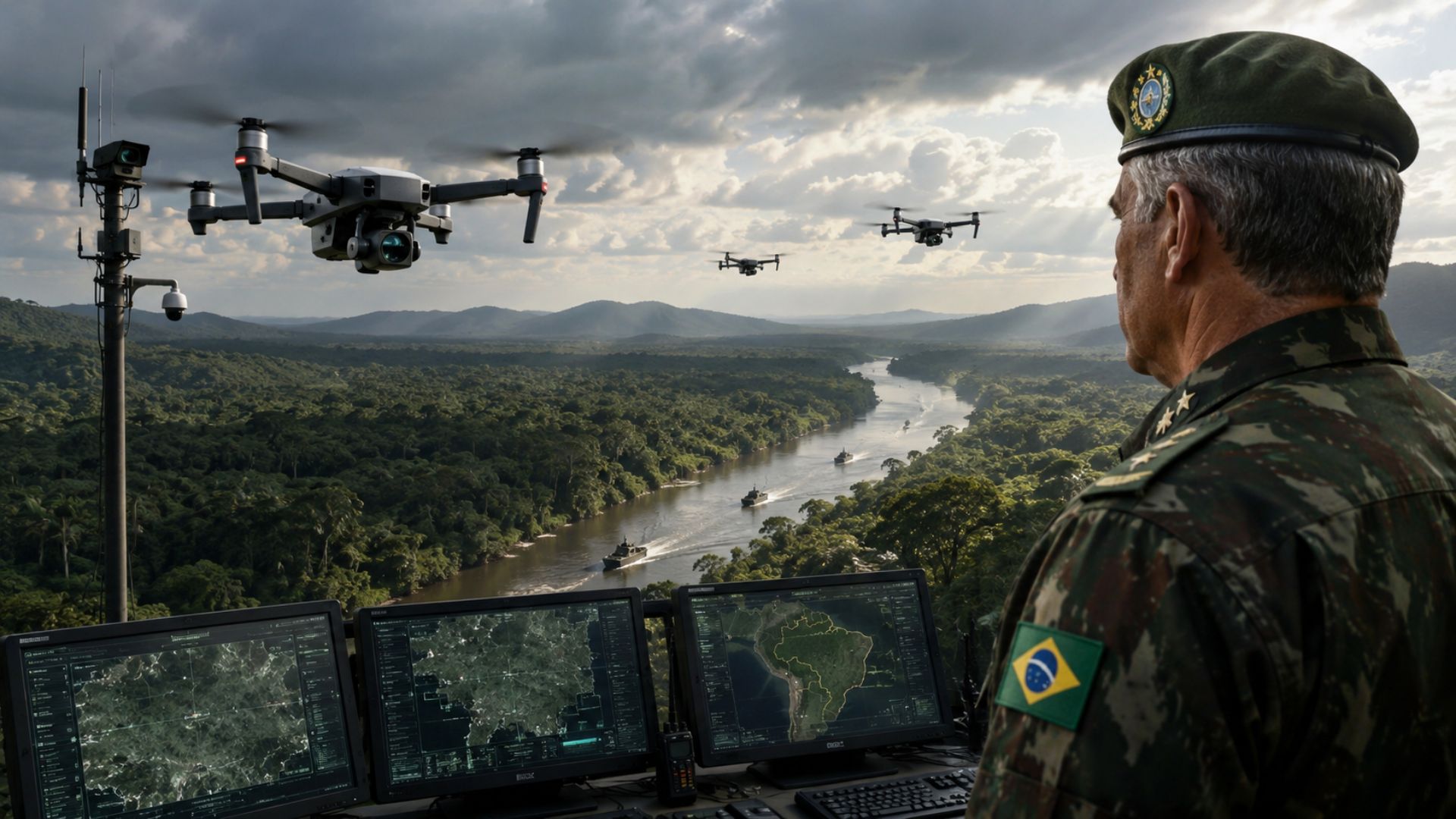


The commander of the Brazilian Army, General Tomás Paiva, declared this Wednesday (27) that there is a “perception of threat in South America,” a situation that, according to him, did not exist in the past. The statement was made during the Unmanned Systems Symposium of the Land Force, in Brasília, where seven companies presented attack, bombing, and surveillance drones to the High Command. According to information from the portal Poder 360, the general stated that the Brazilian Army needs to “employ more and more technology” to protect the border strip, which he called a “huge concern.”
The Brazilian Army publicly acknowledged, through its commander’s voice, that the security scenario in South America has changed. General Tomás Paiva stated during the Unmanned Systems Symposium of the Land Force, in Brasília, that “in the past, we had no threat in South America. Today we have a perception of threat, including our constitutional and legal role of assisting the Republic’s Powers in the border strip, which is a huge, very vast concern.” The statement by the commander of the Brazilian Army marks a significant change in tone regarding the Force’s historical stance, which traditionally treated the South American surroundings as a peaceful zone free of conventional threats.
At the event, seven companies presented to the High Command of the Brazilian Army technologies of unmanned systems, including attack, bombing, and surveillance drones. General Paiva argued that the Force needs to “employ more and more technology” to monitor and protect the border strip, an extension of more than 16,000 kilometers that stretches from the Amazon to the South of Brazil. The symposium is part of the Brazilian Army’s Transformation Policy, a program that seeks to make the institution more agile, integrated, and technologically prepared for current geopolitical challenges.
What the commander of the Brazilian Army said about threats
Tomás Paiva’s statement is relevant because it breaks with decades of Brazilian diplomatic discourse that presented South America as a region free of interstate conflicts. The general did not specify which threats the Brazilian Army identifies, but mentioned operations in the border zone as a priority, suggesting concerns about transnational organized crime, drug trafficking, illegal mining, and political instability in neighboring countries.
-
Structural Report Reveals Serious Issues at Historic Corinthians Stadium, Engineer Recommends Partial Demolition

-
For a Decade, a Young Sudanese Innovator Builds Robots from Electronic Scrap in a Makeshift Lab in Omdurman

-
Woman with no tech background uses AI to develop app, reaches 50,000 users and goes viral with 2 million views by turning conversations into an emotional support tool.
-
From Construction Helper at 12 to Leading Real Estate Ventures Worth $210 Million After Delivering Over 2,000 Homes


Brazil’s border zone is 150 kilometers wide along the entire land border with ten South American countries. In this area, the Brazilian Army supports public security forces in combating cross-border crimes, an operation that requires constant vigilance in terrains ranging from dense forests in the Amazon to open fields in the South, passing through the Pantanal and the cerrado.
The drones that the Brazilian Army wants to use at the borders
The Unmanned Systems Symposium brought together seven companies that presented drones and terrestrial technologies of different categories. The demonstrations included unmanned attack aerial vehicles, autonomous bombing systems, and surveillance platforms capable of operating for long periods in remote areas where permanent human presence is unfeasible.
For the Brazilian Army, the adoption of drones is a matter of scale. Monitoring over 16,000 kilometers of border with conventional ground patrols would require a contingent that the Force does not have and a budget incompatible with the country’s fiscal reality.
Surveillance drones can cover extensive areas with lower operational costs, transmitting real-time images to command centers that coordinate the response on the ground.
The Brazilian Army Transformation Policy


The symposium was held based on the Brazilian Army Transformation Policy, a document that recognizes “a consistent trend of increasing defense investments” worldwide and warns that Brazil needs to follow this movement “under penalty of increasing strategic vulnerabilities.” The policy is organized into four axes: institutional design, military capabilities, doctrine, and personnel, with the aim of accelerating the incorporation of technologies and developing a transformation mindset within the Force.
The capabilities axis is the most directly linked to the symposium, as it aims to systematize the governance of land military capabilities and accelerate the process of incorporating new technologies. The Brazilian Army seeks not only to acquire modern equipment but also to integrate these systems into an operational doctrine that allows them to be used efficiently in real employment scenarios, from the Amazonian border to law and order operations in urban centers.
What the declaration means for Brazil’s defense
The public admission that the Brazilian Army perceives threats in South America has diplomatic and budgetary implications.
In the diplomatic field, the declaration may generate reactions from neighboring countries that feel alluded to, especially at a time of political instability in nations like Venezuela and Bolivia. In the budgetary field, the perception of threat reinforces the Force’s argument for more resources for modernization and technology acquisition.
General Paiva did not propose an increase in personnel or territorial expansion, but rather the intensive use of technology as a force multiplier.
For the Brazilian Army, the message is clear: Brazil’s borders need permanent technological surveillance, and the era when South America was considered a strategically calm environment is in the past.
Did you know that the commander of the Brazilian Army publicly acknowledged that there are threats in South America? Do you think investment in drones is the right answer or does Brazil need another strategy for its borders? Tell us in the comments.