Portuguese
  Spanish


In the south of Spain, the “sea of plastic” of Almería gathers thousands of greenhouses in an area of about 400 km², transforming a dry region into a European agricultural hub and drawing comparisons with the large monoculture model of the United States
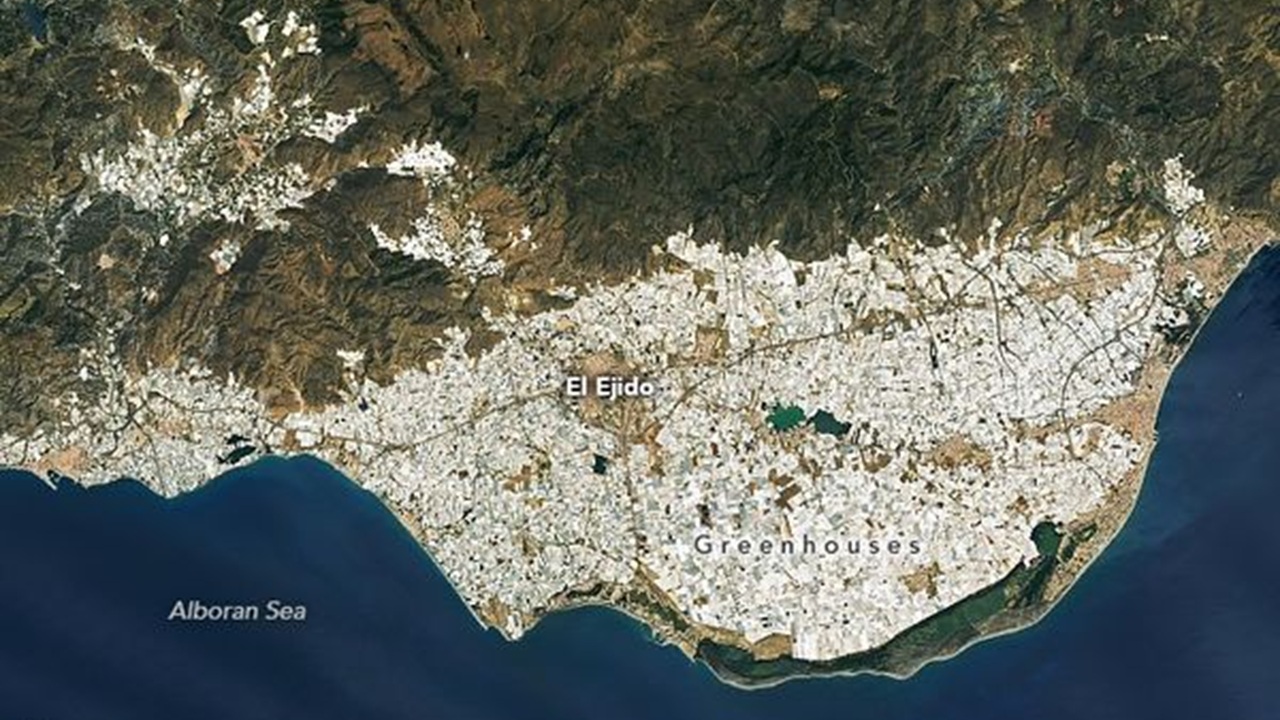
In the south of Spain, the province of Almería draws attention for an unusual landscape: thousands of white structures cover the ground and form a huge mosaic seen from above. At first glance, they look like warehouses or industrial roofs. But, beneath this cover, there are plantations.
The region known as the “sea of plastic” of Almería gathers more than 40,000 hectares of agricultural greenhouses, according to estimates cited by NASA. The complex occupies practically the entire Campo de Dalías and has expanded to neighboring areas, forming one of the largest concentrations of protected agriculture in the world.
According to the channel Business Explains The World, this concentration of greenhouses has transformed an arid area into one of the main vegetable supply hubs in Europe, especially in the autumn and winter months, when local production becomes even more important in the European market.
-
Antarctic Volcano Emits Microscopic Gold Particles That Travel Up to 1,000 Kilometers Across the Continent

-
Little-known Japanese factory is the world’s largest zipper manufacturer, producing 7 billion pieces annually and closing half the world’s pants.

-
Brazilian Factory Recycles One-Third of the Country’s Styrofoam Waste, Matching European Levels with 51,000 Tons Reused Since 2007
-
Brazilian Navy Conducts Major Military Exercise with 2,000 Troops, Amphibious Vehicles, and Drones on Lake Furnas in Minas Gerais


What exists beneath the white greenhouses
Under the plastic covers, farmers grow peppers, tomatoes, cucumbers, zucchinis, fruits, and other vegetables. The system allows for protecting the plants against wind, excessive heat, and climatic variations.
The plastic acts as a kind of shield. It helps maintain more stable conditions inside the greenhouses and reduces some of the risks faced by open-air crops.
This protection was essential for a region that, historically, was not seen as a major agricultural area. Almería is in one of the driest zones of Spain, near the Tabernas Desert, often cited as the only true desert in Europe.
From poor area to agricultural powerhouse
As shown in the academic article by Cambridge University Press, for a long time, Almería was one of the poorest provinces in Spain. The dry climate, strong winds, and unfavorable soil made cultivation difficult.
The change began in the 1950s when farmers started testing new ways to prepare the land. They added layers of sand and organic matter to the soil and began using plastic covers to protect the crops.
In 1963, experiments with plastic boosted the advancement of greenhouses in the region. Over time, irrigation, agricultural engineering, and Spain’s entry into the European Union helped consolidate the model.
The size of production
Today, Almería produces between 2.5 million and 3.5 million tons of fruits and vegetables per year. The production supplies a significant part of the European market, especially during colder periods when other countries have less cultivation capacity.
The video also highlights the case of peppers. While the United States produced about 1 billion pounds of peppers in 2023, Almería’s production was presented as superior. Sectoral data indicates that the local pepper crop in 2023/2024 exceeded 900 million kilograms, equivalent to about 2 billion pounds.
Why the climate helps
One of Almería’s secrets is the sun. The region has more than 300 sunny days per year. This reduces the need for artificial heating in the greenhouses, unlike in colder regions like the Netherlands and Canada.
In the summer, when the heat increases, farmers often paint or lighten the exterior of the greenhouses with white material, such as lime, to reflect sunlight.
Studies have already pointed out that this light cover increased the reflection of solar radiation and caused a local cooling effect, estimated at about 0.3 °C per decade between 1983 and 2006.
Less chemical products and more biological control
Another important point is integrated pest management. Many producers have started to reduce the use of more aggressive pesticides and have adopted beneficial insects to combat pests inside the greenhouses.
In practice, they release organisms that attack the harmful insects to the crops. This helps maintain the balance of cultivation and reduces dependence on chemical pesticides.
The model combines simple technology, environmental control, efficient water use, physical protection of plants, and organization among small producers.
Small farms organized in cooperatives
Almería is not dominated only by large industrial farms. A large part of the production comes from family-owned properties, many of them managed for generations.
These farmers organize themselves into cooperatives to sell better, negotiate prices, gather production, maintain a constant supply, and gain strength in front of buyers and distributors.
This system helps explain how a relatively small area can generate such high production and maintain a relevant role in European supply.
The comparison with the United States
The video uses Almería to compare two agricultural models. In the United States, there is an immense amount of arable land, but a large part of the agricultural area is occupied by monocultures, such as corn, soybeans, and wheat.
These crops are commodities. Many do not go directly to fresh human consumption. They are used in animal feed, biofuels, and industrial products.
At the same time, the United States imports a growing share of fruits and vegetables. In the case of fresh vegetables, USDA data indicates that the share of imports rose from 20% to 38% between 2007 and 2021.
How agricultural policy shaped this scenario
The difference between the models has historical origins. In the United States, the crisis of the 1930s, the Great Depression, and the Dust Bowl led the government to strongly support large agricultural crops.
The Agricultural Adjustment Act of 1933, and later the Farm Bill, created support mechanisms that especially benefited commodities such as corn, wheat, cotton, dairy, and pork.
Over time, large properties gained more strength, while small farmers found it more difficult to compete.
In Spain, Francisco Franco’s regime created the National Institute of Colonization, with the aim of bringing population and agricultural production to rural areas. In Almería, this process opened space for new irrigation techniques, soil preparation, and protected cultivation.
A model with advantages, but not perfect
The case of Almería does not mean that the system is free of problems. Intensive greenhouse farming also faces criticisms and challenges, such as the use of plastic, pressure on water resources, waste disposal, and labor dependency.
Even so, the region shows how a dry area managed to significantly increase its production using a controlled environment, cooperative organization, and climate adaptation.
The debate on food security
The report from the channel Business Explains The World argues that the United States could learn from models like Almería’s, especially in the face of challenges such as water scarcity, loss of fertile soil, dependence on imports, and climate change.
According to the FAO, global food production would need to increase by about 70% by 2050, compared to the level of 2005/2007, to keep up with global demand.
In this scenario, the greenhouses of Almería have become more than just a curiosity seen from space. They represent a practical response to an old problem: how to produce a lot of food in a place where, for a long time, it seemed impossible to plant on a large scale.