






 Portuguese
  Spanish
  6 min of reading
  0 comments


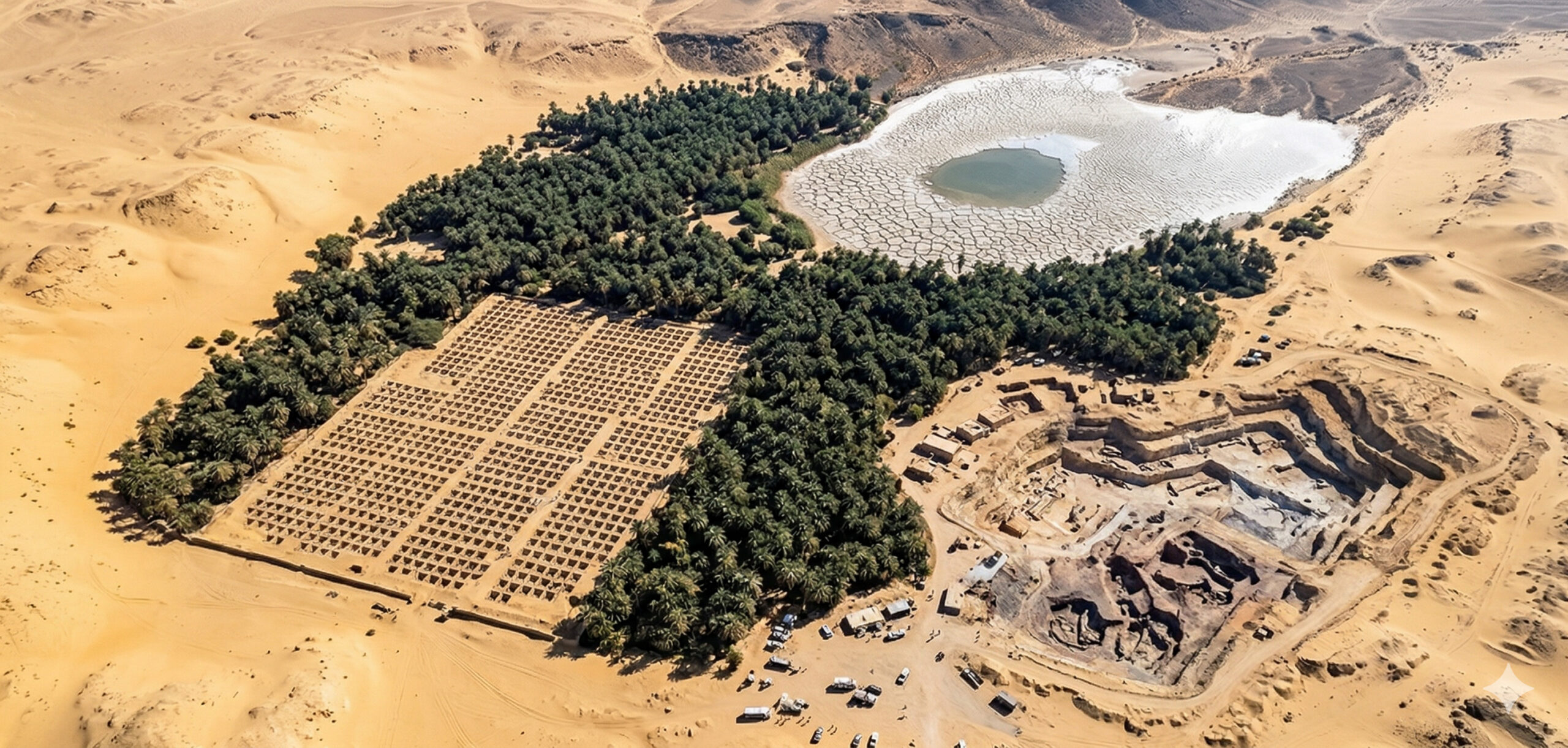
Bahariya Oasis reveals a lake in the desert, golden mummies, and giant dinosaurs in one of the most surprising landscapes in Egypt.
In 2015, a photograph captured by astronauts aboard the International Space Station (ISS) and later published by NASA Earth Observatory revealed a curious pattern in the west of Egypt. Amid the vast clear and homogeneous expanse of the Sahara Desert, small dark spots emerge that are almost imperceptible at first glance. These spots, when observed more closely, correspond to the groves of date palms and olive trees of the Bahariya Oasis, one of the most remarkable habitable enclaves in the Egyptian Western Desert.
Located about 370 kilometers southwest of Cairo, as reported by the official platform Experience Egypt, Bahariya occupies a large geological depression in the desert. The NASA Earth Observatory itself describes the site as one of the large depressions west of the Nile deep enough to reach groundwater, a condition that allows for dense vegetation and agricultural crops in one of the most arid regions on the planet.
What makes this region exceptional, however, is not just on the surface. Beneath the seemingly dry soil, Bahariya holds successive layers of natural and human history, with records studied by geologists and paleontologists in areas such as stratigraphy, paleontology, iron ore deposits, and geoarchaeology. In a study published in the Journal of African Earth Sciences, researchers highlight that the formation and evolution of the depression are linked to long-term geological processes, making Bahariya one of the most complex and historically rich systems in North Africa.
-
In Sweden’s Jukkasjärvi, Artists Transform the Frozen Torne River into the Icehotel, a Seasonal Ice Structure That Melts Back into Nature

-
Innovative Heat Storage Tower in Finland Uses 2,000 Tons of Crushed Soapstone to Warm Cities
-
17-Year-Old Homeschooler from the Bahamas Solves 40-Year-Old Math Puzzle, Earns Direct PhD Admission
-
Giant South American Tree Stores Water in Its Trunk, Survives for Years in Dry Regions


Geological depression allows for the existence of water in the middle of the desert
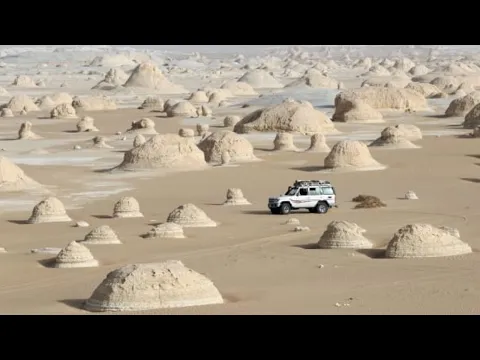

The Bahariya Oasis formed in a natural depression of the terrain, where the altitude is low enough for groundwater to reach the surface. This water feeds small flooded areas and irrigation systems that have sustained human communities for millennia.
The presence of water in desert regions is directly linked to the local geology. In the case of Bahariya, rock formations allow for the retention of groundwater, creating a kind of invisible natural reservoir.
This mechanism is what enables the existence of a lake and isolated wetlands, even in an environment where annual precipitation is extremely low. This condition has transformed the site into a strategic point throughout history, serving as a stop for trade routes and human settlements since the Middle Kingdom of Egypt, around 2000 B.C..
Accidental discovery revealed one of the largest cemeteries of the Roman world
One of the most impressive episodes linked to the Bahariya Oasis occurred in 1996, when an accidental discovery revealed the existence of one of the largest burial sites of the ancient world.
During a routine activity, a donkey reportedly stumbled upon a partially buried object, exposing human remains. Following this event, archaeologists began excavations that led to the discovery of the so-called Valley of the Golden Mummies.
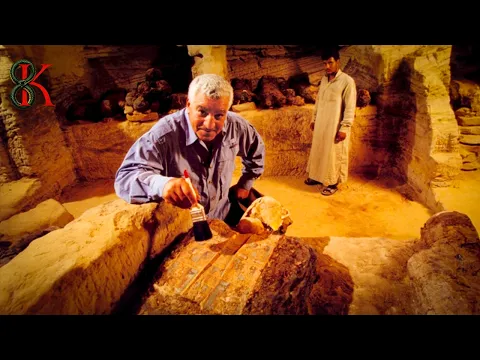
The site revealed more than 10,000 mummies, many of them with golden funerary masks, indicating a high level of social status among the individuals buried there. The mummies date primarily from the Greco-Roman period, between approximately 332 B.C. and 395 A.D., when Egypt was under the influence of various empires.
The quantity of bodies, the quality of materials used, and the organization of the burial space indicate that Bahariya was a significant population center during this period, with a local elite capable of financing elaborate funerary rituals.
Giant dinosaurs lived in the region when the Sahara did not yet exist
The history of Bahariya goes even further back in time. In deep geological layers, paleontologists have found fossils dating back to a time when the Sahara Desert simply did not exist.
Among the most relevant discoveries is the Paralititan stromeri, one of the largest dinosaurs ever identified in Africa. It is estimated that this animal weighed about 75 tons, living approximately 95 million years ago, during the Cretaceous period.

At that time, the region was part of a completely different environment, characterized by marshy areas and river systems connected to the ancient Tethys Sea, an ocean that existed before the formation of the current Mediterranean Sea.
These conditions allowed for an abundant fauna, including large herbivorous dinosaurs and predators. The presence of these fossils in Bahariya is direct evidence of how the environment of the region has changed drastically over time.
Layers of history transform the oasis into a unique geological record
What makes the Bahariya Oasis particularly relevant to science is the overlap of different historical and geological periods in a single location.
On the surface, there is evidence of continuous human occupation for thousands of years. Just below, remnants from the Greco-Roman period can be found, including the golden mummies. In even deeper layers, fossils dating back tens of millions of years emerge.
This combination transforms the region into a true natural archive, where it is possible to study everything from climate evolution to changes in human occupation over time.
Visual contrast explains why the oasis stands out in space images
From a visual standpoint, the Bahariya Oasis stands out because of the contrast between the dark vegetation and the light surroundings of the desert. While the Sahara around it presents shades of beige and yellow, the irrigated areas of the oasis appear as well-defined dark spots.

This contrast is enough for the site to be identified in images captured hundreds of kilometers above.
The presence of dense vegetation and water alters the way sunlight is reflected, creating visual patterns that stand out amid the uniform landscape of the desert.
The scientific and archaeological importance of the region continues to grow
The Bahariya Oasis continues to be the subject of studies in various fields of knowledge, including archaeology, geology, and paleontology. The discoveries made so far represent only a part of the scientific potential of the region.
New excavations and analyses may reveal additional information about:
- The climatic evolution of the Sahara
- The social organization of ancient communities
- The prehistoric fauna of the region
- The irrigation systems used throughout history
The combination of these factors makes Bahariya one of the most important sites for the integrated study of natural and human history in North Africa.
The Bahariya Oasis brings together, in a single depression in the desert, elements that rarely appear together: water in an arid environment, one of the largest cemeteries of the ancient world, and remnants of an era when giant dinosaurs dominated the region.
Now I want to know your opinion: did you imagine that such a seemingly simple place seen from space could hide so many layers of history and transformations over millions of years?


Be the first to react!