






 Portuguese
  Spanish


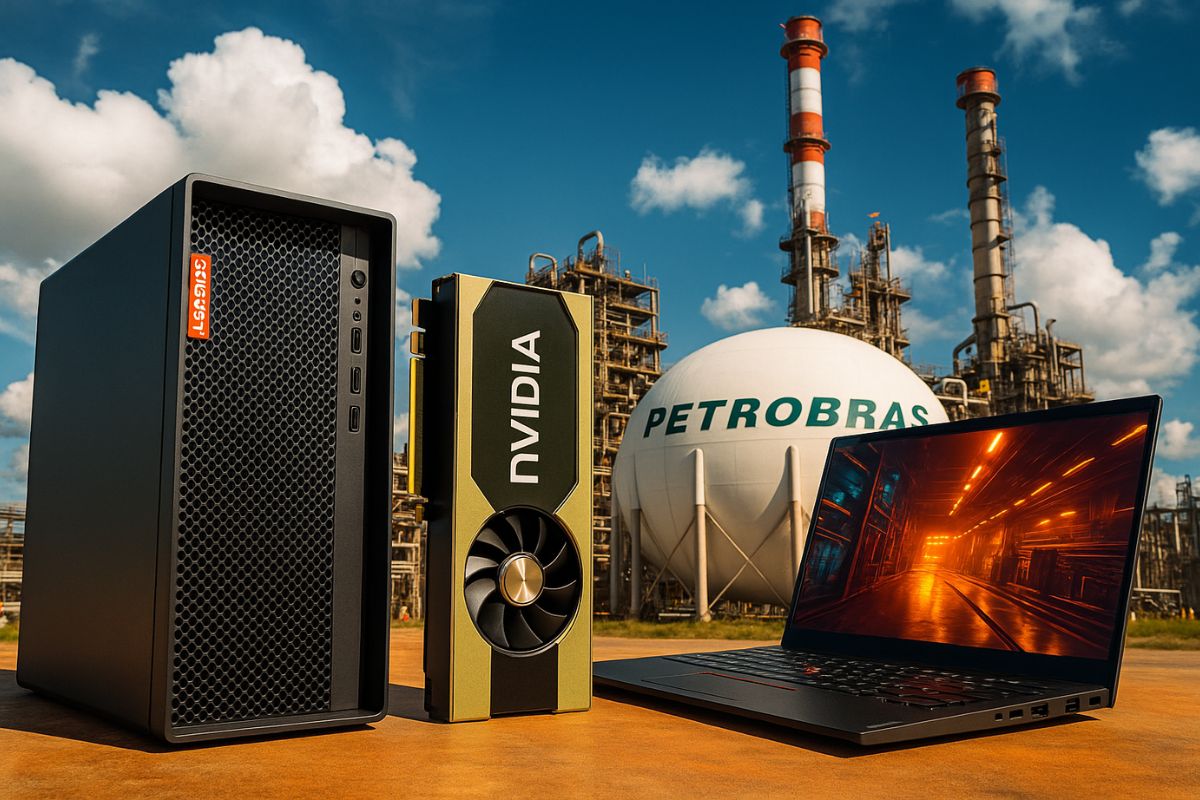


After Providing Five Supercomputers to Petrobras for R$ 500 Million, Lenovo Engages in New Sale of Workstations with Nvidia Chips, Bets on Local Production, Targets a Share of an US$ 800 Million Market, and Also Aims to Lead the Corporate Storage Segment in Brazil, Focusing on Large Clients.
Lenovo closed a new contract worth R$ 150 million with Petrobras, which includes 2,500 computers, mobile devices, graphic processing units, and racks for the oil company’s data center. The equipment, equipped with Nvidia chips, will be used alongside the Harpia supercomputer, expanding the state-owned company’s high-performance computing capacity in exploration projects and complex data analysis.
This agreement deepens the relationship between the two companies and reinforces Lenovo’s strategy to grow in advanced computing and corporate storage in Brazil. After delivering five supercomputers to Petrobras in a R$ 500 million package, the company now uses the new sale of workstations and storage as leverage to compete for leadership in data infrastructure for large enterprises.
Second Major Technology Package for Petrobras
The newly announced deal marks Lenovo’s second major supply to Petrobras in a short period of time.
-
Brazil to Issue “Panda Bonds” in China, Aiming to Raise Up to 5 Billion Yuan at Lower Interest Rates Than Dollar Debt
-
NATO Faces Internal Tensions as U.S. Pushes for Increased Defense Spending, Targeting 5% of GDP by 2035, with Warnings for Countries Near 2% Level

-
Brazil to Introduce B16 Diesel with Increased Soybean Oil Content for Trucks by 2026
-
Brazil’s July Bolsa Família Payments May Include Extra $150 and $50 for Families with Children, Pregnant Women, and Updated CadÚnico Registration


In the previous contract, valued at R$ 500 million, the Chinese manufacturer sold a set of five supercomputers, including the Harpia.
The Harpia weighs about 50 tons and has processing power equivalent to 200,000 laptops, and has been operational since October.
The new computers, GPUs, and racks purchased by Petrobras will now be integrated into this infrastructure, enhancing computing power for activities that require large volumes of data, such as geological simulations and deep water projects.
According to Lenovo, the goal is to meet the continuous growth in Petrobras’s demand for high-performance computing and ensure more technological autonomy in critical data processing.
This infrastructure reinforcement also helps reduce bottlenecks in the state-owned company’s research and development projects.
Workstations with Nvidia Chips Gain Local Production
The contract with Petrobras directly connects to Lenovo’s business plan in the country. The company is incorporating a new line of workstations aimed at the corporate audience, including models like P2 Tower Gen 2, P3 Tower Gen 2, and ThinkPad P16v Gen 3, all with Nvidia chips similar to those provided to the oil company.
These devices will be manufactured at the company’s Brazilian facilities. Lenovo has three factories in the country, located in Manaus, Indaiatuba, and Jaguariúna.
The latter is responsible for the production of about 14 million cell phones per year for the Motorola brand, which is part of the group.
Over the past 12 years, the company claims to have invested R$ 950 million in research and development in Brazil, maintaining a team of approximately 2,100 employees.
By bringing the production of new workstations to the national territory, Lenovo bets on cost reduction, scale gains, and faster delivery times for corporate clients like Petrobras.
Workstation Market Expected to Generate US$ 800 Million
The high-capacity computer segment, such as workstations, has been rapidly growing in the country. Sales jumped from 14,600 units in 2019 to 58,300 in 2024, reflecting the digitalization of the economy and the advancement of data-intensive and artificial intelligence applications.
In Lenovo’s view, there is room for this growth to continue over the next ten years, albeit at a more moderate pace.
The company sees potential especially in sectors like oil and gas, engineering and architecture, manufacturing, banking, media and entertainment, and higher education.
According to the company, combined, these segments could generate around US$ 800 million in workstations over the next few years in Brazil.
The new contract with Petrobras serves as a showcase for this market, as it demonstrates Lenovo’s ability to deliver comprehensive solutions, ranging from supercomputers to machines directly used by technical and engineering teams.
The internal expectation is that the deal will help unlock new sales for other large companies facing similar data processing challenges.
Storage Becomes a Priority in the Race for Corporate Data
In addition to workstations and supercomputers, Lenovo is strengthening its presence in the storage market, dedicated to corporate data storage.
This is a segment whose annual revenue in Brazil is expected to rise from the current US$ 260 million to US$ 323 million by 2029, driven by the need to store, protect, and access increasingly larger volumes of information.
The company officially entered this market in 2018 and has been recording double-digit revenue growth, serving clients interested in solutions for databases, backup, high-performance computing, audio and video streaming, and camera surveillance systems, among other uses. The declared plan is to achieve leadership in storage by 2027.
To this end, Lenovo is bringing the Storage DE Series line to Brazil, which will also be produced locally and targets small businesses to large corporations.
The combination of domestic manufacturing, relevant contracts like that of Petrobras, and a portfolio that covers everything from backup to high performance is presented by the company as the tripod to compete in the corporate storage market.
The strategy is supported by a clear understanding of the role of data in companies. As sums up Marcos Café, director of Storage Solutions at Lenovo in Latin America, stating that “data is the new gold” and that “no one stores gold anywhere,” the company is trying to show that investing in one’s own storage is also a decision of security and autonomy.
In parallel, there are clients who have returned to preferring on-premises servers, reducing exclusive reliance on third-party cloud providers.
Advanced Computing and Petrobras at the Center of the Dispute
By combining supercomputers, workstations with Nvidia chips, and locally produced storage solutions, Lenovo positions itself to directly compete for major data infrastructure projects in the country.
Lenovo closed a new contract worth R$ 150 million with Petrobras, which includes 2,500 computers, mobile devices, graphic processing units, and racks for the oil company’s data center.
The equipment, equipped with Nvidia chips, will be used alongside the Harpia supercomputer, expanding the state-owned company’s high-performance computing capacity in exploration projects and complex data analysis.
Petrobras, due to the scale of investments and the criticality of its operations, emerges as a central client in this strategy.
For the oil company, the reinforcement in advanced computing infrastructure means more capacity to process complex models, accelerate strategic projects, and reduce risks in sensitive technical decisions.
For Lenovo, each new contract with Petrobras serves as a seal of robustness to conquer other sectors that are also in the race for data.
Now I want to know from you: Should Petrobras continue to expand its own supercomputers and storage, as it does with Lenovo, or should it prioritize even more cloud solutions from large global providers?







