






 Portuguese
  Spanish


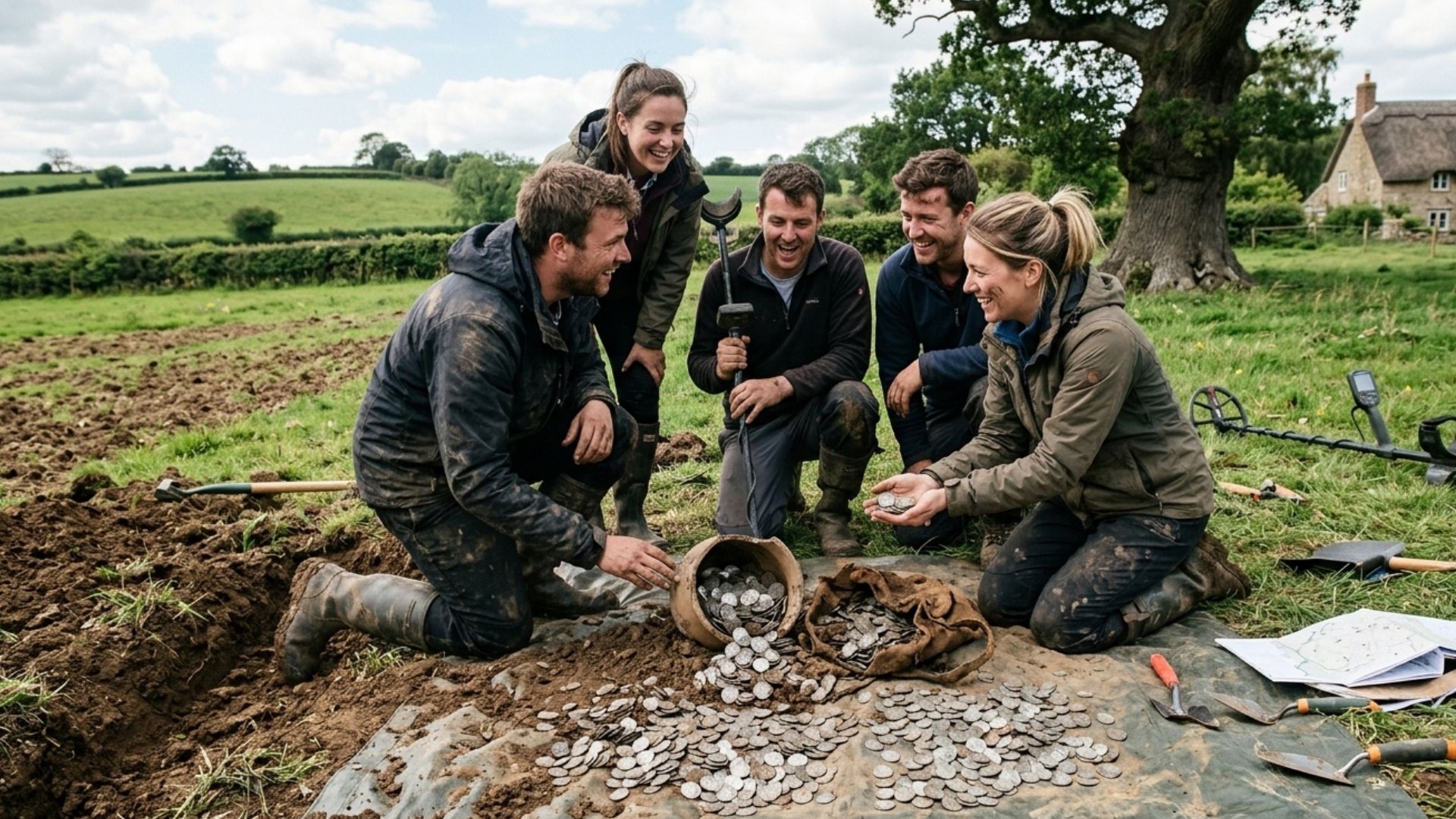

Group of friends found 2,584 silver coins from the time of the Norman Conquest; £4.3 million treasure became a historic record in England.
In January 2019, a group of seven friends went to a farmland in the southwest of England without imagining they would make one of the most important archaeological discoveries ever recorded in the country. The goal was simple: to test metal detection equipment and spend a few hours practicing the hobby in a rural area of Somerset. Shortly after the search began, the detectors started emitting repeated signals. What seemed to be just another isolated coin quickly turned into an extraordinary find. Buried under the earth were thousands of silver coins almost a thousand years old, forming what is now known as the Chew Valley Hoard, the most valuable treasure ever found in England.
How a simple outing to test equipment revealed the largest treasure ever found in England
The detectorist Adam Staples reported that the discovery began with a single signal from the device. After recovering the first coin, another appeared, then another, and it soon became evident that something much larger was hidden at the site. According to him, the detectors practically didn’t stop emitting alerts.
Throughout the excavation, the seven friends recovered 2,584 silver coins minted between the years 1066 and 1068, a period that coincides with one of the most turbulent moments in British history: the Norman Conquest of England.
-
How to Prevent Brown Recluse Spider Bites: Common Hiding Spots and Free Tips to Reduce Risks

-
Natto: The Unusual Japanese Superfood Gaining Popularity on Social Media and Driving Record Exports
-
Brazilian Mayor Goes Undercover as Homeless for 24 Hours to Assess Public Services

-
15-Year-Old Entrepreneur Malu Lira Publishes 20 Children’s Books on Financial Education, Earns $500,000, and Expands Her Project to the Amazon Rainforest






The collection was later valued at £4.3 million, equivalent to about US$ 5.6 million at the time of acquisition by the British government, officially becoming the highest value treasure ever recorded in the country.
Coins show the transition between two kings who changed English history
The most important aspect of the discovery is not just the financial value. The coins record a decisive moment in medieval European history.
Some of them feature the image of Harold II, the last Anglo-Saxon king of England. The others display William I, known as William the Conqueror, the Norman leader who defeated Harold at the famous Battle of Hastings in 1066.

Experts state that the collection offers a rare economic and political snapshot of the period when England ceased to be governed by the Saxons and came under Norman rule. Many coins were minted just months after the invasion that transformed the country.
Why someone buried thousands of silver coins and never returned to retrieve them
Archaeologists believe that the treasure was hidden during a period of extreme political instability. After the Norman victory, various revolts occurred in several English regions, especially in the southwest of the country.
Researchers from the South West Heritage Trust suggest that the owners likely buried the fortune to protect it from the conflicts spreading through the region between 1067 and 1068. Something, however, prevented them from returning to recover the money.
The result was an improvised medieval vault that remained hidden for almost ten centuries until it was found by detectorists.
Treasure spent years under analysis before being acquired for a museum
Although it was discovered in 2019, the collection took several years to undergo the procedures required by British legislation on archaeological treasures.
After analysis and cataloging, the collection was acquired by the South West Heritage Trust with resources from the National Lottery Heritage Fund and the Art Fund. The coins became part of the British public heritage and began to be displayed in museums.

Experts classified the Chew Valley Hoard as one of the most significant archaeological discoveries of recent decades for providing new information about the period immediately following the Norman Conquest.
How much the seven friends received for the million-dollar discovery
According to British rules, when a treasure is officially declared a historical heritage, the amount paid for the acquisition is divided between the finders and the owner of the land where the material was found.
In the case of the Chew Valley Hoard, half of the amount was allocated to the landowner and the other half divided among the seven detectorists involved in the discovery. Adam Staples later stated that he received a few hundred thousand pounds, enough to buy a house.
Even after the discovery that changed his life, Staples declared that he does not intend to abandon the hobby that led him to the greatest treasure in English history.
The story raises a curious question: how many other forgotten chests, buried during wars, invasions, and revolts centuries ago








