Portuguese
  Spanish


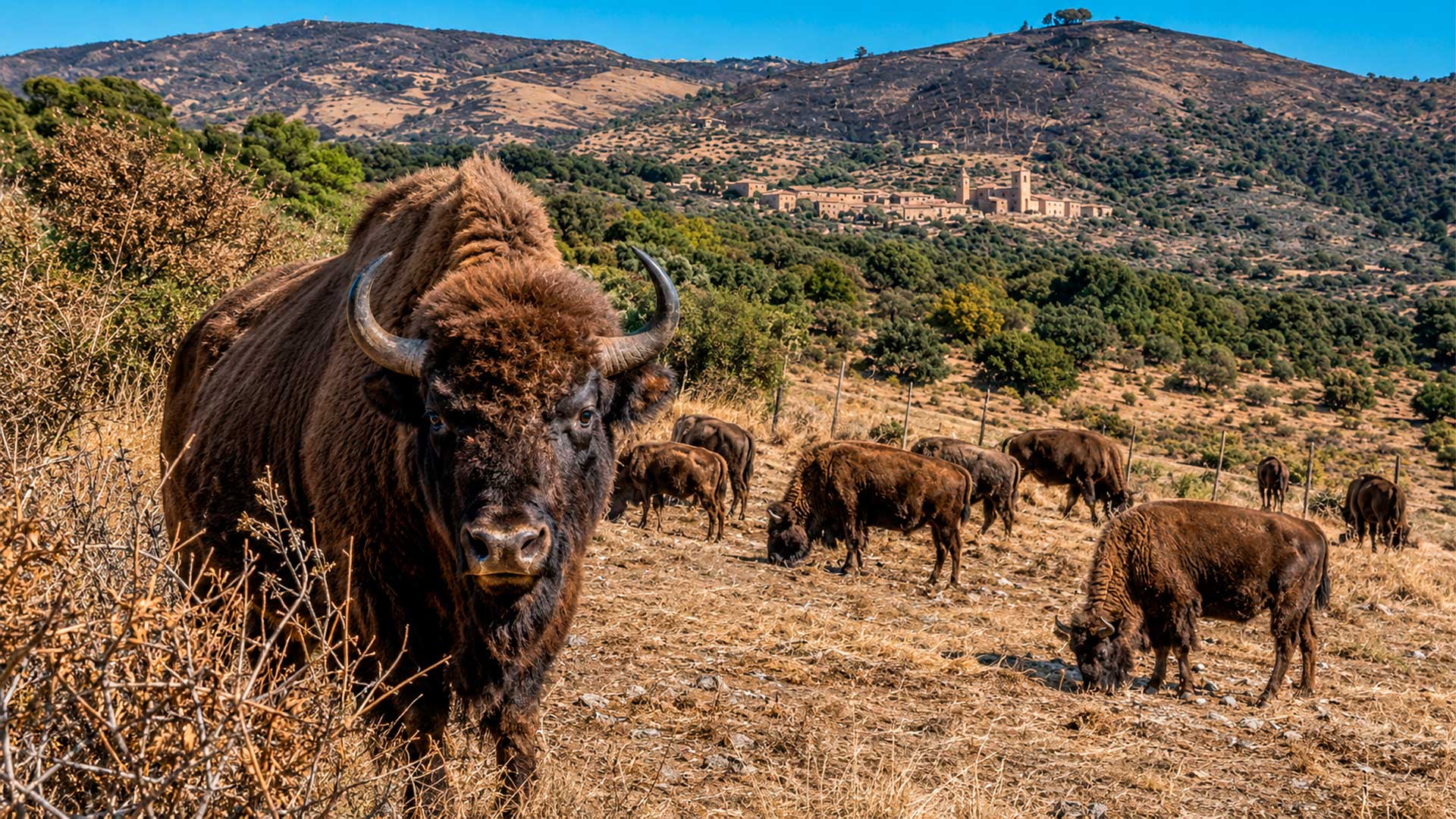

Five females and four males have been living since January in an enclosed area in the interior of Spain, where researchers monitor diet, movements, and changes in vegetation. The proposal is to discover if the largest terrestrial mammal in Europe can help recover abandoned areas and reduce the available fuel for forest fires.
Nine European bison began occupying, in January 2026, a public forest area in the municipality of El Recuenco, in the province of Guadalajara, Spain. The animals are part of an experiment that aims to measure their effects on vegetation, biodiversity, and the risk of fire spread.
The herd was not released on the streets nor does it roam freely outside the project area. The five males and four females live in semi-freedom within 400 enclosed hectares, are tracked by GPS, and remain under observation by field professionals. The research is conducted by Rewilding Spain with universities from the Basque Country, Manchester, and Aarhus.
El Recuenco has about 80 registered residents, but the permanent population drops to approximately 20 people during the winter. With the disappearance of extensive livestock farming in the region, shrubs, dry grasses, and other plants have started to accumulate in areas that were previously used by herds.
-
YOU LOOK AT SUGAR EVERY DAY, BUT THERE IS A BAN ON IT THAT ALMOST NO ONE KNOWS; UNDERSTAND WHY MAKING IT AT HOME IS NOT ALLOWED IN BRAZIL

-
Arrival of the São Francisco River waters in Rio Grande do Norte marks a historic chapter, boosts development, and symbolizes social justice for millions of Northeasterners.
-
Scientists discover beetles with elongated antennae and mandibles in China and Laos and name a new genus Luffy in honor of the protagonist of One Piece.
-
Former gas station attendant leaves job for recycling business, employs 12 people, and earns up to R$ 20,000 per month.


The bet is to have the bison take on part of this role. They eat, break, and trample the vegetation, opening spaces in the terrain and altering the amount of available biomass. This can hinder the continuity of fire, but the responsible parties avoid presenting the experience as a ready-made solution.
The herd arrived acclimatized, but their behavior will be compared to that of bison from various parts of Europe


The animals taken to El Recuenco came from a property in El Espinar, in the province of Segovia. The adults had previously arrived from Poland and the Netherlands, while the younger specimens were born on Spanish territory.
After an initial period in a smaller enclosure, the herd began to roam the experimental area. Researchers collect feces to analyze hormones, immunoglobulins, and DNA fragments of consumed plants, a method that allows for reconstructing the diet without continuously capturing the animals.
The work also compares sections of forest without intervention with areas that underwent thinning before the arrival of the bison. This way, it will be possible to verify if grazing maintains open spaces and prevents shrubs from quickly regaining their previous volume.
The consumption of woody vegetation explains why the bison were included in the fire prevention plan
The principle used in El Recuenco is already known in prevention programs with goats, sheep, and cattle. By consuming vegetation in strategic locations, the herds help maintain strips with lower fuel loads, used to reduce the speed and intensity of the flames.
A study conducted in La Rioja, also in Spain, analyzed a program that combined shrub removal and extensive livestock farming. The study found a reduction in fuel biomass, the number of fires, and the burned area, although the results came from a set of measures and not just the presence of animals.
The bison draw attention because their diet is not limited to grasses. A study published in 2024 in the journal Biodiversity and Conservation, conducted with animals in the Sierra de Andújar, found woody components in 52% of the plant fragments identified in the bison feces.
In that survey, the animals consumed more woody plants during the fall and winter and increased their intake of grasses in the summer. Researchers also recorded the consumption of mastic, a flammable shrub species present in Mediterranean environments, but acknowledged that property management included food supplementation during part of the year.
This prevents the data from Andújar from being simply transferred to El Recuenco. Each area has different climate, terrain, water availability, plant composition, and animal density, factors that directly alter the grazing outcome.
The first months indicate adaptation, but do not yet show a reduction in fires
On July 4, 2026, biologist Diego Rodríguez, responsible for monitoring the region, reported that the nine animals had repeatedly traversed the 400 hectares and gained weight since their arrival. The weight gain was interpreted as an initial sign that they found sufficient food and adapted to the environment.
None of these observations prove that the project has already reduced the fire risk. Conclusions will depend on comparing data on vegetation cover, shrub structure, present species, and the amount of combustible material over different seasons. The experiment will also serve as the basis for two doctoral theses linked to the universities of Manchester and the Basque Country.
The size of the area helps to understand the limitation. Nine animals distributed over 400 hectares represent, on average, one bison for a little more than 44 hectares, although the herd does not use the land uniformly.
Zones near water, areas with abundant food, and places used for resting may experience more pressure. Other parts of the property may remain almost untouched, which is why GPS tracking will be cross-referenced with observed changes in the soil and vegetation.
The scientific discussion begins even before the results appear
The presence of the European bison in the Iberian Peninsula provokes a dispute that goes beyond the Guadalajara project. One of the issues is historical, as fossils confirm the existence of other bison species in the region, but there is no consensus on the past occurrence of the current Bison bonasus.
In 2024, about 40 researchers from 25 universities published an article opposing the introduction of the animal in Spain as a wild species. The group argued that the European bison would not have a proven advantage over native or domestic herbivores in clearing the land and might depend on water, supplementary feeding, and veterinary care to withstand hot and dry summers.
Supporters respond that the goal does not need to be to exactly reconstruct the fauna of the past. For them, the practical question is to discover if a large herbivore can perform ecological functions lost after the abandonment of livestock and contribute to maintaining more open landscapes.
There is also evidence of positive effects on plant diversity outside of Spain. An eight-year study conducted in European forests found an increase in vascular plant richness in areas occupied by bison, especially in oak groves with abundant undergrowth. The same effect did not appear in closed beech forests, showing that the result depends on the type of environment.
This difference helps to explain why the data from El Recuenco will be relevant. The project could confirm local benefits, reveal undesirable impacts, or show that the number of animals is insufficient to modify the landscape on a scale capable of influencing fire behavior.
Bison can help in management, but do not replace firebreaks, surveillance, and firefighting teams
Even if the herd reduces shrubs and grasses, nine animals do not prevent the ignition of a fire. Lightning, irregular burns, electrical failures, machinery, and human actions are still capable of starting a fire, especially during periods of heat, strong winds, and low humidity.
Grazing also needs to be controlled. Excessive pressure can compact the soil, eliminate desirable plants, and favor erosion; too little pressure can produce changes too small to reduce the continuity of combustible vegetation.
Therefore, the Spanish experience should be understood as a part of forest management. Mechanical cleaning, protection strips, meteorological monitoring, access for brigades, supervision, and territorial planning remain necessary, even in areas occupied by large herbivores.
The most relevant outcome may not be discovering if the bison “put out fires,” but measuring how much brush they remove, which plants they consume, where they concentrate their movements, and how much it costs to maintain the operation. Only these numbers will allow us to decide if the model can be expanded or if goats, cattle, and other management forms would deliver better results.
Do you consider it reasonable to use large animals to control vegetation in abandoned areas, or do you believe the risks outweigh the possible benefits? Leave your opinion in the comments and share if a similar initiative could work in Brazilian regions affected by forest fires.