






 Portuguese
  Spanish
  6 min of reading
  0 comments


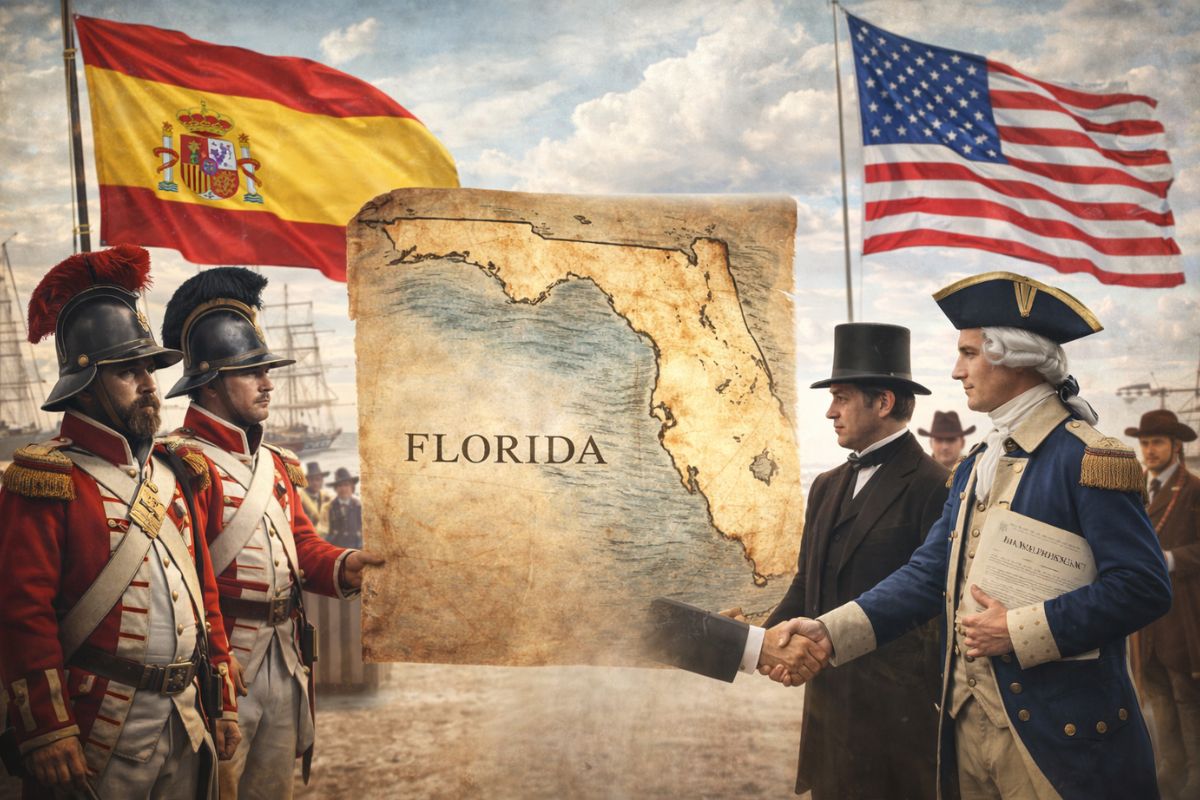
Florida was ceded by Spain to the United States by the Adams-Onís Treaty in 1819, without direct financial compensation. The empire that controlled half of the Americas handed over a territory twice the size of Portugal because it no longer had the military or economic means to defend it.
The Florida was Spanish for over three centuries before being handed over to the United States in one of the most disproportionate agreements in the colonial history of the Americas. In 1819, Spain signed the Adams-Onís Treaty, officially ceding the territory without receiving any significant financial compensation in return. The United States only agreed to assume $5 million in claims by American citizens against the Spanish government, basically compensations for confiscated properties and damages caused during years of border conflicts. For a territory twice the size of Portugal, the price was symbolic.
The question this story raises is inevitable: how could an empire that dominated almost half the world hand over Florida so easily? The answer involves centuries of wear, a metropolis ravaged by the Napoleonic wars, colonies in revolt throughout Latin America, and the rise of a new power to the north that had no patience for negotiation and had already invaded the territory even before the agreement was signed. Florida was not lost all at once. It was gradually abandoned until handing it over became the only rational decision.
Why Florida was important to Spain despite never being rich
Unlike colonies such as Mexico or Peru, Florida was never a source of wealth for the Spanish empire. There were no large reserves of gold or silver, the swampy terrain made colonization difficult, and the strong presence of indigenous tribes deterred the interest of colonizers. The Spanish population in the region was always small and the military presence limited, a stark contrast to the rich colonies that financed the coffers of Madrid.
-
An 11-year-old boy left home with two cousins to sell popcorn for R$ 5, became an entrepreneur at 15, sells 100 buckets a day, and uses the profit to pay the entire family working in the business.

-
To escape traditional rent, a couple bought a 21 m² floating house without seeing it, renovated everything in 3 months, and started living isolated on a lake in the USA, without electricity, without cell phone signal, and accessible only by boat.

-
Tired of expensive housing, couple buys a boat for US$ 1, refurbishes the sailboat at low cost, and sails over 1,600 kilometers to the Florida Keys.

-
The Jacaroá Lagoon in Maricá has turned into a “liquid sky” that glows blue at night: the bioluminescence of the microalgae has exploded, and the city hall attributes the phenomenon to the dredging of the channels.



But Florida had another currency of value: its geography. Located between the Atlantic Ocean and the Gulf of Mexico, Florida served as a forward base to protect the maritime routes through which the wealth from Mexico, Peru, and the Caribbean flowed towards Europe. Losing control of Florida meant leaving merchant ships exposed to attacks by pirates and privateers. For Spain, protecting these routes was as important as protecting the silver mines, as without safe transport, colonial wealth did not reach its destination.
The moment Florida went from strategic asset to dead weight
Over the centuries, Florida’s strategic role began to lose relevance. Trade routes diversified, the costs of maintaining unproductive territories became unfeasible, and Spain needed to concentrate resources on more urgent fronts. While Florida’s importance diminished for the Spaniards, a power was emerging to the north that looked at the territory with growing ambition.
The purchase of Louisiana in 1803 more than doubled the territory of the United States and laid the groundwork for manifest destiny, the belief that the country was destined to expand from the Atlantic to the Pacific. In this context, pressure on Florida’s borders increased each year, fueled by American farmers furious with enslaved people fleeing to Spanish territory in search of freedom and by the Seminoles, an indigenous people using the region to resist American encroachment. Florida became a ticking time bomb on the United States’ border.
The crises that destroyed Spain’s ability to defend Florida
From 1808, Spain faced one of the greatest crises in its history. During the Napoleonic wars, Spanish territory was invaded by the forces of Napoleon Bonaparte, and King Charles IV was forced to abdicate the throne. Within months, the center of the glorious Spanish empire collapsed. On the other side of the Atlantic, the consequences were immediate: without legitimate authority in Europe, independence movements emerged throughout Latin America.
The empire that had been one of the greatest powers in the world for centuries began to fragment. Spain had to deal with a weakened metropolis, rebellious colonies scattered across the continent, and Florida surrounded by a rising power, all at the same time. Defending a distant and unprofitable territory when the very center of the empire was threatened was simply impossible. In 1810, settlers in West Florida revolted against Spanish rule, and the territory was quickly annexed by the United States, an unmistakable sign that control over Florida was already hanging by a thread.
The invasion by Andrew Jackson that forced Spain to negotiate
If diplomacy did not resolve the issue, the Americans had other methods. General Andrew Jackson, known for his impatience and military aggressiveness, led incursions into Florida’s territory going far beyond the orders he had received. His troops advanced under the pretext of combating Seminole groups but, in practice, occupied Spanish forts and demonstrated that Spain no longer had the capacity to defend the territory.
Jackson’s actions generated diplomatic tensions between Spain and the United States, but served a clear strategic purpose. The invasion proved that Florida was already, in practice, indefensible. The Spaniards could protest in diplomatic offices, but they had no soldiers or resources to expel American troops. Faced with this reality, negotiation became the only possible way out for Spain, which needed an agreement that at least guaranteed stable borders in other territories it still controlled.
The Adams-Onís Treaty and the definitive handover of Florida
In 1819, the Adams-Onís Treaty was signed, in which Spain officially ceded Florida to the United States. The agreement did not include direct payment for the territory: the United States only assumed $5 million in claims by American citizens against the Spanish government, an amount that represented compensations for damages accumulated during years of border conflicts. For a territory of this size and geographical importance, the price was essentially symbolic.
But the treaty went beyond Florida. It also defined the borders between American and Spanish territories in the west of the continent, reducing tensions in regions that would be disputed in the following decades. For Spain, the agreement was pragmatic: to hand over what it could no longer maintain in exchange for stability in the remaining borders. For the United States, it was another step in the continental expansion that would culminate in the conquest of the west and the consolidation of the country as a hemispheric power.
What the loss of Florida reveals about the end of empires
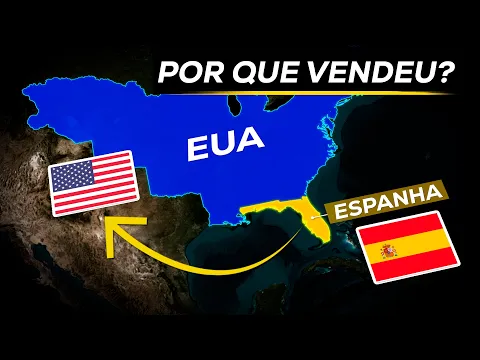

The handover of Florida did not happen overnight. It was the formalization of a gradual process in which Spanish control deteriorated over decades, corroded by internal crises, external pressure, and the inability to project power thousands of kilometers from the metropolis. Spain did not lose Florida in a battle. It lost it gradually, at every unguarded border, in every abandoned fort, in every enslaved person who fled to the territory without anyone stopping them.
The history of Florida is a reminder that empires do not fall solely due to military defeats. They fall when the cost of maintaining territories outweighs the benefit of owning them, and when emerging powers are willing to occupy the vacuum that decline creates. The Spain that handed over Florida in 1819 was no longer the same as the one that conquered it in the 16th century. And the United States that received it was just beginning to build what would become the greatest power in the world.
Spain handed over Florida for free to the United States after centuries of rule. Do you think it was a pragmatic decision or an imperial humiliation? What other territorial losses in history surprise you? Leave your opinion in the comments.





Be the first to react!