






 Portuguese
  Spanish
  3 min of reading
  0 comments


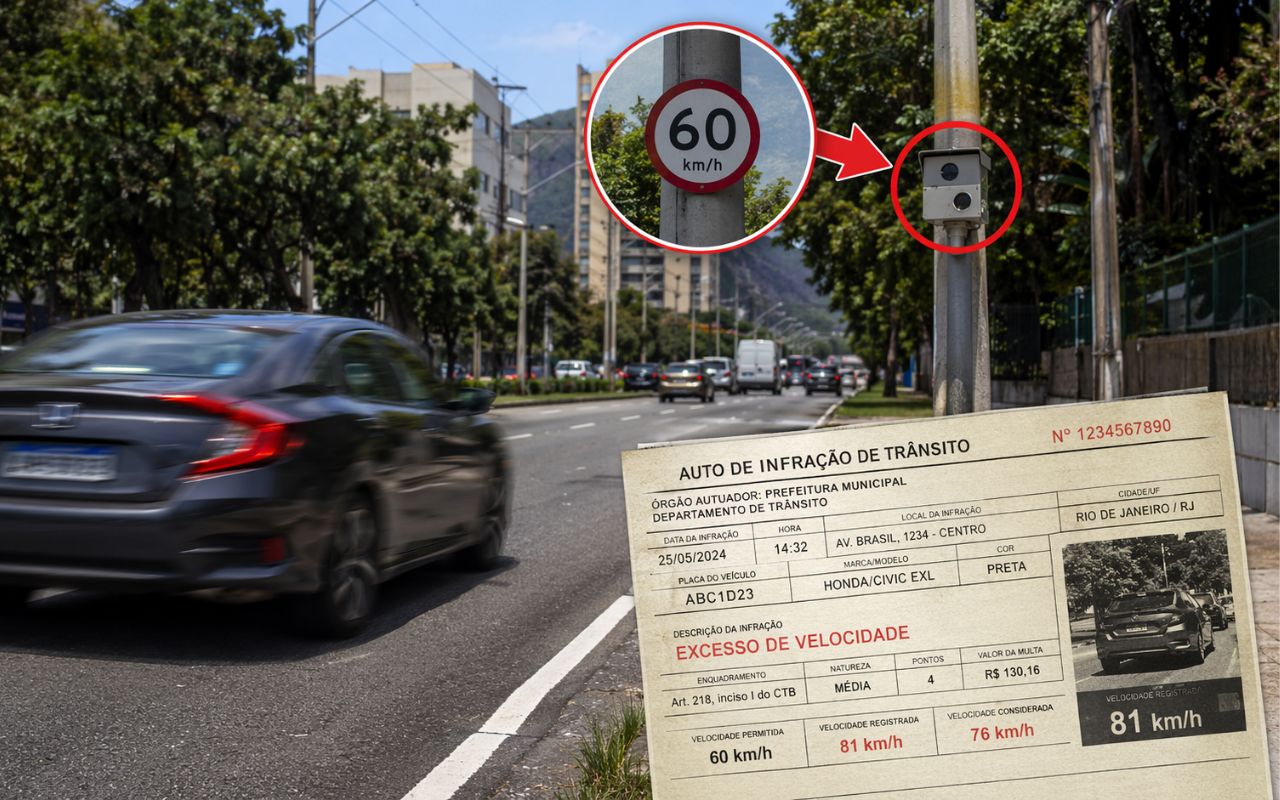
Speeding leads to traffic fines in Brazil and increases accident risks, see numbers and consequences.
Speeding has become the main cause of traffic fines in Brazil, accounting for almost half of the infractions recorded in the country in recent years. Official data shows that millions of drivers continue to disregard the established limits, even with intensive monitoring by radars.
In 2025, Brazil surpassed the mark of 100 million traffic violations, with over 45 million for speeding alone. This phenomenon occurs on urban roads and highways, driven by reckless behavior and constant monitoring. In light of this scenario, experts warn that reducing speed is essential to avoid accidents and save lives.
High speed increases accident risk on the road
The impact of speeding goes far beyond fines. It directly affects the driver’s reaction time. The higher the speed, the greater the distance required to stop the vehicle. This reduces the chances of avoiding collisions on the road.
-
Uber Faces Shareholder Scrutiny as Board Accused of Ignoring Safety, Compliance, and Harassment Warnings Amid Over 3,500 U.S. Lawsuits

-
Ferrari’s First Electric Car Divides Fans, Priced at $630,000, Amid Concerns Over Limited Editions; Brand Clarifies It’s Not Just for Future Perks
-
BYD Dolphin Mini: The Electric Car That Defies Depreciation, Losing Only 3.58% in a Year and Becoming the Best-Selling Retail Model Under $22,000

-
Electric Car JAC E-JS4 Loses $19,000 in Value in One Year, Leading Record Depreciation of Used Cars in Brazil Due to Expensive Battery and New Models


The relationship between speed and safety is clear. A car at 50 km/h can stop in about 8 meters. At 80 km/h, the distance exceeds 20 meters. Therefore, a few extra kilometers make a significant difference on the road.
In adverse conditions, the scenario worsens. Speeding on wet roads significantly increases the risk. “This braking distance can vary by 70% compared to a dry road,” commented Lieutenant Eduardo Filho.
Speeding fines dominate traffic statistics
In addition to collisions, there is a direct impact on the severity of accidents. Speed influences survival in pedestrian accidents. At 50 km/h, the chance of survival is about 70%. At 80 km/h, this rate drops to just 15%.
The numbers reinforce the magnitude of the problem. In 2025, Brazil recorded 100,036,053 traffic fines. Of this total, 45,839,641 were for speeding. This represents 45.82% of the infractions.
The scenario repeats itself over the years. In 2024, there were 86,480,060 fines, with 47.11% for exceeding the speed limit. In 2023, the percentage was 45.83%. In 2022, it was 45.53%, maintaining stability in traffic.
Driver behavior influences speeding
A large part of the fines is captured by radars. These devices continuously monitor traffic. They are present on highways and in urban centers. Thus, they contribute to the high number of violations.
Even with enforcement, many drivers ignore the limits. This behavior contributes to the volume of fines. “Where the government is present, the driver obeys the rules and the number of occurrences decreases,” says José Aurélio Machado.
Real cases show the impact of speeding
Stories of victims reinforce the risks on the road. Young Emily Nathieli was hit by a car at high speed. She is still undergoing treatment after the accident. “I just wanted to have my life back. Why this speed, why do this?” she reported.
Penalties vary according to speeding
Traffic fines are classified by severity. Up to 20% above the limit is a medium offense. In this case, the fine is R$ 130.16, with 4 points on the driver’s license. Between 20% and 50%, the offense is serious, with a fine of R$ 195.23.
Serious offenses can lead to suspension of the driver’s license
When the driver exceeds more than 50% of the allowed speed, the offense is very serious. The fine reaches R$ 880.41. In addition, there are 7 points on the license and immediate suspension of the right to drive. Therefore, the impact goes beyond fines.
Experts advocate combined actions to reduce the problem. Education and enforcement are essential. “We need to talk more about speed, about traffic laws…”, said Alice Conceição Rosa Ramos. Finally, the reduction of fines depends on awareness. Respecting limits is a simple attitude. Thus, traffic becomes safer for everyone.
With information from g1





Be the first to react!