






 Portuguese
  Spanish


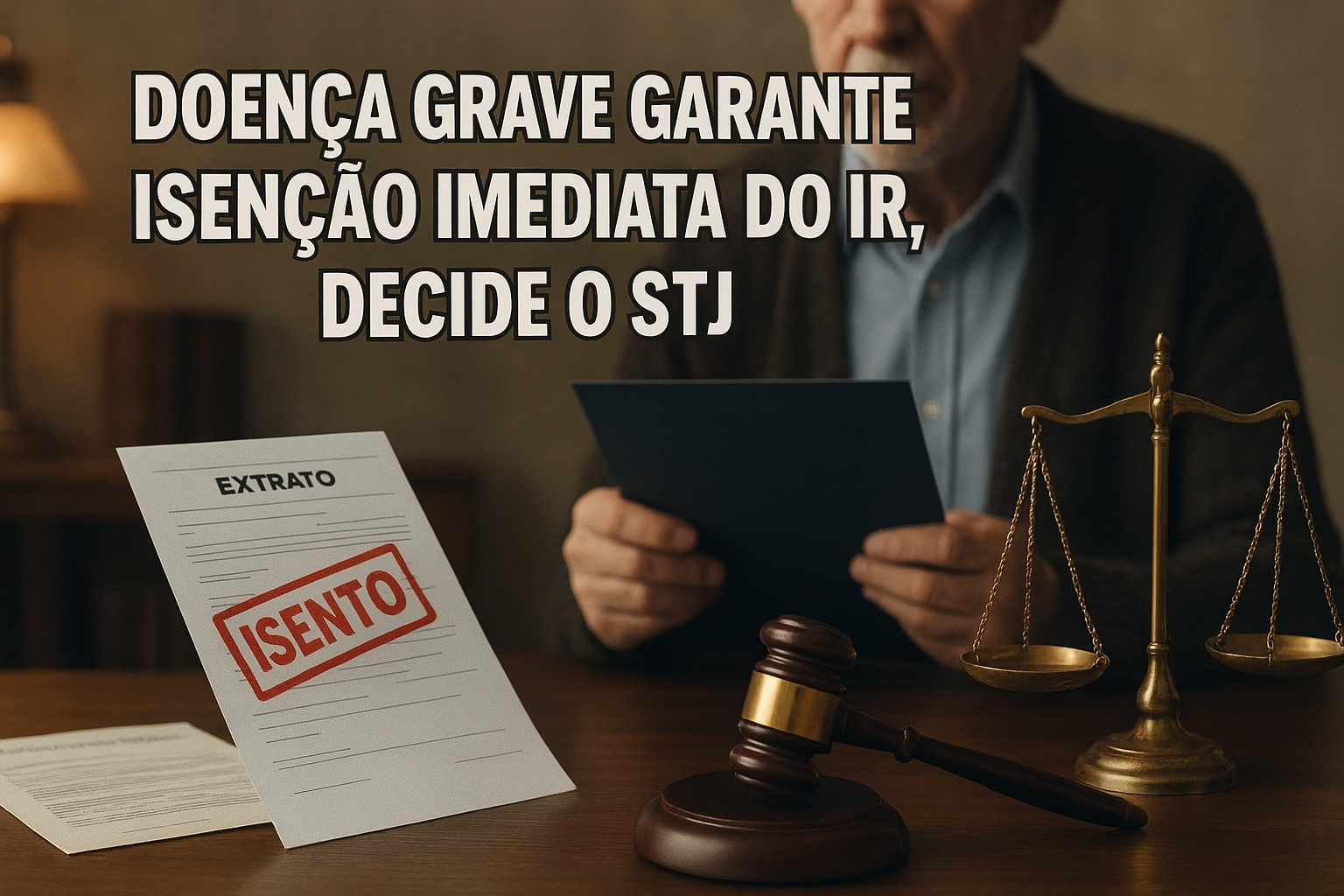


STJ Confirms Immediate Exemption from Income Tax for Retirees with Serious Illnesses and Releases Retroactive Refund from the Last 5 Years.
The recent decision by the Superior Court of Justice reignited one of the most important debates regarding the rights of retirees and pensioners in Brazil: after all, does someone with a serious illness need to be in treatment to ensure full exemption from income tax? The answer is now clear — no need. And more: the Court confirmed that the insured can recover everything that was improperly charged in the last five years, even if the illness is controlled or asymptomatic.
The judgment involves the interpretation of Article 6, Clause XIV, of Law 7,713/1988, which lists the diseases that guarantee income tax exemption for retirees and pensioners — among them severe heart disease, malignant neoplasm, blindness, Parkinson’s, Alzheimer’s, severe liver disease, among others. What was previously a source of dispute between the Federal Revenue and the insured now has a consolidated understanding: exemption is a right guaranteed by the diagnosis, not by the current presence of symptoms.
The STJ Decision That Changes the Lives of Millions of Retirees
In the case analyzed by the Court (Theme 1,037 and precedents such as REsp 1,836,864), the retiree sought exemption even after entering remission. The tax authority argued that since there were no symptoms, the benefit should cease. The STJ overturned this understanding. The decision established three central points:
-
Brazil Approves Proposal to Cap Vehicle Tax at 1% of Car Value

-
Brazilian Senate Approves Bill to Automate Child Support Payments Directly from Debtors’ Accounts

-
Brazilian Congress Advances Bill to Ensure Full Pension Benefits for Families Receiving Reduced INSS Death Benefits
-
Unusual Traffic Signs in Brazil: Wheelbarrow Ban, Crosswind Warning, and Customs Stop


- The serious illness, once diagnosed, guarantees permanent exemption, regardless of the evolution of the clinical condition.
- It is not required for the insured to be in treatment, continuously using medication, or currently disabled.
- The retiree can request a refund of amounts charged in the last five years, adjusted, in case they were improperly taxed by the paying source.


This point is crucial: even those who had cancer 10, 15, or 20 years ago, and are now fully recovered, continue to have the right to exemption and the return of everything that was improperly collected in the last five years.
Who Has the Right to Immediate Exemption?
The STJ decision reinforces that the benefit is valid for retirees and pensioners diagnosed with illnesses such as:
- Malignant Neoplasm
- Severe Heart Disease
- Parkinson’s
- Alzheimer’s
- Blindness
- Multiple Sclerosis
- Severe Liver Disease
- Active Tuberculosis
- Leprosy
- Irreversible or Disabling Paralysis
- Paget’s Disease (Advanced Stage)
- Radiation Contamination
- Cystic Fibrosis
And, according to the Court’s understanding, there is no “expiration date” for the illness: proof of diagnosis is sufficient at any stage of life.
How Can the Retiree or Pensioner Request Exemption?
Even with the favorable decision, many beneficiaries still face bureaucracy at the Federal Revenue and in pension schemes. The insured must:
- Present official medical report, issued by a public health service (federal, state, or municipal).
- Request the exemption directly from INSS, RPPS, or paying source (bank, pension fund, etc.).
- After recognition, file a request for refund of the last five years via amended declaration or electronic request for refund.
In many cases, when the exemption is denied administratively, lawyers have taken legal action and obtained quick injunctions, as the STJ’s understanding is clear and binding.
The Economic Impact on Retirees and Families
The burden of income tax on pensions can exceed 10% to 22% of monthly earnings — a significant amount for the elderly who depend on medication, special diets, and private care.
With the decision, thousands of people can:
- Immediately Increase Monthly Income
- Receive Retroactive Amounts that reach R$ 20,000, R$ 30,000, or more
- Avoid Unjust Deductions in the Future

The social effect is also enormous: it alleviates the financial burden on the elderly, preserves rights provided by law, and corrects restrictive interpretations that have harmed taxpayers.
The STJ decision opens an essential precedent on dignity, solidarity, and tax justice. And you, reader: do you agree that the exemption should remain even when the illness is controlled? Do you believe that the Revenue should facilitate this recognition to prevent retirees from needing to resort to the courts?


A decisão do STJ foi tecnicamente perfeita e humana, contrariando a “sanha” arrecadadora do fisco federal.