Portuguese
  Spanish


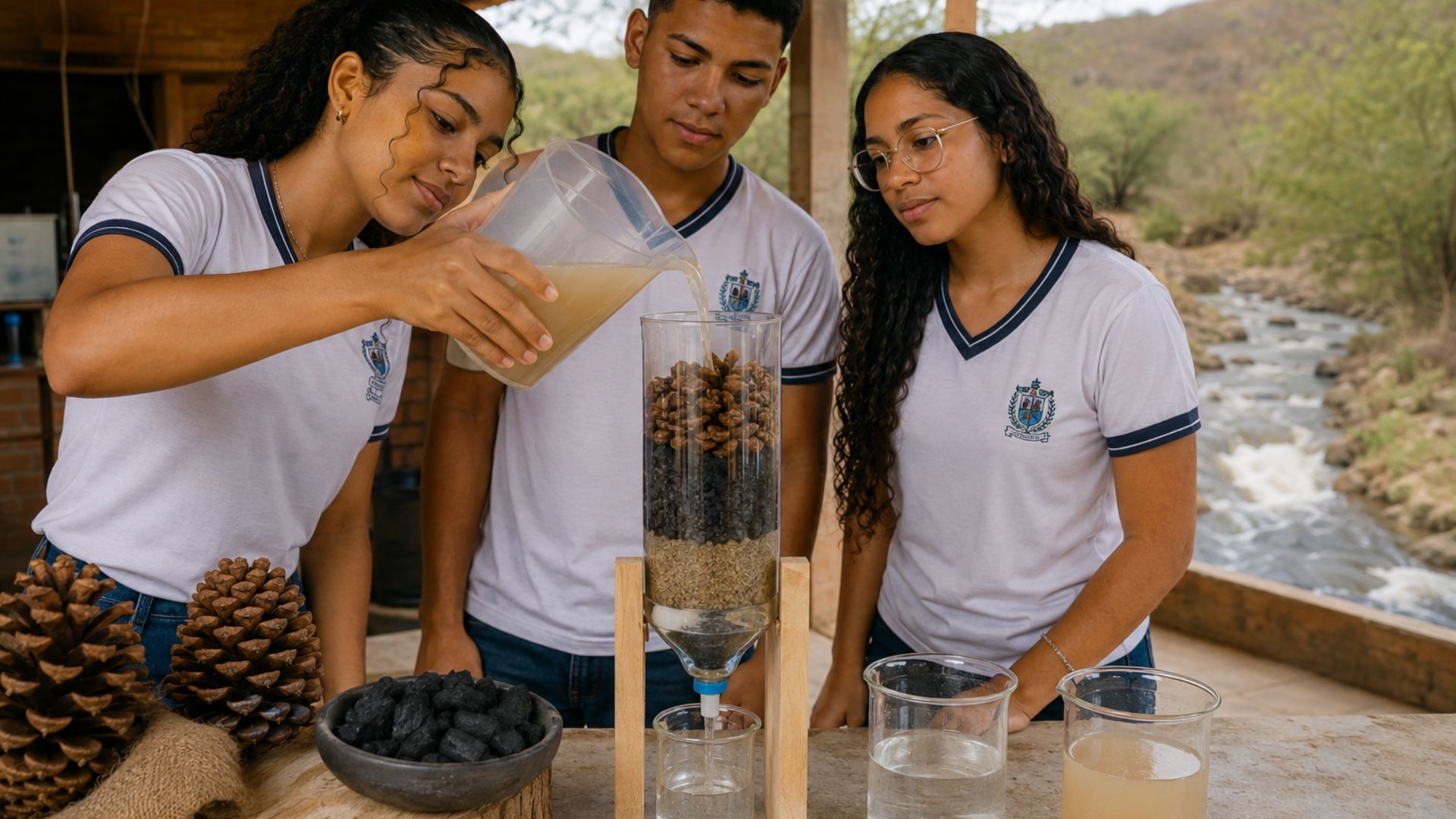


Students from Pernambuco created Filtropinha, a filter made with soursop peels and activated charcoal capable of reducing the toxicity of manipueira, a residue from flour mills that contaminates soils and rivers in the Northeastern hinterland.
A group of public school students from the Pernambuco hinterland created a simple solution to an old environmental problem that affects cassava flour-producing communities in various regions of the Northeast. Students from the Escola Técnica Estadual Professor Paulo Freire, in Carnaíba, in the Sertão do Pajeú, developed a low-cost filter made with soursop peels and activated charcoal capable of reducing the toxicity of manipueira — a liquid generated during cassava flour production and known for its high potential to contaminate soil and water.
Named Filtropinha, the project was developed by 2nd-year high school students and gained national prominence after winning the Creative School + Nature Award 2025, promoted by Instituto Alana. The team received R$ 12,000 to expand the initiative and also secured participation in activities related to COP30, the UN climate conference held in Belém in November 2025. The project drew attention because it transforms simple and cheap waste into a practical alternative for a historical environmental problem in the Northeastern semi-arid region.
What is manipueira and why does it concern environmentalists
Manipueira is a liquid extracted from cassava during flour production. Although many people don’t know the name, it is present in practically all traditional flour mills in the Northeast. The problem is that this residue has a high organic load and toxic substances derived from cassava, including cyanogenic compounds that can cause severe environmental impacts when discarded without treatment.
-
Iraq floats and sinks under an arm of the Euphrates 10 giant concrete boxes of 46,000 tons and 125 meters each to assemble a 2.4 km submerged tunnel and open a new land route between Asia and Europe.

-
Scientists use more than 20,000 artificial birds and solar speakers to “trick” seabirds, reactivate nesting routes, and revive a colony on an island that seemed abandoned.

-
She spent 73 years breathing inside an iron lung, survived the aftereffects of polio, and became the last woman in the United States dependent on the equipment before dying at 78 years old.
-
Brazilian students created a $1 filter using pine bark, cotton, and 3D-printed parts to clean cassava wastewater, reduce the toxicity of a hazardous waste, and transform contaminated water into biofertilizer.


In several rural regions, manipueira ends up being discharged directly into the soil or watercourses. Over time, this can cause river contamination, soil alteration, fish deaths, vegetation degradation, and environmental imbalances in areas already vulnerable to drought. It was precisely by observing this scenario in their own community that the students decided to create an accessible solution.
The filter uses soursop peels and activated charcoal
Filtropinha was developed using simple and inexpensive materials. The filter structure has layers composed of cotton, filter paper, flour produced from soursop peels, and activated charcoal obtained from burning these peels. According to the students, the soursop peel has porous characteristics that aid in the impurity retention process.
The filter was also designed with the aid of 3D printing to facilitate installation in containers used for storing manipueira in flour mills. The estimated cost of the prototype was around R$ 5, a value considered extremely low for an environmental solution of this type.
The test results surprised the team
To verify if the filter actually worked, the students conducted germination tests with seeds exposed to treated and untreated manipueira. The results were striking. When the manipueira passed through the filter, the germination rate reached approximately 80%. In untreated samples, germination dropped to about 20%.
In practice, this indicated that Filtropinha significantly reduced the toxic effects of the residue. The data reinforced the project’s viability and helped the initiative gain recognition at educational fairs and awards.
Project born within a quilombola community
One of the most important aspects of the initiative is its direct connection to traditional communities in the region. Two team members live in a quilombola community in Sertão do Pajeú, where flour mills are part of the local culture and family income generation.

According to the award organizers, the project was designed precisely to improve the environmental conditions of these communities without compromising a traditional economic activity of the region. Instead of eliminating artisanal flour production, the students sought a way to reduce environmental impacts using resources accessible to their own local reality.
The project won a national award related to the environment
Filtropinha was one of the winners of the Creative School + Nature 2025 Award, an initiative of the Creative School program, from Instituto Alana. The award selected student projects related to Brazilian biomes and received over 1,500 initiatives from different regions of the country. The Pernambuco project won in the category related to the Caatinga.
In addition to the cash prize, the students gained participation in activities related to COP30, a global climate conference held in Belém. The recognition placed the project on the radar of educational and environmental initiatives aimed at sustainable development in the semi-arid region.
A simple solution for a historical problem of the sertão
The story of Filtropinha is noteworthy because it shows how complex environmental problems can generate innovative solutions within the affected communities themselves. Using simple waste, school knowledge, and observation of local reality, high school students created an inexpensive system to reduce the impacts of a toxic residue produced daily in many regions of the Northeast.
The project also reinforces the growing role of Brazilian public technical schools in developing solutions related to sustainability, applied science, and environmental preservation. While major environmental technologies often involve millionaire investments, Filtropinha shows that, sometimes, an idea created within a school in the sertão can offer practical answers to problems ignored for decades.