






 Portuguese
  Spanish


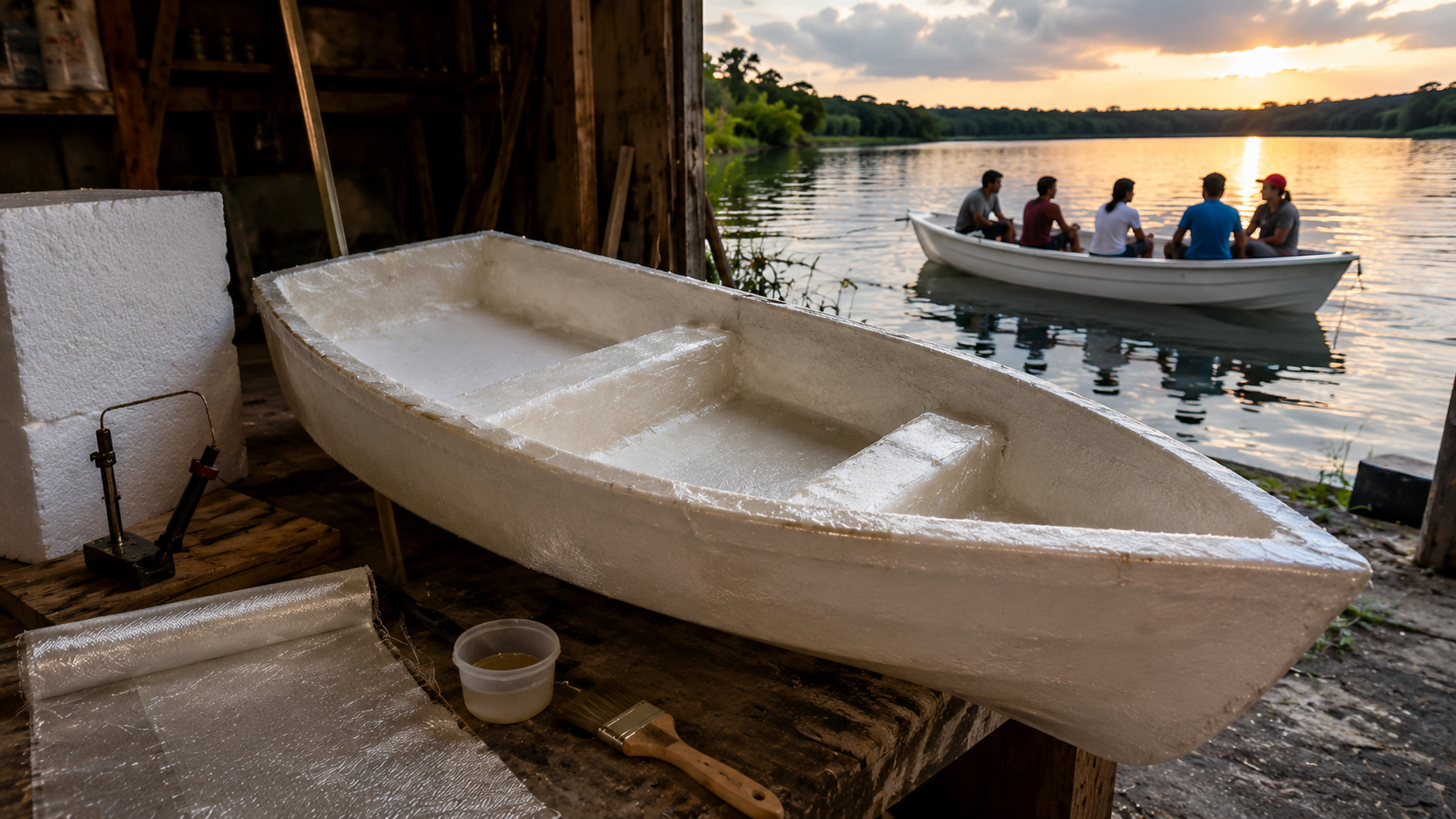


Styrofoam boat with fiberglass uses sandwich system, is up to 40% lighter than solid hulls, can float even when damaged, and requires correct design, good resin, and Navy registration when motorized.
According to the Boat Building Manual, styrofoam used as a structural core in vessels is one of the most efficient techniques for amateur builders. This is not improvisation, but a variation of the sandwich system, a method also used by the professional nautical industry with materials such as PVC foam and divinycell. The sandwich system consists of a light and rigid core, such as styrofoam, encased by two layers of fiberglass impregnated with resin. The result is a structure 30% to 40% lighter than an equivalent solid fiberglass hull, while maintaining comparable mechanical strength.
A 2-meter by 50-centimeter float made with styrofoam coated with fiberglass supports 100 kilograms, according to a project cited by the Brazilian Symposium on Mechatronics. 4.80-meter trimarans have already been built using this method, capable of navigating rivers and lakes with sail and oar.
Styrofoam boat with fiberglass uses a light and resistant sandwich system
The structural principle of the sandwich system is similar to that of reinforced concrete: combining materials with different properties to obtain superior performance than each material alone. In a styrofoam boat with fiberglass, the light core separates the two laminated faces and increases the rigidity of the hull.
-
The FLIP: A 108-Meter Ocean Laboratory That Stood Vertically for 60 Years, Dismantled in 2023

-
North Korean Fiasco: Launch of the Largest Warship Ends in Sinking

-
While giant ships still burn heavy fuel and the maritime sector races against climate targets, Maersk and Vale are starting to bet on ethanol as a new route to reduce emissions at sea.

-
China begins construction of the world’s largest LNG ship, a 344-meter giant capable of supplying 4.7 million homes for a month, carrying 271,000 m³ of gas, and placing QatarEnergy in the largest naval order ever recorded in world history.


Styrofoam does not work by having great inherent strength, but by maintaining distance between the fiber layers. The greater this separation, the greater the flexural strength with less material, making the hull lighter and more efficient.


A sandwich hull with 5 centimeters of styrofoam and thin fiber on both faces can be more rigid in bending than a 1-centimeter solid fiber hull. The advantage lies in lightness, buoyancy, and structural efficiency.
Styrofoam in vessels maintains positive buoyancy even with hull cracks
Styrofoam has three important properties for vessels: it is light, does not rot, and maintains positive buoyancy. When properly coated with resin and fiber, it is also protected against water and moderate impact.
Even if the hull cracks, the styrofoam core continues to float. This characteristic helps reduce the risk of immediate sinking, especially in small boats used in rivers, lakes, and reservoirs.
For this reason, many artisanal boats, kayaks, and fishing vessels use styrofoam in internal or side compartments. Reserve buoyancy is one of the biggest advantages of styrofoam in amateur naval construction.
E-type fiberglass is the most used in artisanal and professional boats
The fiberglass used in naval construction is, in most cases, E-type. It was originally developed for electrical insulation but became standard for offering a good balance between cost, tensile strength, and flexural strength.

This type of fiber appears in both artisanal kayaks and professional vessels. In a styrofoam boat, it forms the resistant skin of the hull, protecting the light core and distributing mechanical stresses.
The quality of the lamination is decisive. Poorly impregnated fiber, air bubbles, and irregular layers reduce strength and can compromise the durability of the vessel.
Polyester, vinyl ester, and epoxy resins define boat durability
The choice of resin is one of the most important steps in building a styrofoam and fiberglass boat. Polyester resin is the cheapest and easiest to find, cures quickly, and works well for simple uses, especially above the waterline.

The disadvantage of polyester is its higher water permeability, which can lead to osmosis over time. Gelcoat, proper painting, and maintenance reduce this problem, but do not completely eliminate the risk.
Vinyl ester resin has better water and fatigue resistance, making it suitable for bottoms and areas with prolonged water contact. Epoxy resin is the most resistant, most adhesive, and most waterproof, but also the most expensive.
How to build a styrofoam and fiberglass boat in practice
Construction begins with a mold or direct shaping of the styrofoam block. Cutting can be done with a hot wire, which reduces the white dust from mechanical cutting, or with a hot knife for minor adjustments.

The hull shape is defined by progressive sanding until the desired profile is achieved. The biggest challenge is maintaining symmetry between the two sides, which requires templates, constant measurements, and patience during shaping.
Once the core is ready, lamination begins. Fiberglass is cut, positioned over the styrofoam, and impregnated with resin using a roller or brush, until air pockets and dry fibers are eliminated.
Hull lamination requires well-applied fiber, correct curing, and gelcoat or PU finish
After the first cure, the hull is sanded and receives new layers of fiber until the desired thickness is reached. The inner face also needs to be laminated after the hull is turned, ensuring strength on both sides of the sandwich structure.
The final finish includes polyester putty to correct imperfections, progressive sanding, and painting with PU or gelcoat application. This step protects the fiber, improves impermeability, and increases the hull’s durability.
Execution defines the result. What separates a functional boat from a fragile hull is not the styrofoam, but the quality of the lamination, the resin, the finish, and the design.
Styrofoam boat load capacity depends on buoyancy and geometry
Load capacity is not defined solely by material strength. In small boats, it primarily depends on buoyancy, hull geometry, and freeboard height.
One cubic meter of styrofoam can displace approximately one ton of water. A hull 3 meters by 1 meter, with 20 centimeters of depth, would have about 600 liters of volume, enough to support 600 kilograms before sinking to the edge.
In practice, the safe load should be between 40% and 60% of this value to maintain freeboard and prevent water ingress. For three to five people, a 3 to 4-meter hull with adequate beam can be viable in rivers and lakes.
Styrofoam boat without motor has different rules than motorized boat in the Navy
Legalization is one of the most important parts for those intending to build a homemade boat. In inland waters, unmotorized vessels, propelled by oars or sail, do not require the same registration applied to motorized boats.
When a motor is added, the rule changes. Every motorized boat needs to be registered with the Port Authority responsible for the navigation region, and the process may require a technical report from a naval engineer.

To navigate in coastal waters, even without an engine, the requirements increase. The operator may also need appropriate certification, such as Arrais Amador, depending on the type of navigation and the area of use.

The safest way is to start with a project already designed for registration, especially if there is an intention to install an engine. Handmade boats can be legalized, but they need to be built with technical criteria compatible with Navy requirements.
Styrofoam and fiberglass boat works, but requires design, correct resin, and careful execution
Styrofoam with fiberglass can create light, cheap, and functional boats for rivers, lakes, and reservoirs. The method is not improvised: it is an accessible adaptation of the sandwich system used in various areas of naval construction.
The difference between a safe project and a risky experience lies in the execution. Hull symmetry, correct lamination, resin choice, finish, stability, and freeboard define the final performance.
For boats with engines or use outside simple inland waters, the technical report and regularization must be included in the planning from the start. The constructive principle is valid, but naval safety cannot be treated as a garage detail.


