Portuguese
  Spanish


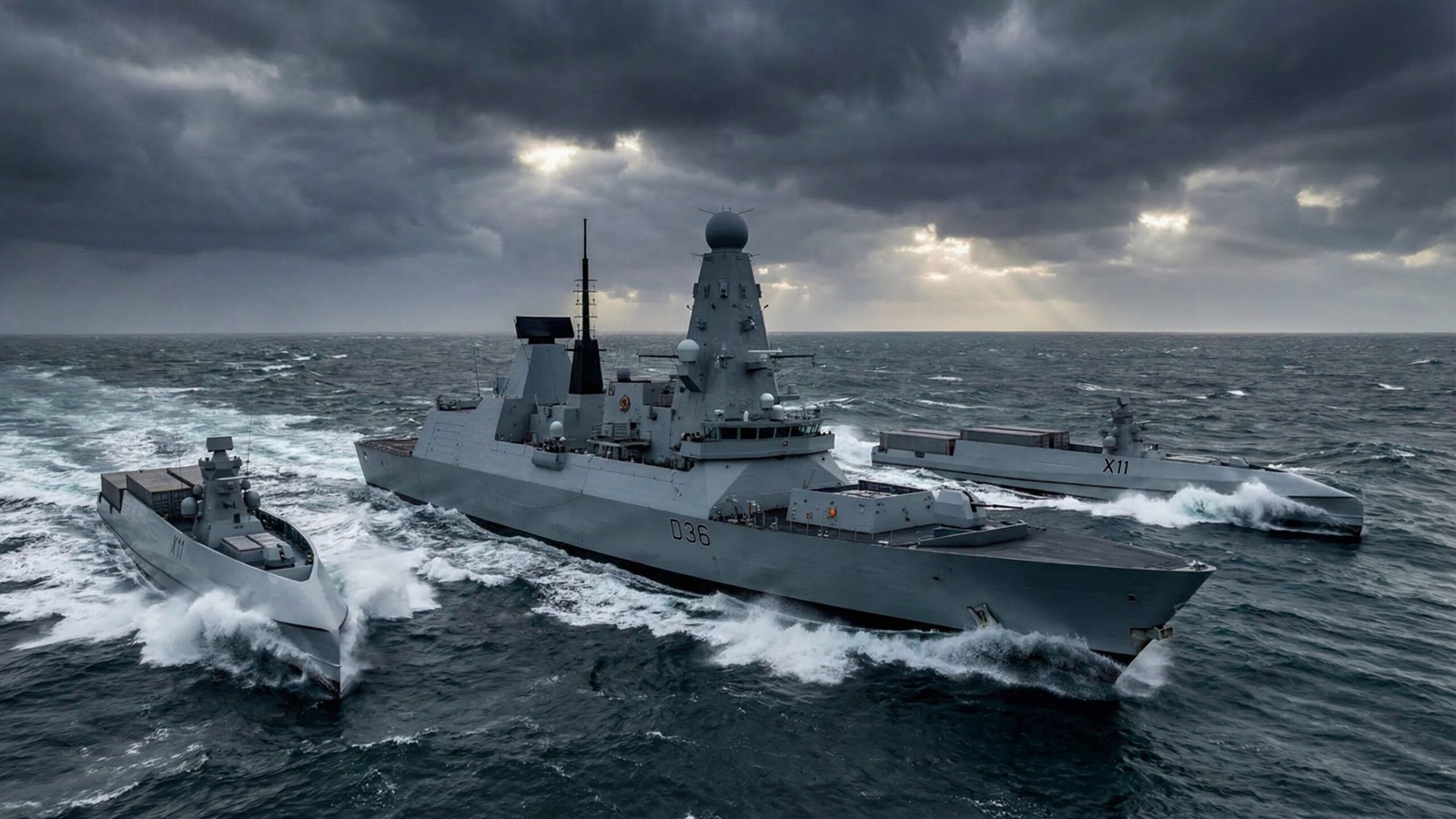

LASV75 concept was presented by Navantia UK in Farnborough with a 75-meter modular hull, over 1,000 tons, autonomous operation, and focus on surveillance missions, escort, electronic warfare, and support for hybrid fleets.
Navantia UK presented the LASV75, a 75-meter and over 1,000-ton unmanned warship concept, during the Combined Naval Event in Farnborough, to support future hybrid fleets with autonomy, software, and modular payloads.
Warship bets on autonomy and unmanned missions
The project was developed in the United Kingdom by the Navantia team based in Bristol. The proposal is to operate independently or integrated with larger naval groups, alongside manned ships, autonomous escorts, drones, and other unmanned systems.
With a 246-foot modular hull, equivalent to 75 meters, the LASV75 is conceived as an unmanned platform from the outset. The absence of accommodations and human support systems frees up space for sensors, mission payloads, and greater operational endurance.
-
The U.S. Navy Conducts Submarine Tests in Idaho Lake to Detect Underwater Noises Hidden by the Ocean

-
Nuclear Submarine USS Alexandria Retired After 35 Years, Having Completed Over 1 Million Miles in Missions

-
MODEC Introduces New Hull Design for FPSO Gato do Mato to Produce Up to 120,000 Barrels of Oil Per Day in Brazil’s Pre-Salt Region
-
This Massive 12-Meter, 21-Ton Underwater Drone Can Operate Autonomously for Up to Five Days


The vessel was designed for functions such as surveillance, escort, electronic warfare, and operations related to attacks, depending on the chosen configuration. The model displayed showed a configurable cargo deck, modular sensor arrangements, and interchangeable masts.
Modularity seeks rapid adaptation at sea
Navantia UK states that persistence, modularity, and scalability guided the development of the concept, especially for demanding environments such as the North Atlantic. At CNE 2026, Simon Jones, director of product development, advocated for a vessel of this size for long operations in adverse maritime conditions.
The company is also evaluating mission packages in NavyPOD containers and NATO Standard interfaces, aiming to expand interoperability with allied navies. The modular architecture would allow versions focused on sensors, operational systems, or mixed functions.
This approach seeks to simplify manufacturing and accelerate adaptations according to each mission. Instead of relying on a fixed configuration, the warship could receive different payload arrangements, according to operational needs.
Concept accompanies industrial expansion in the United Kingdom
The LASV75 appears amid Navantia UK’s expansion following the acquisition of Harland & Wolff’s assets. The company is working on modernizing four British shipyards, located in Appledore, Arnish, Belfast, and Methil.
The announced investment is £157 million, aimed at digital shipbuilding tools, automation, and advanced manufacturing infrastructure. The company’s expectation is to reduce project and construction timelines for large naval vessels by up to 30%.
The initial production of autonomous ships would likely begin in Appledore, Devon, a shipyard capable of accommodating vessels up to 120 meters, and increase flexibility in long-duration missions.